
How to Choose the Right Spark Plug for a 2-Stroke Brush Cutter
Choose a brush cutter spark plug by thread size, reach, heat range and gap. See what dealers should confirm before stocking replacements for 2-stroke units.
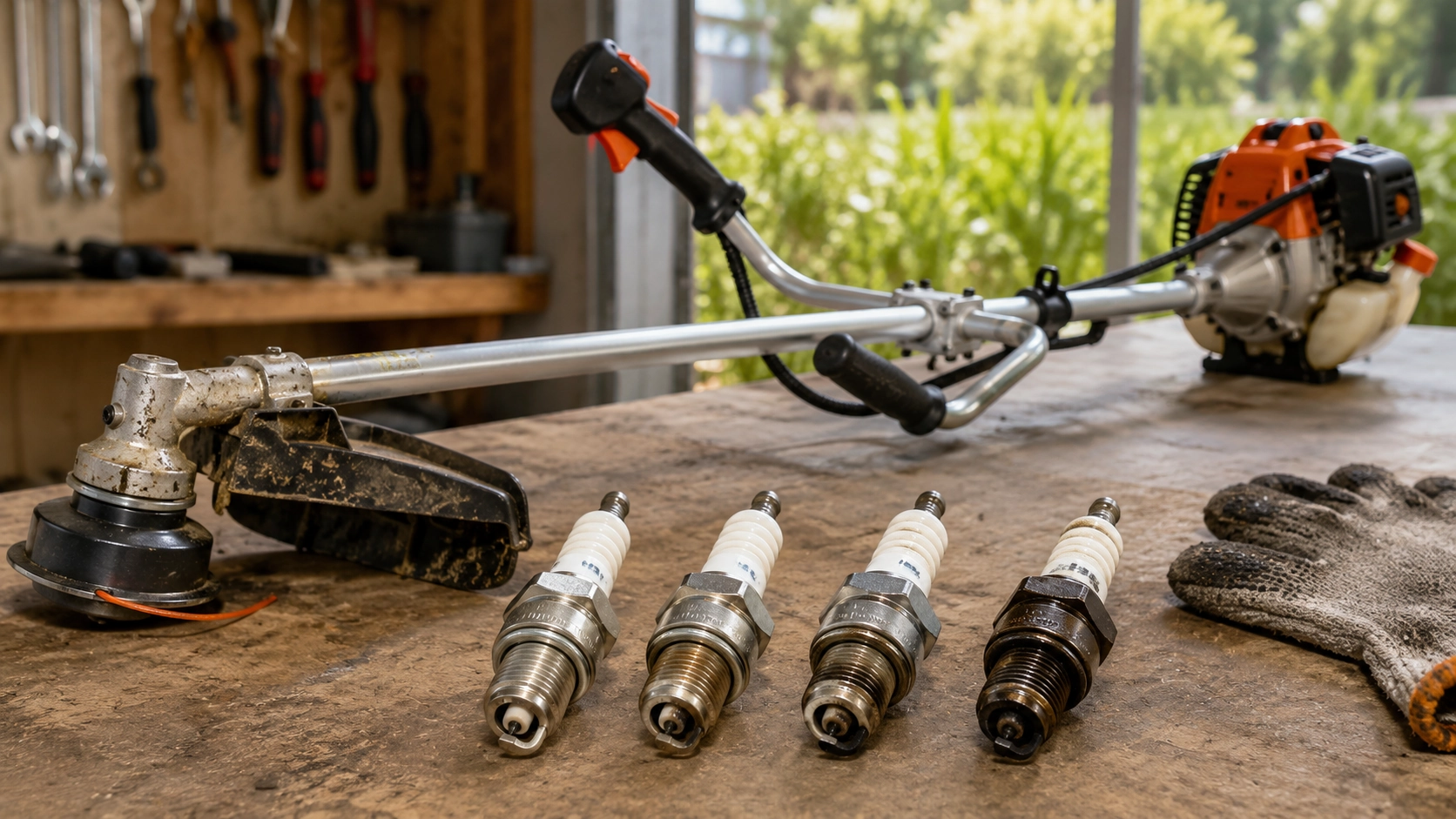
Brush Cutter Spark Plug Replacement: What Importers Should Check
A replacement brush cutter spark plug should be selected from the exact engine specification, not simply from engine displacement or from a label such as “2-stroke spark plug.” Before installing, approving or stocking a replacement, confirm the original plug reference, thread dimensions, reach, heat range, seat type, terminal arrangement and specified electrode gap.
This is primarily a parts-compatibility issue rather than an engine troubleshooting guide. A brush cutter that is hard to start, backfires, dies under acceleration or refuses to restart when hot requires diagnosis of that particular symptom. Here, the purchasing question is more specific: is the replacement spark plug actually correct for the engine?
Quick answer: Do not purchase a spark plug only because the listing says “43cc brush cutter,” “52cc trimmer” or “universal 2-stroke plug.” Start with the engine's approved plug reference, then verify thread diameter and pitch, reach, heat range, seat type, terminal design, resistor specification and electrode gap. For distributors, the safest spare-parts system links each spark plug to the brush cutter model, engine model and confirmed plug reference. If a substitute brand is required, use an approved cross-reference rather than matching plugs only by appearance or printed heat-range number.
1. Why “43cc Brush Cutter Spark Plug” Is Not a Complete Specification
Online spare-parts listings commonly describe spark plugs as suitable for “43cc brush cutters,” “52cc trimmers” or general “2-stroke garden tools.” Those descriptions can identify the product category, but they do not confirm actual fitment.
Spark plugs are manufactured with different thread diameters, thread pitches, threaded reaches, seat designs, terminal arrangements and heat ranges. Two brush cutters with similar engine displacement may still use different cylinder heads or ignition specifications, so a plug that fits one 40–43cc engine should not automatically be treated as interchangeable with another.
| Specification | Why it matters | Purchasing mistake to avoid |
| Thread diameter / pitch | Must match the cylinder-head threads | Assuming all 43cc engines use the same thread |
| Reach | Determines how far the threaded section extends into the head | Checking only whether the plug screws in |
| Heat range | Must suit the intended engine application | Treating a higher or lower number as a quality grade |
| Seat / terminal | Must match the cylinder head and spark-plug cap | Approving a plug from thread size alone |
| Electrode gap | Should follow the approved engine specification | Assuming the gap supplied in the box is correct |
2. Start With the Original Spark Plug Reference
The safest starting point is the spark plug specified for the actual engine. Before removing an existing plug, record the manufacturer and complete reference printed on its ceramic insulator. Do not record only part of the code, because individual letters and numbers can identify different construction details.
If the machine has already been serviced, remember that the installed plug may not necessarily be the original specification. In that situation, confirm the reference against the engine specification or approved production configuration before preparing a replacement order.
Importer risk: Preparing several hundred spare plugs before the production specification has been confirmed can create an avoidable compatibility problem. The engine reference should be established first, especially when the product page itself does not publish a fixed spark plug model.
3. Check Thread Size, Reach and Seating Before Approving a Substitute
A spark plug must use the correct thread diameter and pitch for the cylinder head. A physically similar plug can still have different threads, and forcing an incorrect plug risks damaging the cylinder-head threads.
Reach is equally important. It refers to the length of the threaded section extending from the plug seat toward the combustion chamber. A replacement can therefore have the correct thread diameter but still have the wrong threaded length.
| Step | Check | Approval question |
| 01 | Thread diameter | Does it exactly match the approved engine plug? |
| 02 | Thread pitch | Can the plug be installed without forcing or cross-threading? |
| 03 | Threaded reach | Does the threaded length match the approved reference? |
| 04 | Seat type | Does the sealing arrangement match the cylinder head? |
| 05 | Terminal connection | Does the top terminal fit the engine's spark-plug cap? |
For distributors using a second spark plug supplier, compare the complete dimensional specification with the approved original part. Visually similar plugs should not be mixed together in workshop storage without clear identification.
4. Heat Range, Electrode Gap and Resistor Type Need Separate Confirmation
Heat Range Is an Application Specification
Heat range describes how the plug transfers heat away from its firing end. It should not be interpreted as a quality score where a higher number means a better spark plug. The correct heat characteristic depends on the engine application.
Extra care is needed when substituting between manufacturers because heat-range numbering systems are not necessarily equivalent. A number printed on one brand should not automatically be matched with the same number from another. If another brand must be used, rely on an approved cross-reference or confirmation from the engine supplier.
Do Not Guess the Electrode Gap
Spark plug gap should follow the engine's specified requirement. Do not assume every new plug leaves the factory at exactly the gap required by a particular brush cutter engine.
The gap should be confirmed against the approved engine or spark plug specification and checked with an appropriate gauge when required. If the product specification does not publish a gap, copying a value from another 2-stroke brush cutter is not a reliable substitute.
Keep the Intended Resistor Specification
Some spark plugs incorporate an internal resistor, and this information is commonly represented within the manufacturer's complete plug reference. When selecting a replacement, retain the electrical specification intended for the engine instead of matching only the visible dimensions.
5. TM-CG143R: Engine Specification Does Not Identify the Plug by Itself
TM-CG143R Gasoline Brush CutterModel: TM-CG143R
|
Spare-parts note The published specification does not identify a fixed spark plug model, thread size, heat range or electrode gap. These should be confirmed from the actual engine and production configuration.
|
Although TM-CG143R is marketed in the 43cc class, its listed displacement is 41.5cc. Neither that displacement, the 143R engine name, the 1000 ml fuel tank nor the 28 mm shaft independently identifies the correct spark plug.
For OEM buyers wanting to prepare service stock before delivery, the final approved engine configuration should therefore remain the reference point.
6. Dealers Should Stock Spark Plugs by Engine Model, Not Displacement
A distributor carrying several brush cutter families may be tempted to create one inventory item called “43cc/52cc spark plug.” That makes the parts catalog look simpler but can introduce unnecessary compatibility problems.
Weak Spare-Parts RecordItem: Spark plug Description: For 43cc / 52cc brush cutter This does not prove compatibility with a particular engine. |
Better Spare-Parts Record
|
This method lets the dealer identify the correct plug from the machine or engine rather than asking workshop staff to estimate compatibility from displacement.
7. Keep Spark Plug Purchasing Separate From Engine Troubleshooting
Spark plugs are inexpensive and easy to access, so they are often replaced whenever a small gasoline engine runs poorly. That does not mean every running problem is caused by the plug.
If the objective is to purchase a replacement part, focus first on dimensional and electrical compatibility. If the engine is hard to start, backfires, dies on throttle, refuses to restart when hot or repeatedly fouls plugs, diagnose that particular symptom separately.
Dealer service boundary: Installing another spark plug with the approved specification is a maintenance operation. Finding out why a correctly specified plug repeatedly becomes fouled or damaged is an engine-diagnosis job. Keeping these two issues separate prevents a parts compatibility discussion from turning into trial-and-error troubleshooting.
8. Importer Checklist Before a Bulk Spark Plug Order
If spark plugs will be included with machines, dealer kits or aftermarket stock, record the specification before the bulk order is released. This is especially useful when substitute brands or repeat production batches are involved.
- Confirm the brush cutter model that the spare plug will support.
- Record the actual engine model instead of relying only on the cc category.
- Confirm the approved spark plug manufacturer and full reference where specified.
- Verify thread diameter and thread pitch against the approved plug.
- Confirm threaded reach and seat type rather than testing only whether the plug screws into the head.
- Check the required heat range and do not compare different manufacturers by number alone.
- Confirm the terminal arrangement matches the spark-plug cap.
- Verify resistor or non-resistor specification where it forms part of the approved reference.
- Confirm the required electrode gap from the engine specification rather than copying another machine.
- Approve substitute-brand cross-references before purchasing aftermarket stock.
- Keep repeat orders linked to the approved engine configuration so dealers do not receive incompatible parts under one SKU.
FAQ About Brush Cutter Spark Plug Compatibility
Can I use any spark plug listed for a 43cc brush cutter?
No. Engine displacement is not enough to confirm spark plug compatibility. The thread, reach, heat range, seat, terminal arrangement, resistor specification and electrode gap should match the engine's approved plug specification.
How do I identify the correct replacement brush cutter spark plug?
Start with the complete manufacturer and reference on the approved original plug, then confirm that specification against the actual engine model. If the installed plug may have been changed previously, verify it against the engine configuration before ordering replacements.
Can a spark plug have the right thread but still be wrong?
Yes. A plug can use the correct thread diameter yet have an incorrect reach, heat range, seat type, terminal arrangement or electrical specification. Being able to screw the plug into the cylinder head does not by itself prove compatibility.
Can I match heat-range numbers between different spark plug brands?
Do not assume the numbering systems are directly equivalent. If changing manufacturers, use official cross-reference information or confirm the substitute with the engine supplier.
Should a new spark plug gap be checked before installation?
The required gap should follow the engine specification. Do not assume that every replacement plug is supplied at exactly the gap required for that brush cutter.
Which spark plug does the TM-CG143R use?
The published TM-CG143R specification confirms a 143R, 41.5cc, 2-stroke air-cooled engine with 1.6 kW rated output at 6500 rpm, but it does not publish a fixed spark plug reference, thread size, heat range or electrode gap. Those details should be confirmed according to the actual production configuration or quotation before spare plugs are ordered.
Confirm the Spark Plug Before Adding It to Your Spare-Parts OrderA brush cutter spark plug replacement should be approved against the actual engine configuration rather than a broad displacement description. For TM-CG143R orders, confirm the approved plug reference and relevant dimensional and electrical specifications before preparing dealer stock, service kits or bulk replacement parts. |
|