
Can a 52cc Chainsaw Handle Daily Firewood Cutting in Africa?
Can a 52cc chainsaw handle daily firewood cutting in Africa? Compare workload, log size, 18/20-inch bar options, chain setup, and spare-parts needs.
Is a 52cc Chainsaw Enough for Daily Firewood Cutting in Africa?
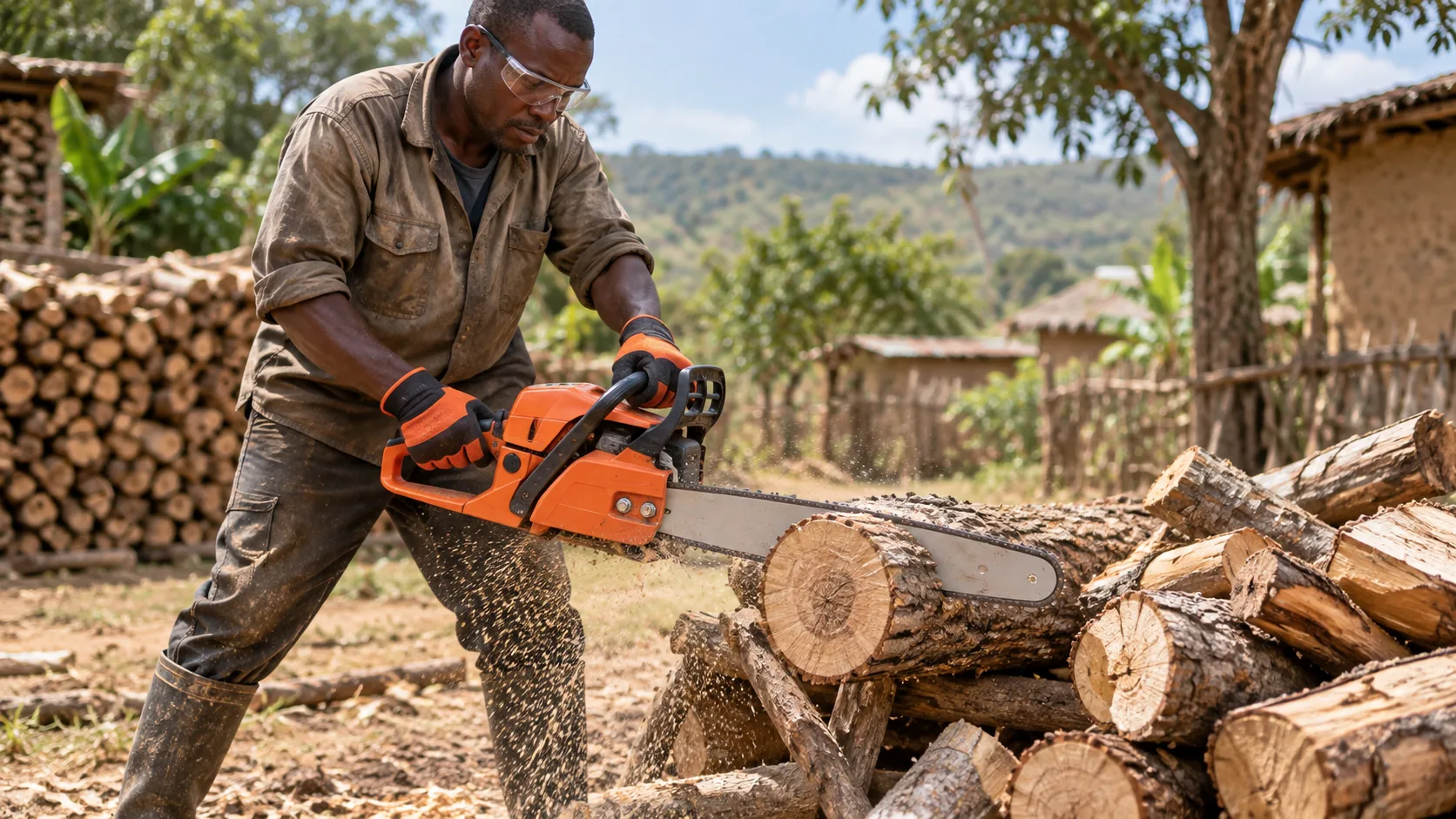
A 52cc chainsaw for African firewood cutting can be a practical choice when daily work mainly involves branches, farm wood, small to medium logs and repeated cross-cutting rather than continuous felling of very large timber. Frequency alone does not determine whether the saw is large enough.
For farmers, firewood sellers, small timber yards and machinery dealers, the more useful buying questions are what diameter of wood is normally cut, whether the timber is fresh or dry, how often the guide bar works close to full depth, and whether replacement chains and service parts can be supplied locally.
| QUICK ANSWER | |
| Where 52cc fits best | Quick answer: A 52cc petrol chainsaw is well matched to repeated firewood cutting where most jobs involve manageable branches and logs rather than continuous large-diameter hardwood. Before choosing a larger saw, check chain sharpness, lubrication, guide-bar condition and cutting technique because these can make a correctly sized machine feel underpowered. African importers should also confirm whether customers need an 18-inch or 20-inch bar and make sure the matching .325 chain, guide bar and common service parts can be supplied after the sale. |
Where a 52cc Chainsaw Fits in African Firewood Work
Firewood cutting often means making many repeated cuts rather than one exceptionally difficult cut. An operator may divide branches into transportable lengths, cross-cut farm timber, prepare household fuel or process wood for local resale.
A 52cc machine sits between lighter pruning-focused saws and larger-displacement machines intended for heavier forestry work. That middle position can be useful where the operator carries the saw around farms, roadside wood piles or scattered cutting areas.
| Typical Work | 52cc Assessment | What the Dealer Should Ask |
| Branches and farm wood | Generally relevant | How often and how dry is the wood? |
| Small to medium logs | Typical firewood workload | What is the normal log diameter? |
| Repeated cross-cutting | Suitable when load is manageable | Is the saw allowed to cut without being forced? |
| Continuous large hardwood | Larger class deserves comparison | Is most cutting close to full bar depth? |
Daily use does not automatically mean a larger chainsaw is necessary. A firewood seller making frequent cuts through manageable logs can create a lighter engine load than an operator making fewer cuts through very large, dense timber.
TM-CS5200 Specifications and Practical Buying Meaning
The TM-CS5200 is specified with a 52cc engine and 2.2 kW rated output at 7500 rpm. The model is available with 18-inch and 20-inch guide bar options, uses a .325 chain pitch and has a listed 6.7 kg net weight.
| Specification | TM-CS5200 | Procurement Relevance |
| Engine displacement | 52cc | Middle work class for general wood and firewood applications. |
| Rated output | 2.2 kW / 7500 rpm | Should be judged together with wood density and cutting depth. |
| Guide bar | 18 inch / 20 inch | Allows dealers to match the setup to normal log dimensions. |
| Chain pitch | .325 | Important for replacement-chain and after-sales planning. |
| Fuel tank | 550 ml | Reference capacity only; operating time varies with workload. |
| Oil tank | 260 ml | Relevant to repeated-cutting lubrication checks. |
| Net weight | 6.7 kg | Matters where users carry the saw between scattered work areas. |
These figures define the supplied machine more accurately than a simple “52cc chainsaw” description, but they still do not guarantee identical performance in every timber type. Wood condition and chain condition can change cutting resistance substantially.
Dry Hardwood Can Make a Correctly Sized Chainsaw Feel Underpowered
Log diameter is only one part of the cutting load. Two pieces of timber with similar dimensions can behave very differently when one is softer or fresher and the other is dry and dense.
Dirty bark, sand, soil and old wood can also damage the chain edge quickly. This matters to commercial firewood users because a customer may report that the saw “has no power” even though the real issue is a chain that no longer cuts efficiently.
Observe the cut before changing engine size:
A sharp chain should produce chips and feed into the wood without the operator repeatedly pushing the guide bar downward. If cutting becomes noticeably slower, inspect chain sharpness, lubrication and bar condition first.
For dealers, this distinction separates a machine-selection complaint from an after-sales maintenance issue. Recommending more displacement will not solve poor cutting caused by a dull or poorly lubricated chain.
18-Inch or 20-Inch Bar: Which One Should Firewood Buyers Choose?
The TM-CS5200 provides both 18-inch and 20-inch guide bar options. The longer bar should not automatically be treated as the better wholesale configuration.
| Comparison | 18-Inch Setup | 20-Inch Setup |
| Best match | Customers whose daily cuts are mainly smaller logs and branches. | Customers who need additional reach for larger material. |
| Buying logic | Useful where most cuts do not require maximum bar length. | Useful when larger logs occur regularly, but cutting load still matters. |
| Main mistake | Assuming a shorter bar means the saw is only for light pruning. | Assuming every log close to 20 inches will be an easy continuous cut. |
A 20-inch bar describes the cutting attachment length; it does not mean the chainsaw should spend the entire day cutting dense wood near that diameter. As more chain teeth enter the wood, cutting resistance increases, especially with dry hardwood, a dull chain or excessive feed pressure.
Importers should ask about normal log diameter before selecting the guide-bar configuration for a market. If most customers cut much smaller wood, ordering the longest available bar may provide little practical advantage.
When a 52cc Chainsaw Feels Too Small: Check These Points First
A 52cc chainsaw may genuinely be undersized when most of the day's work stays near the upper practical range of the machine. The important signal is a repeated pattern, not one unusually difficult log.
| 01 | Check chain sharpness. A dull chain can make a 52cc engine feel dramatically weaker than it is. |
| 02 | Check chain tension. Incorrect tension affects cutting behavior and should be corrected before judging power. |
| 03 | Confirm chain lubrication. Make sure oil is reaching the guide bar and chain during repeated cutting. |
| 04 | Inspect the guide bar. Poor bar condition can create additional resistance and wear. |
| 05 | Watch operator pressure. The chain should cut the wood rather than being forced downward continuously. |
| 06 | Look at the workload pattern. Constant use of nearly the full bar in dense timber is a stronger reason to compare a larger saw. |
If engine speed falls heavily on most cuts even when the chain is sharp, correctly tensioned and lubricated, and the operator is not forcing the saw, the workload may justify comparison with a larger-displacement model.
Safety: stop the engine before checking, tensioning or touching the chain or guide bar. If the chain becomes unusually hot, dry or tight during work, stop and inspect the lubrication system before continuing.
Why .325 Chain and Service Parts Matter to African Dealers
The TM-CS5200 uses a .325 chain pitch. For the user, this affects replacement-chain selection. For the importer, it affects what needs to be stocked for after-sales support.
Chain pitch alone is not enough to order a replacement. The chain must match the complete cutting setup, including the actual guide bar and sprocket arrangement. Similar-looking .325 chains should not automatically be treated as interchangeable without confirming the supplied specification.
Parts worth discussing for frequent firewood users
|
|
This is especially relevant where local repair shops depend on individual mechanical parts rather than replacing complete assemblies. A chainsaw can fit the cutting workload well but still become inconvenient for a commercial user if routine wear parts are difficult to obtain.
TM-CS5200 for General Firewood and Farm Wood Cutting
MODEL MATCH
TM-CS5200 52cc Gasoline ChainsawModel: TM-CS5200 Reference configuration: 52cc, 2.2 kW at 7500 rpm, 18-inch or 20-inch guide bar, .325 chain pitch, 550 ml fuel tank, 260 ml oil tank and 6.7 kg net weight. This model is worth comparing for farmers, firewood sellers and dealers who need a petrol chainsaw for general wood and repeated firewood cutting rather than a lightweight pruning saw or a machine dedicated to continuous large-timber forestry. |
Best evaluated by: Normal log diameter, wood hardness, bar choice, chain availability and daily cutting cycle.
|
Importer and Dealer Checklist Before a Bulk Order
For buyers building a chainsaw range for African firewood customers, the useful checks go beyond engine displacement. The order should support both the initial sale and routine local servicing.
| 1 | Define the normal wood size. Ask for typical log diameter rather than only maximum occasional diameter. |
| 2 | Identify wood condition. Fresh farm wood and dry dense hardwood do not create the same cutting resistance. |
| 3 | Choose 18-inch or 20-inch guide bar configuration according to actual customer use. |
| 4 | Confirm the complete .325 chain specification for the supplied guide bar and sprocket arrangement. |
| 5 | Plan replacement chains and guide bars for customers who cut firewood frequently. |
| 6 | Discuss starter, filter, spark-plug and sprocket-related service parts according to local repair requirements. |
| 7 | Confirm the 550 ml fuel tank and 260 ml oil tank specification in the final ordered configuration. |
| 8 | Do not promise operating hours from tank size. Consumption varies with throttle use, wood condition and cutting load. |
| 9 | Keep repeat-order cutting-system specifications consistent where dealers rely on the same replacement parts. |
| 10 | Confirm final bar, chain and accessory configuration in the quotation or PI rather than assuming it from the 52cc engine description. |
FAQ About 52cc Chainsaws for African Firewood Cutting
Can a 52cc chainsaw be used every day for firewood?
Yes, depending on the workload. Frequent cutting of manageable branches and logs is different from spending most of the day cutting large-diameter dense timber close to the full guide-bar depth.
Is a 20-inch chainsaw better than an 18-inch chainsaw for firewood?
Not automatically. The 20-inch bar provides more reach, but an 18-inch setup may be more appropriate where most daily cuts involve smaller logs. Buyers should select by normal wood size rather than maximum advertised bar length.
Why does my 52cc chainsaw lose cutting speed in dry wood?
Dry dense timber can create more resistance than softer or fresher wood. Also check whether the chain is sharp, correctly tensioned and adequately lubricated before assuming the engine is too small.
Can every .325 chain fit the TM-CS5200?
The .325 pitch is only one part of replacement-chain selection. The correct chain must match the actual guide bar and sprocket arrangement supplied with the machine.
When should a firewood buyer move above the 52cc class?
A larger-displacement saw deserves comparison when users spend much of the working day cutting very large or dense timber, repeatedly use nearly the full bar length, and still experience heavy engine-speed drop with a sharp, correctly lubricated chain.
What spare parts should African dealers consider for daily chainsaw users?
Replacement chains and guide bars are obvious priorities. Depending on the confirmed model configuration and local service conditions, dealers may also discuss sprocket-related components, starter parts, filters, spark plugs and other service items.
Build the Firewood Range Around Real Cutting ConditionsFor African importers comparing a 52cc chainsaw for firewood cutting, the TM-CS5200 fits the middle workload between light pruning and continuous heavy forestry. Confirm the customer's log size, 18- or 20-inch guide bar choice, .325 cutting-system specification and service-parts plan together before finalizing a wholesale order. |
|