
How Should Dealers Build a Brush Cutter Model Mix?
Import brush cutters from China with a balanced dealer model mix. Compare usage levels, model overlap, accessories and parts before selecting your range.
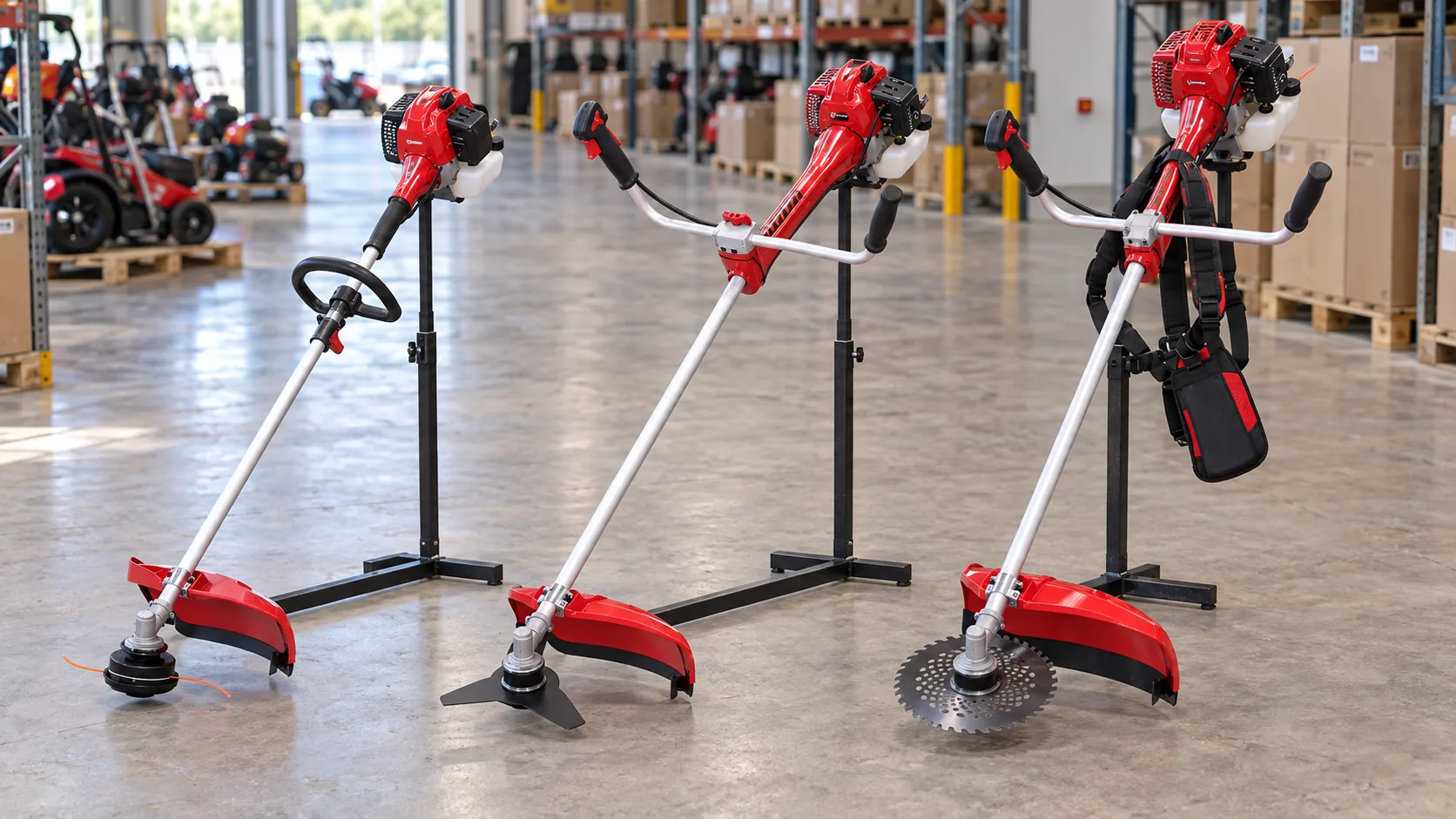
Dealer Range Planning
Import Brush Cutters From China: Plan a Dealer Model Mix
Importers should build a brush cutter range around different workloads and customer groups rather than ordering several machines that compete for the same buyer.
A practical dealer lineup may combine an accessible model for routine trimming, a general-purpose machine for broader demand and a heavier option for field maintenance. The purpose is not to display as many engine sizes as possible. Each selected machine needs a distinct role, an understandable price position and an after-sales plan linked to its confirmed configuration.
This distinction matters when businesses import brush cutters from China. Suppliers may offer several models and variants that appear different in a catalog but address almost identical work. Without a range plan, importers can end up dividing sales between overlapping machines while increasing spare-parts, manual and inventory complexity.
| 01 | Quick answer: Begin with customer jobs rather than supplier model numbers. Separate routine trimming, general garden or farm-edge maintenance, and heavier vegetation control into clear commercial levels. Compare the confirmed engine, weight, shaft, attachments, fuel requirements, packing and service parts for every shortlisted machine. Add a variant only when dealers can explain its different user, workload or configuration. A focused range with verified accessory compatibility is normally easier to sell and support than a large catalog of overlapping models. |
01. Start With Customer Jobs, Not Model Numbers
Model numbers separate products in a quotation, but they do not tell a dealer why each machine deserves a place in stock. Before comparing a supplier’s catalog, divide local demand according to the work customers actually perform.
| Customer job | Purchasing consideration | Possible range position |
| Light grass around homes and small plots | Handling, straightforward operation and suitable line-head configuration | Entry-level trimming |
| Garden and landscaping maintenance | Balanced configuration and locally supportable accessories | General-purpose |
| Farm boundaries and roadside vegetation | Confirmed blade setup, harness and operating conditions | General-purpose or field model |
| Tall grass and established weeds | Cutting capacity, attachment approval and operator workload | Heavier field maintenance |
| Repeated work over longer periods | Weight, balance, fuel capacity, harness and service support | Application-dependent |
These five job groups do not automatically require five machines. When two models cover similar vegetation, operating time and customer budgets, stocking both may split sales without expanding the dealer’s useful market coverage.
02. Build Three Commercial Levels Before Adding Variants
A three-level structure gives importers a manageable starting point. The final lineup can later be expanded using dealer inquiries, sales records and identifiable gaps in local demand.
| Entry-Level Trimming | Intended for maintained grass and lighter vegetation. Handling, straightforward operation and an accessible selling position may matter more than maximum engine output. It should not be promoted for the same dense field-clearing work assigned to the heavier model. |
| General-Purpose Dealer Model | Serves a broader group of buyers and may cover garden maintenance, farm-edge trimming and regular weed control, depending on the confirmed engine and attachment setup. Dealers should be able to demonstrate and service this model without maintaining an unusually complex parts range. |
| Heavier Field Maintenance | Requires a clear reason for inclusion, such as taller grass, established weeds or buyers who prioritize cutting capacity. A larger model is not automatically better because machine weight, fuel use, operator fatigue and attachment suitability remain part of the decision. |
Sales staff should be able to explain each level without relying only on displacement or appearance. If the practical explanation for two adjacent models is identical, their positions need to be reconsidered.
03. Compare the Supplier Range as One System
The Teamax brush cutter product range includes models such as the TM-CG260, TM-CG330, TM-CG430, multiple TM-CG520 versions and the TM-CG630A. The category page displays 12 of 39 available products, giving importers more choices than they would normally need for one initial order.
A broad range is useful only when models are compared on the specifications and configurations that determine their commercial roles. Product names alone cannot show whether two machines require different service parts or provide meaningfully different customer coverage.
|
|
Specifications may vary by model and order configuration. Final values should be confirmed in the quotation or proforma invoice rather than inferred from a model name or a similar-looking machine.
04. Reject Variants That Do Not Create a New Sales Position
Several versions within one product family may differ in appearance, handle design, shaft construction, engine components or other order details. The importer must decide whether a version serves a different market segment or merely offers an alternative configuration.
Four-question variant test
- Does the version serve a different type of customer?
- Does it address a different level of vegetation or working intensity?
- Does it require different accessories or service parts?
- Can sales staff explain its purpose without relying only on color or exterior appearance?
If most answers are no, adding the variant may increase inventory without improving market coverage. It may also create extra manuals, packaging records and parts-identification work.
Selecting one approved configuration for each commercial level is usually easier to manage than ordering small quantities of several visually similar machines.
05. Create Defensible Price Steps and Attachment Packages
Adjacent models become difficult to sell when their final retail prices are almost identical. Customers may choose the machine that appears larger or more powerful, leaving the other model with slower inventory movement.
Compare the full landed and dealer-level cost, not only the factory unit price. Cutting heads, blades, harnesses, packaging and spare-parts packages can materially change the gap between two configurations.
| Reason for a price step | What the dealer must be able to explain | What to confirm before ordering |
| Lighter handling | Why the machine suits routine trimming or carrying preferences | Complete weight, handle, harness and intended attachment |
| Broader general use | Which common jobs it covers without overlapping the entire range | Engine, attachments, shaft and routine service support |
| Heavier field position | Which vegetation and customer expectations justify the step | Cutting system, weight, fuel requirements and operating guidance |
| Different package | Why the included accessories create practical value | Exact carton contents and local replacement compatibility |
Each model also needs a defined cutting package. Record the standard attachment, optional attachments, replacement dimensions, mounting requirements and corresponding guard. Nylon line may fit routine grass trimming, while a grass blade may be selected for denser vegetation depending on the approved machine configuration.
Do not position one machine for every type of vegetation simply by adding more attachments to the carton. The engine, transmission, guard and operating instructions must remain suitable for the intended use.
06. Standardize Parts Only After Compatibility Is Verified
A dealer model mix is easier to support when selected machines share certain consumables and service items. However, similar displacement, tube diameter or exterior design does not prove that parts are interchangeable.
| Parts group | Compatibility evidence | Stocking approach |
| Trimmer heads and blades | Mounting thread, blade bore and fixing components | Standardize only across confirmed matching cutting ends. |
| Shaft and gearbox items | Tube dimensions, drive design and connection details | Link parts to the approved shaft configuration. |
| Routine engine parts | Spark plug, filters, fuel lines and actual engine assembly | Stock more deeply for models expected to sell in higher volume. |
| Repair components | Starter, clutch, drum, cable and switch reference | Use model codes, photographs or reference numbers for identification. |
The expected best-selling dealer model will normally need deeper support for fast-moving consumables and routine service parts. A lower-volume specialist machine may need smaller quantities, but its critical compatibility information should still be available.
There is no universal spare-parts percentage for every market. Quantities should reflect planned machine volume, the number of participating dealers and local repair capability.
07. Approve and Document Every Selected Level
One sample cannot represent an entire multi-model range. If the planned order includes entry-level, general-purpose and heavier field machines, each sample should be evaluated in the exact configuration intended for production.
Importer and dealer approval checklist
|
|
The purpose of inspecting several samples is not to repeat the same general check. It is to verify that the differences used to position the models are real, practical and easy for dealers to demonstrate.
Once approved, connect every machine to its own configuration sheet, packaging record and parts list. If the supplier proposes a later component change, determine whether it affects compatibility or the model’s commercial position before accepting the revision.
Frequently Asked Questions
Q1. How many models should a new brush cutter importer begin with?
There is no fixed number, but three clearly separated commercial levels can provide a practical starting structure: an entry-level trimming model, a general-purpose dealer model and a heavier field-maintenance option. A smaller range may be appropriate if local demand is narrow.
Q2. Should importers order several 52cc brush cutter variants?
Only when the variants create different customer, workload or configuration positions. If they differ mainly in appearance and compete for the same buyer, one approved version may be easier to stock and support.
Q3. Is engine displacement enough to separate dealer models?
No. Compare the complete engine specification, rated output, machine weight, shaft, handle, fuel requirement, cutting package and intended application. Two different displacements may still overlap commercially, while two variants of one family may require different service parts.
Q4. Can different brush cutter models share spare parts?
They may share some consumables or components, but compatibility must be verified using actual dimensions, connection details, reference numbers or approved samples. Similar appearance does not prove interchangeability.
Q5. How should cutting attachments be assigned to the range?
Define a standard attachment for each model according to its intended vegetation and approved configuration. Record the mounting dimensions, guard requirements and optional attachments rather than placing several unverified cutting accessories in every carton.
Q6. What is the main risk when importers choose too many models?
Overlapping machines can divide sales, slow inventory movement and increase the number of manuals, accessories and service parts dealers must manage. The added range is useful only when each model fills a recognizable market gap.
Build a Focused Brush Cutter RangeWhen you import brush cutters from China, choose each model for a defined workload and customer group. Review the available Teamax models, compare their confirmed configurations and shortlist a range that your dealers can clearly position and support. |
|