
Fuel Label Checks When Importing 52cc Brush Cutters from China
Check 52cc brush cutter fuel labels, manuals and mixing bottles before importing from China to prevent conflicting instructions and dealer complaints.
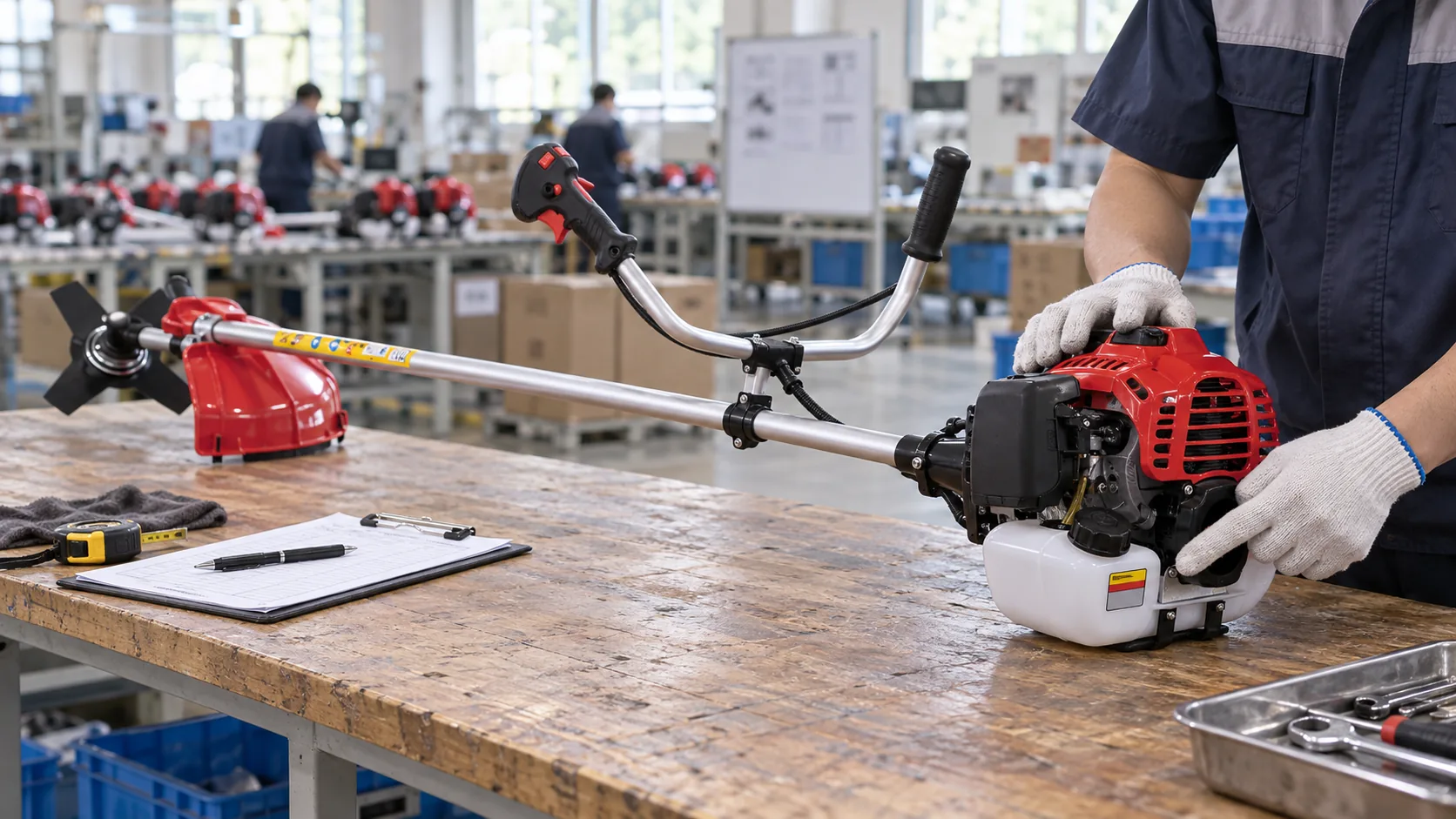
52cc Brush Cutter Procurement Check
Importing 52cc Brush Cutters from China: Verify Fuel Labels Before Shipment
Fuel labels are a small but important detail when importing 52cc brush cutters from China. The ratio printed on the machine, user manual and supplied mixing bottle must agree. Conflicting instructions can lead dealers to explain the product incorrectly and customers to prepare the wrong gasoline-and-oil mixture.
This is not a general inspection guide for every part of a 52cc brush cutter. It addresses one specific procurement risk: verifying fuel-ratio information before production and shipment. The TM-CG520TB and its stated 1:30 mixed-fuel ratio provide the working example.
| Quick answer: | Do not approve a 52cc brush cutter fuel label from displacement alone. First confirm the ordered engine and its specified fuel mixture. Then compare the numerical ratio and its meaning across the machine label, manual, mixing bottle, packaging and sales documents. For the TM-CG520TB, the stated reference is a TB52 two-stroke air-cooled engine, 51.7cc displacement and a 1:30 mixed-fuel ratio. Any conflicting ratio should be corrected before mass-production packing begins. |
Why Fuel Instructions Belong in the Import Specification
A two-stroke brush cutter depends on premixed gasoline and two-stroke oil, but the required ratio cannot safely be assumed from engine displacement. Two machines described as 52cc may carry different instructions according to their engine configuration and the documentation prepared for the order.
For an importer, the fuel ratio is part of the ordered product information. It should be confirmed alongside the engine model, displacement, shaft specification and included accessories—not treated as a general operating note that can be added after production.
|
Reference configuration TM-CG520TB 52cc Gasoline Brush CutterThis model is listed with a TB52 two-stroke air-cooled engine, 51.7cc displacement, a 1:30 mixed-fuel ratio and a 1,200 ml fuel tank. These values identify the configuration discussed here and should not be copied to another 52cc model without checking its specification. |
|
Audit Every Place Where the Fuel Ratio Appears
Conflicts often appear because artwork, manuals and accessories are prepared by different teams or reused from earlier orders. A specification sheet may state one ratio while an older manual or generic tank sticker displays another. A running test will not reveal this documentation mismatch.
| Inspection point | What to compare | Typical procurement risk |
| Machine label | Ratio, wording and model reference | Generic or outdated sticker applied to the tank or engine cover |
| Manual and quick-start sheet | Ratio, preparation method and translated meaning | Numbers retained while gasoline and oil meanings are reversed |
| Mixing bottle | Scale, units and correct ratio line | Multiple unlabeled ratio marks confuse first-time users |
| Carton or color box | Any printed fuel directions and model code | Old artwork remains after an engine configuration change |
| Commercial documents | Quotation or proforma invoice specification | Production and inspection teams follow different references |
The wording does not need to be identical in every location, but the numerical instruction and its meaning must agree. If the machine states 1:30 while the manual states 1:40, the supplier should resolve the difference before shipment.
Explain the 1:30 Ratio Without Ambiguity
A label showing only “1:30” may be understood by an experienced mechanic but misread by a first-time owner. The surrounding text should identify which number refers to oil and which refers to gasoline. It should also follow the convention used in the destination market.
For a gasoline-to-oil ratio of 30:1, one litre of gasoline requires approximately 33.3 ml of two-stroke oil. The following quantities can be used when checking the manual or a dealer handover card:
| Gasoline quantity | Two-stroke oil for 30:1 | Useful label wording |
| 1 litre | 33.3 ml | Add approximately 33.3 ml oil |
| 2 litres | 66.7 ml | Add approximately 66.7 ml oil |
| 3 litres | 100 ml | Add 100 ml oil |
| 5 litres | 166.7 ml | Add approximately 166.7 ml oil |
Inspect the Mixing Bottle and Ordered Engine Together
A supplied mixing bottle can reduce measurement errors only if its scale supports the stated ratio and remains readable in normal workshop conditions. A generic bottle containing several ratio lines can create uncertainty when the correct line is not identified.
Bottle usability check
|
Configuration controlApprove fuel artwork only after the selected engine and order configuration are fixed. The factory sample, artwork proof and mass-production inspection must use the same model code. A label approved for one engine should not become a universal label for every 52cc brush cutter. |
The listed 1,200 ml tank capacity of the TM-CG520TB does not mean fuel should be mixed directly in the machine tank. The amount already inside the tank may be unknown, making accurate oil measurement difficult. The customer instructions should call for preparation in a separate approved fuel container.
Add Fuel Documentation to Pre-Shipment Inspection
Fuel-document verification can be completed without dismantling the machine. Inspect cartons from different parts of the finished batch and compare their contents with the approved sample. This is especially useful when manuals or mixing bottles are added late in the packing process.
- Select cartons from different packing periods. Avoid checking only adjacent cartons from one pallet position.
- Match the model code. The machine, carton, manual and inspection record should identify the same ordered model.
- Photograph the machine label. The ratio and surrounding wording must be readable.
- Photograph the relevant manual page. Include enough of the page to show which model the instruction belongs to.
- Record the mixing-bottle scale. Make the units and correct ratio marks visible.
- Separate operating tests from document checks. A machine running with correctly prepared fuel does not prove that every packed carton contains the correct instructions.
Importer and Dealer Fuel-Label Checklist
Use this model-specific checklist when importing 52cc brush cutters from China. Record each decision in the sample approval or pre-production confirmation instead of relying on verbal instructions.
| 01 | Confirm the exact engine model and displacement before approving fuel artwork. |
| 02 | Record the required fuel ratio in the quotation or proforma invoice when it forms part of the confirmed specification. |
| 03 | Compare the ratio on the machine label with the approved specification. |
| 04 | Check the user manual and quick-start sheet for the same numerical instruction and meaning. |
| 05 | Verify that translated text does not reverse gasoline and oil quantities. |
| 06 | Test whether the supplied mixing bottle has readable units and a practical 1:30 or 30:1 scale. |
| 07 | Review carton and color-box artwork for old or generic fuel instructions. |
| 08 | Inspect cartons from more than one packing period during pre-shipment inspection. |
| 09 | Prepare a short dealer handover explanation with common fuel and oil quantities. |
| 10 | Keep fuel-document photographs separate from starting and running test records. |
Prepare Dealers for Handover and After-Sales Questions
Dealers need a short, repeatable explanation rather than a technical paragraph hidden inside the manual. A model-specific handover card can show the required ratio, common preparation quantities and a warning not to pour unmeasured oil directly into the machine tank.
The ratio should be identified as belonging to the confirmed model. Customers who own several two-stroke tools may assume one premix is suitable for all of them. Clear marking on the machine and fuel container helps prevent different mixtures from being confused in a workshop.
When a customer reports smoke, poor running or a suspected lubrication problem, the after-sales team should first ask which fuel was used, how the oil was measured and whether the supplied model instructions were followed. These observations help distinguish a possible mixing error from carburetion, ignition or load-related problems.
Frequently Asked Questions
1. Do all 52cc brush cutters use the same fuel ratio?
No. Engine displacement alone does not establish the correct gasoline-and-oil ratio. Confirm the actual engine configuration and supplier documentation for the ordered model.
```2. What fuel ratio is stated for the TM-CG520TB?
The TM-CG520TB is listed with a 1:30 mixed-fuel ratio. It uses a TB52 two-stroke air-cooled engine with 51.7cc displacement.
3. Is 1:30 the same as 30:1?
The notation can be used differently between documents and markets, so the label should explicitly identify gasoline and oil. For the calculation discussed here, 30 parts gasoline to one part oil requires approximately 33.3 ml of oil per litre of gasoline.
4. Can the fuel be mixed directly in the 1,200 ml machine tank?
It should be prepared in a separate approved fuel container. Mixing directly in the tank makes accurate measurement difficult, especially when the amount already inside the tank is unknown.
5. What should an importer photograph during inspection?
Photograph the machine fuel label, the relevant manual page, the mixing-bottle scale and any fuel directions on the packaging. The model number should be visible wherever practical.
6. How does this check support the main “Import Brush Cutters from China” topic?
A general import guide covers supplier verification, model selection, sampling, packaging and order control. This fuel-label audit addresses a narrower issue that directly affects dealer handover, customer use and after-sales diagnosis for two-stroke models.
```
Review the Complete Brush Cutter RangeBuyers planning to import brush cutters from China can compare available models before fixing engine specifications, fuel documentation, accessories and packing requirements for a bulk order. |
|