
What Spare-Parts Records Should a 41cc Brush Cutter Supplier Provide?
Learn which engine, carburetor, shaft, gearbox and cutting-system records importers should obtain from a 41cc brush cutter supplier.
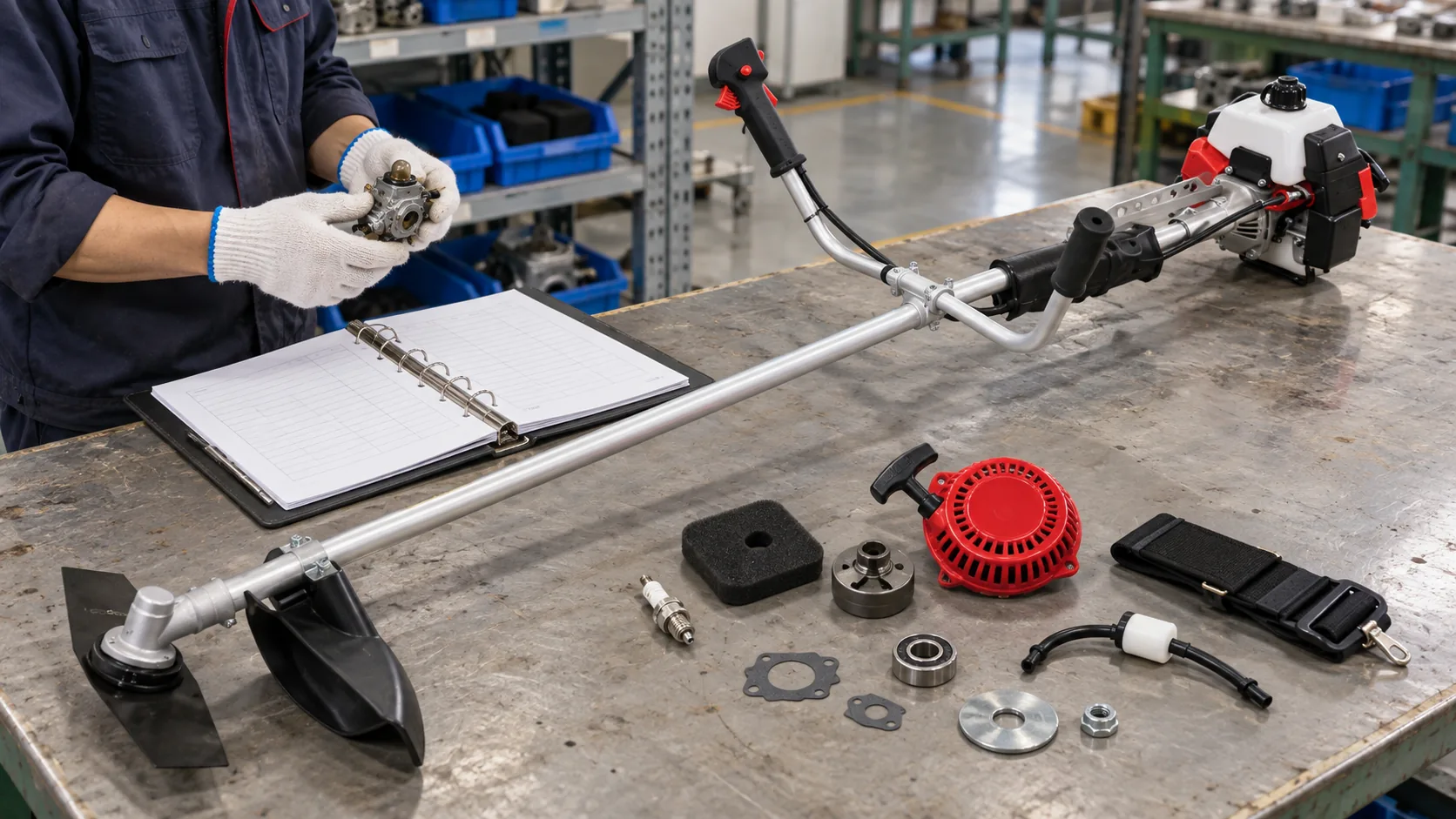
Dealer After-Sales and Parts Control
What Spare-Parts Records Should a 41cc Brush Cutter Supplier Provide?
Importers often compare brush cutters by displacement, rated output and unit price. Those figures matter, but they do not show whether a dealer will be able to identify the correct replacement parts after the machines enter the market.
A 41cc brush cutter may use components that resemble parts fitted to 40cc or 43cc machines. Similar appearance does not prove compatibility. Mounting holes, shaft splines, carburetor connections, clutch dimensions and gearbox threads can differ even when two components look almost identical.
When selecting a 41cc brush cutter supplier, importers should request records linked to the exact machine and engine configuration rather than accepting a general document labeled only “41cc spare parts.”
Parts Identification Rule
Quick answer: A useful spare-parts record should combine the machine model, engine code, supplier part number, photographs, critical dimensions, thread or spline details, compatible versions and production-change information. For the TM-CG411, the starting identity is the 1E40F-6 two-stroke engine, 40.2cc actual displacement, floating-type carburetor, 1000ml fuel tank, 28mm shaft and 8.0kg net weight. “41cc carburetor” or “28mm gearbox” is not specific enough for dependable repeat ordering.
1. Start With the Complete TM-CG411 Machine Identity
Displacement describes cylinder capacity; it does not define every component installed on the machine. Two brush cutters within a similar displacement class can use different starters, carburetors, filter housings, fuel tanks, clutches, control handles, drive shafts, gearboxes and cutting hardware.
| Identity Field | TM-CG411 Listed Specification | Parts-Control Purpose |
| Product model | TM-CG411 | Connects the parts record to the approved complete machine |
| Engine model | 1E40F-6 | Separates it from similar-displacement engine versions |
| Actual displacement | 40.2cc | Prevents the commercial 41cc description from replacing technical identification |
| Engine type | Two-stroke, air-cooled | Defines the basic fuel and lubrication system |
| Carburetor | Floating type | Requires matching fuel connections, linkage and mounting |
| Fuel tank | 1000ml | Supports identification of the tank, cap, grommet and hose arrangement |
| Shaft diameter | 28mm | Provides only the first measurement for shaft-system identification |
| Net/gross weight | 8.0/9.0kg | Helps reveal major configuration differences between shipments |
The importer should retain this identity with the approved sample photographs, quotation and proforma invoice. Later parts orders can then be traced to the same physical configuration instead of relying on memory or external appearance.
Common ordering failure: A dealer requests a “41cc carburetor” or “28mm gearbox,” receives a similar-looking component and discovers that the linkage, spline, thread or mounting dimensions do not match the machine.
2. Link Engine and Carburetor Parts to the 1E40F-6 Code
The commercial product category is 41cc, while the listed technical displacement is 40.2cc. Neither description is sufficient for identifying every internal engine component. The 1E40F-6 engine code provides a more specific starting point.
Engine Components
|
Starting and Drive
|
Intake and Fuel
|
An engine code should not be treated as proof that every component remains unchanged indefinitely. Production versions can differ, and similar engines may use components from different sources. Critical engine parts should therefore be linked to a supplier part number, applicable version, photograph and relevant dimensions.
Floating-Type Carburetor Record
A replacement carburetor record should include:
- carburetor model or supplier reference;
- mounting-hole spacing;
- intake connection dimensions;
- fuel-inlet location;
- throttle-linkage arrangement;
- choke-control design;
- gasket and insulator configuration;
- approved adjustment reference;
- applicable machine and engine model.
A carburetor may attach physically while still having a different throttle connection or adjustment range. Exterior photographs alone may not reveal these differences. For the first bulk order, the importer can discuss a small quantity of confirmed carburetor assemblies and related gaskets; the appropriate quantity depends on order volume, fuel quality, repair practices and expected use.
3. Document the Fuel System as Individual Service Parts
The TM-CG411 lists a 1000ml fuel tank and a 1:30 mixed-fuel ratio. Tank capacity helps identify the general configuration, but it does not define the complete fuel-delivery system.
| Fuel-System Item | Record to Request | Stocking Question |
| Fuel tank | Shape, mounting points, capacity and part reference | Available individually or only as an assembly? |
| Cap and seal | Thread, seal or gasket and venting arrangement | Can the cap and seal be ordered separately? |
| Fuel lines and grommet | Hose dimensions, routing, connections and tank grommet | Is a prepared hose set available? |
| Fuel filter and vent | Connection size and applicable fuel-system version | Which items are routine service parts? |
Whether parts are supplied individually or only as a complete tank assembly affects dealer repair cost and inventory planning. The importer should record that distinction before ordering service stock.
The listed 1:30 instruction should remain consistent across the machine label, manual, mixing bottle and dealer information. Conflicting fuel instructions can produce complaints and make fuel-system diagnosis more difficult.
4. Record the Complete 28mm Shaft and Gearbox System
The listed 28mm shaft diameter is only an outer-tube measurement. It does not confirm that another 28mm drive shaft or gearbox will fit the TM-CG411.
|
|
Importers should not tell dealers that any 28mm shaft will fit. The outer tube can match while the internal drive system remains incompatible. If a component is shared with another TEAMAX model, record the exact compatible models and verified component reference.
Gearbox and Cutting-Hardware Identification
The gearbox record should cover:
- gearbox input size and spline profile;
- gearbox reduction configuration, where relevant;
- output-shaft thread size and direction;
- upper and lower blade-flange dimensions;
- blade center-hole requirement;
- retaining nut and washer;
- nylon-head thread specification;
- guard mounting arrangement;
- grease point and service instruction.
A blade, nut or nylon head should not be selected only because it is advertised for a 41cc machine. Thread direction, center hole, mounting system and intended application must match. Blade flanges, washers and retaining nuts should be kept as a verified set so that parts from different mounting systems are not mixed.
5. Divide Stock Into Consumables, Damage-Prone Parts and Repair Parts
A structured list helps dealers set initial quantities according to service frequency and repair capability. It also prevents expensive repair assemblies from being ordered in the same ratio as routine consumables.
| Parts Category | TM-CG411 Parts to Consider | Planning Basis |
| Routine consumables | Air filters, fuel filters, spark plugs, starter ropes, nylon line and cutting blades | Replacement frequency and installed specification |
| Operating and damage-prone | Recoil starter, control handle, throttle cable, tank, cap, guard, harness, handle mounts and shaft components | Working conditions, transport and dealer assembly practices |
| Model-specific repairs | Carburetor, ignition coil, clutch, clutch drum, cylinder, piston, seals, gaskets, gearbox and internal drive shaft | Dealer repair capability and exact model compatibility |
Even routine parts require controlled specifications. An air filter must fit its housing, and a cutting blade must correspond with the flange, center hole, guard and retaining hardware.
Recommended Product Reference
TM-CG411 41cc Gasoline Brush Cutter
Use the TM-CG411 model, 1E40F-6 engine code, 40.2cc actual displacement, floating-type carburetor, 1000ml tank and 28mm shaft as the base identity for every related service-parts record.
| Check TM-CG411 Specifications |
6. Request a Verified Compatibility and Version Matrix
Importers carrying several brush cutter models can reduce inventory when parts are genuinely shared. A compatibility matrix should list only components that have been verified; it should not assume interchangeability from engine displacement or external appearance.
| Part | TM-CG411 Record | Compatibility Field | Verification Method |
| Air filter | Confirmed part number | Verified models only | Housing fit and supplier record |
| Carburetor | Confirmed model or supplier reference | Never assume from displacement | Mounting, linkage, connections and adjustment |
| Drive shaft | Length and spline reference | Matching shaft systems | Dimensions and physical assembly |
| Gearbox | Input and output specifications | Verified shaft systems | Spline, tube, mounting and thread check |
Use Several Identification Methods Together
A dependable record can combine:
- supplier part number;
- machine model and engine model;
- clear photographs from several angles;
- critical dimensions;
- thread or spline specification;
- version or production-date information;
- verified compatible models;
- notes identifying components that are not interchangeable.
Photographs help with fast recognition, but dimensions are necessary when components look alike. Part numbers improve repeat ordering only when they remain linked to the actual approved component. For critical items, the importer may also retain a physical reference sample in the service department.
Record Production Changes
A component change can affect after-sales support even when the complete machine continues to operate normally. Dealers may hold stock for an earlier version while a new shipment requires a different carburetor, starter, clutch, shaft or gearbox.
The supplier should report changes affecting:
- carburetor mounting or adjustment;
- recoil starter fit;
- fuel-tank and hose arrangement;
- clutch and clutch drum;
- shaft splines and gearbox connection;
- blade-mounting hardware;
- control handle or throttle cable;
- labels and fuel instructions.
The change record should show which production batch uses the previous component and which uses the revised one. A substitute should not be accepted merely because it fits during assembly; compatibility with existing service stock must also be considered.
7. Establish Parts Records During Sample and Shipment Inspection
The approved sample is the best opportunity to create a physical after-sales reference. Parts documentation should not be postponed until a dealer reports the first failure.
During Sample Approval
|
Before Shipment
|
Small components should not be placed loose in an unmarked carton. Clear labels allow the importer to receive, stock and distribute parts without reopening every package.
The machine product page lists kraft-carton or customized color-box packaging. Spare-parts packaging should be planned separately according to component size, corrosion protection, storage and dealer handling requirements.
Importer and Dealer Parts-Record Checklist
- Record TM-CG411 as the applicable machine model.
- Connect engine parts to the 1E40F-6 code and applicable version.
- Retain the exact 40.2cc technical displacement in the specification record.
- Identify the floating-type carburetor by reference, mounting and linkage.
- Separate the 1000ml tank, cap, seal, hoses, filter, grommet and vent components.
- Record the 1:30 fuel ratio consistently across customer materials.
- Document the 28mm tube together with shaft length, splines and connections.
- Record gearbox input, output thread and complete blade-mounting hardware.
- Divide stock into consumables, damage-prone parts and repair components.
- List only physically or dimensionally verified compatible models.
- Track component changes by production batch or version.
- Verify packaging, labels and quantities before shipment.
8. Frequently Asked Questions About TM-CG411 Spare Parts
| 01 |
Is the TM-CG411 exactly 41cc?The commercial model is described as a 41cc brush cutter, while the listed technical displacement is 40.2cc. The exact value should be recorded together with the 1E40F-6 engine code. |
| 02 |
Can parts from another 40cc or 43cc machine fit?Some components may be shared, but compatibility cannot be inferred from displacement. Part numbers, dimensions, mounting systems and production versions must be checked. |
| 03 |
What carburetor does the TM-CG411 use?The specification lists a floating-type carburetor. Its supplier reference, mounting, fuel connections, throttle linkage and applicable version should be documented. |
| 04 |
Does every 28mm gearbox fit this brush cutter?No. The 28mm description normally refers to the outer shaft tube. The inner spline, input connection, output thread and mounting dimensions can still differ. |
| 05 |
Which spare parts should dealers order first?Initial stock often includes filters, spark plugs, starter items, fuel-system parts, cutting heads, blades and selected repair components. Quantities depend on order volume, local conditions and dealer repair capability. |
| 06 |
Why keep an approved spare-parts record?It allows dealers to identify correct replacements, compare production versions and place repeat orders without relying only on engine displacement or appearance. |
Evaluate TM-CG411 After-Sales SupportRequest a quotation with the required machine quantity, destination market, cutting attachments, OEM details and spare-parts package. Ask for records connecting the TM-CG411 model, 1E40F-6 engine code and approved service components. A dependable brush cutter supplier should support both the complete machine and the information required to stock the correct parts. |
|