
How Should a Brush Cutter Manufacturer Control Wheeled Assembly?
See how a wheeled brush cutter manufacturer should control frame alignment, engine mounting, cutting geometry, vibration and bulk-production consistency.
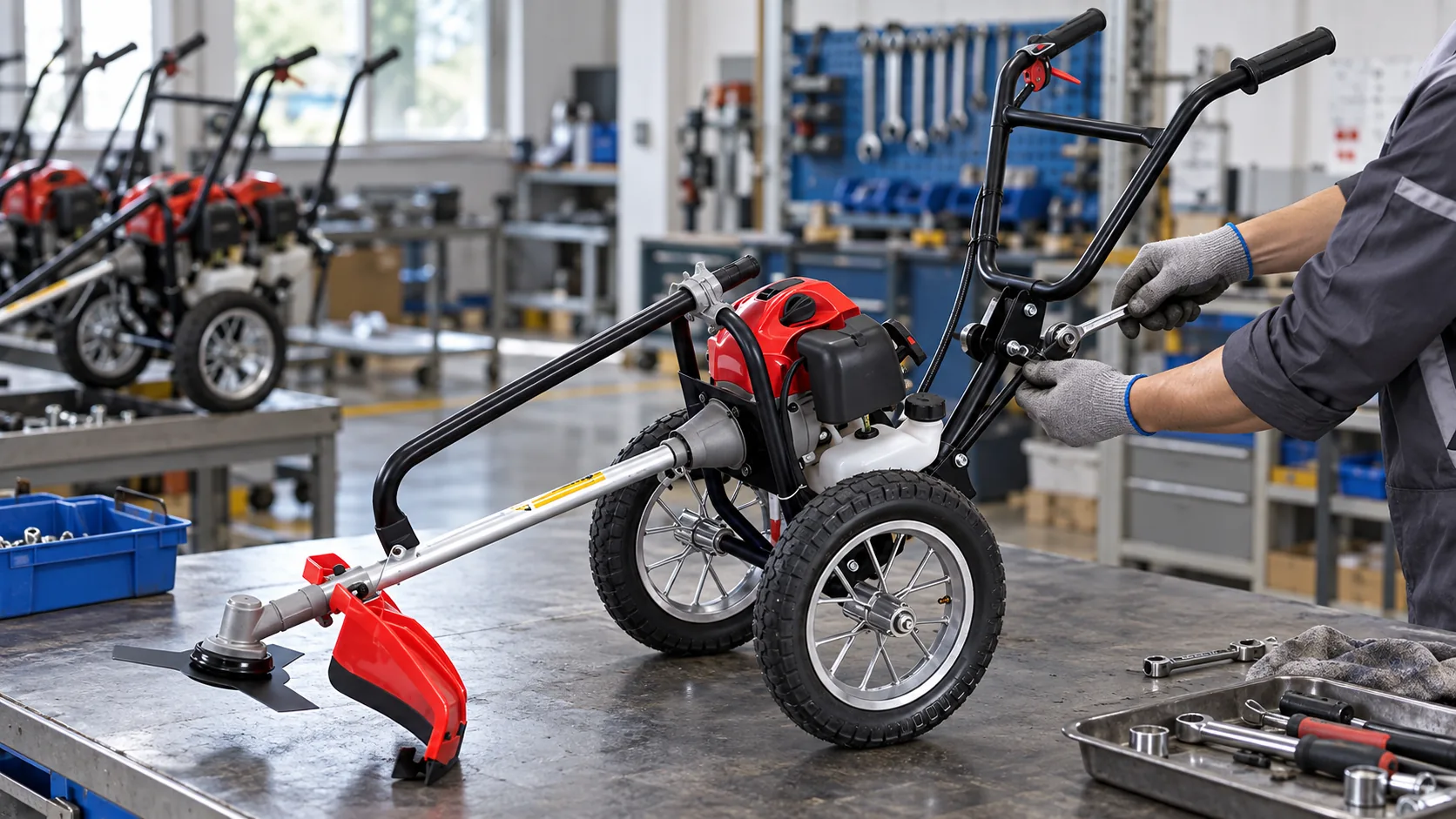
Wheeled Brush Cutter Manufacturer: How Importers Should Check Assembly Consistency
A wheeled brush cutter manufacturer has to control more than engine displacement and rated output. On a hand-push machine, the frame, wheel position, engine mounting and cutting-system location work together as one assembled structure. A production unit can use the correct engine and still behave differently from the approved sample if these relationships change.
For importers, this creates a different inspection priority from a conventional shoulder-carried brush cutter. The practical question is whether the factory can reproduce the complete wheeled assembly consistently across bulk production, not simply whether individual components meet their listed specifications.
ASSEMBLY CONTROL PRIORITY
Quick answer: Importers evaluating a wheeled brush cutter manufacturer should approve and inspect the complete assembled machine, not only the engine and cutting-width specification. Use the approved sample to record frame position, wheel arrangement, engine mounting and cutting-system location. Before powered testing, place selected production units on a flat surface and check stability, wheel tracking, clearances and fasteners. Then separate engine-running behavior from frame vibration or directional pull. For repeat orders, any component substitution that changes mounting dimensions should be checked against the previously approved assembly.
1. Define the Production Problem Before Inspecting the Machine
A shaft-type brush cutter is mainly controlled around the engine, shaft, handle and cutting attachment. A wheeled brush cutter adds a supporting frame, wheels and several mounting relationships that affect how the finished machine sits on the ground and moves through the working area.
That difference changes the inspection logic. Starting the engine successfully does not confirm that the complete machine has been assembled like the approved sample. Wheel alignment, frame geometry or cutting-system position can still differ even when the power unit is correct.
| Control Area | What Can Change | What the Importer May Notice |
| Frame | Mounting position or structural alignment | Rocking, uneven stance or changed component position |
| Wheel assembly | Wheel, axle or support position | Machine pulls to one side during a straight push |
| Engine mounting | Bolt security, bracket seating or engine position | Unexpected vibration transmitted through the frame |
| Cutting system | Position relative to frame and wheels | Different cutting position or reduced component clearance |
For manufacturer evaluation, these complete-machine relationships should be treated separately from market-fit questions such as terrain, orchard access or vegetation type. Product suitability and production consistency are two different procurement decisions.
2. Turn the Approved Sample Into an Assembly Reference
The approved sample should become more than a reference for engine model, paint color and general appearance. For a wheeled machine, importers should document how the main components are positioned in relation to one another.
The TM-WBC520A hand push brush cutter provides a useful example. Its listed configuration includes a 1E44F-5 two-stroke engine, 51.7cc displacement, rated output of 1.80 kW (2.5 HP), 700 mm cutting width, 18.0 kg net weight and 19 kg gross weight.
What the sample record should capture
|
|
The published specification confirms important technical values, but those figures do not describe every geometric relationship on the completed machine. Photos and inspection notes from the approved sample give the factory and buyer a clearer reference when bulk assembly starts.
3. Check Frame and Wheel Geometry Before Cutting Performance
The frame is the structural reference for the wheeled machine. If its mounting points vary, the wheels and cutting system can move away from their intended positions even when each individual component is acceptable.
A useful first inspection does not require fuel. Place the finished unit on a reasonably flat surface and examine the complete structure from the front, rear and both sides.
| 01 | Set the machine on a flat surface. Observe whether it sits naturally or shows obvious twisting and rocking. |
| 02 | Compare the two sides. Look at wheel supports, cross-members and engine brackets against the approved sample. |
| 03 | Push the machine straight ahead. Check whether it tracks reasonably straight without constant steering correction. |
| 04 | Inspect working clearances. Confirm that moving or cutting components are not positioned unusually close to the wheels or frame. |
Wheel alignment should be checked before judging cutting performance. If one wheel position, axle connection or frame mounting point differs from the approved sample, the operator may have to keep correcting the machine to maintain a straight cutting path.
This is a practical factory-control check because it can reveal assembly differences before fuel is added or the machine is operated under power.
4. Separate Mechanical Assembly Issues From Engine Behavior
The TM-WBC520A reference configuration uses a 51.7cc two-stroke engine, but engine specification alone does not explain every vibration or handling complaint on a wheeled machine.
Before adjusting the carburetor or ignition system because the machine feels abnormal, inspect whether the engine mounting bolts are secure, brackets are seated correctly and the engine position matches the approved sample. A loose or uneven mounting point can transmit vibration through the frame, handles and wheels differently.
Diagnostic boundary
If the engine runs normally but the complete machine shows unusual directional pull, frame movement or vibration, check the wheel assembly, mounting points and cutting-system installation first. If engine speed itself is unstable, diagnose the engine system separately.
The listed 700 mm cutting width should be treated in the same way. It confirms the nominal cutting-width specification, but it does not prove that the cutting system occupies exactly the same position relative to the frame and wheels on every production unit.
During inspection, compare the cutting-side location with the approved sample and check that the working area remains clear of surrounding structural components. A wheeled brush cutter is better evaluated as one assembled geometric system rather than as an engine plus a cutting-width figure.
5. Use a Non-Powered Push Test Before the Operating Test
A manual push test can reveal issues that are difficult to identify from product photos or an engine-starting video. With the engine stopped, move the assembled machine forward, backward and through a controlled turn.
| Check during manual movement | What the inspector is looking for |
| Forward rolling | Obvious wheel binding or continuous pull toward one side |
| Backward movement | Interference between frame, wheels and other assembled components |
| Controlled turn | Whether the handle and frame allow normal steering movement |
| Visual clearance | Unusual contact between rotating, cutting or structural parts |
After the non-powered inspection is complete, selected machines can be checked under appropriate operating conditions using the confirmed fuel and cutting configuration. Observe engine behavior and complete-machine behavior separately rather than treating every abnormal sensation as an engine problem.
Stop the engine and wait for all moving parts to come to a complete stop before inspecting the cutting area or making adjustments.
6. TM-WBC520A as a Wheeled Assembly-Control Reference
PRODUCTION REFERENCE MODEL
TM-WBC520A Hand Push Brush Cutter
| Engine | 1E44F-5, two-stroke |
| Displacement | 51.7cc |
| Rated output | 1.80 kW (2.5 HP) |
| Cutting width | 700 mm |
| N.W. / G.W. | 18.0 kg / 19 kg |
These specifications give importers a defined model reference, while production inspection should also compare the frame, wheels, engine mounting and cutting-system position with the approved assembled sample.
| View TM-WBC520A Details |
7. Control Repeat Orders and Component Changes
Assembly records become particularly useful when the same wheeled model is reordered several months later. The manufacturer should be able to trace the confirmed engine, frame arrangement, wheels, cutting system and other order-specific details back to the previously approved configuration.
A component substitution that looks minor in a parts list can matter if it changes mounting dimensions or alters how the finished machine sits on the frame. Changes affecting assembly should therefore be reviewed against the approved model before mass production.
Before Repeat Production
|
If a Component Changes
|
This helps keep repeat-order control focused on the complete machine instead of assuming that individually acceptable replacement components will automatically reproduce the same finished assembly.
8. Importer / Dealer Wheeled Brush Cutter Inspection Checklist
Before approving bulk production or selected pre-shipment units:
| 01 | Confirm the model and engine identification against the approved sample. |
| 02 | Compare general frame position and left-right symmetry. |
| 03 | Check whether the complete machine sits stably without obvious twisting or rocking. |
| 04 | Push the machine over a short straight section and observe directional tracking. |
| 05 | Inspect wheel supports, axle connections and mounting points. |
| 06 | Confirm engine mounting bolts and brackets are seated securely. |
| 07 | Compare the cutting-system position with the approved machine. |
| 08 | Check visible clearance between moving parts, wheels and structural components. |
| 09 | Separate engine-speed problems from frame vibration or steering behavior during powered checks. |
| 10 | Record any component substitution that could affect mounting dimensions or finished-machine geometry. |
The objective is not to create an unnecessarily complicated inspection procedure. It is to check the assembly characteristics that are specific to wheeled construction and cannot be confirmed by engine specification alone.
FAQ About Wheeled Brush Cutter Manufacturer Inspection
What should importers check when evaluating a wheeled brush cutter manufacturer?
Check whether the factory can reproduce the approved complete assembly, including the frame, wheel position, engine mounting and cutting-system location. Engine specification alone does not confirm assembly consistency.
Why should wheel alignment be checked before starting the engine?
A manual straight-line push can reveal directional pull caused by wheel, axle or frame-position differences. This allows the inspector to identify a mechanical assembly issue before powered testing begins.
Does a 700 mm cutting width confirm that every production machine is assembled the same way?
No. The 700 mm value is the listed cutting-width specification for the TM-WBC520A, but inspectors should still compare the physical position of the cutting system relative to the frame and wheels.
Can abnormal vibration come from the wheeled assembly instead of the engine?
Yes. Engine mounting, bracket seating or other assembly conditions can change how vibration is transmitted through the machine. Check mechanical installation before assuming the engine itself requires adjustment.
Should importers inspect more than one completed unit in a bulk order?
Yes. The purpose of assembly control is to determine whether the approved configuration is reproduced across production. Checking only one engine or one completed machine does not show complete-machine consistency throughout the batch.
Why do repeat orders need the original assembly record?
The record helps the manufacturer and importer compare later production with the previously approved engine, frame, wheels and cutting-system arrangement, especially when alternative components are proposed.
Check the Complete Wheeled Assembly Before Bulk ProductionFor importers comparing a wheeled brush cutter manufacturer, the useful production reference is the complete assembled machine. The TM-WBC520A combines a 1E44F-5 two-stroke engine, 51.7cc displacement, 1.80 kW output and 700 mm cutting width, but bulk-order inspection should also confirm that its frame, wheels, engine mounting and cutting-system position remain consistent with the approved sample. |
|