
What Size Earth Auger Bit Do You Need for Fence Posts?
Choose the right earth auger bit for fence posts by matching post width, concrete clearance, soil conditions, and required hole depth before drilling.
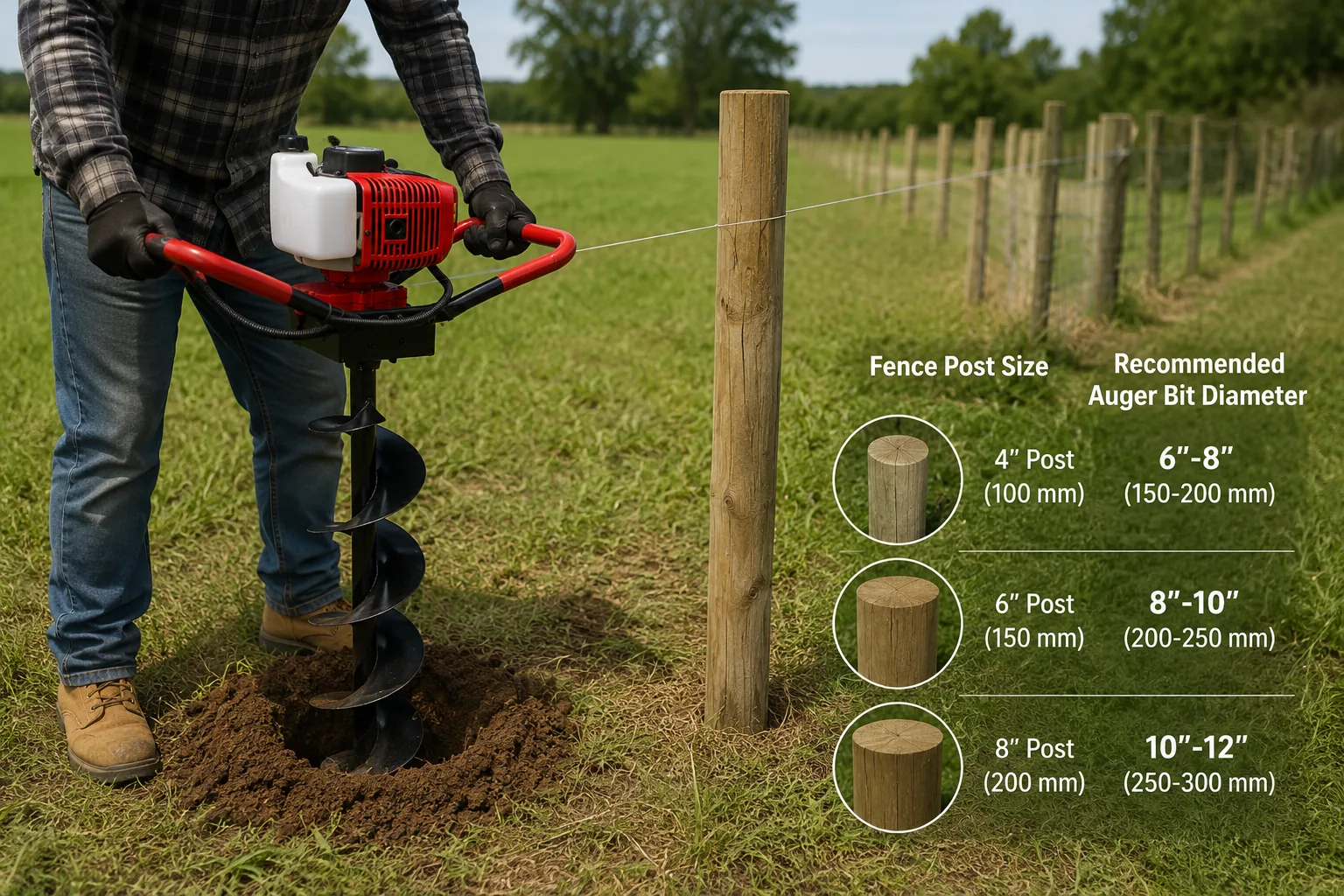
Fence Installation and Auger Selection
What Size Earth Auger Bit Do You Need for Fence Posts?
Choose an earth auger bit from the required finished hole diameter, not from the post name or the largest bit available. Post width, concrete clearance, drainage material, soil condition and whether the post supports a line, corner or gate all affect the correct drilling size.
A commonly used starting point is a hole approximately three times the width of the fence post. That guideline can be useful for initial planning, but it does not replace the project specification, local construction rules or the requirements for terminal and gate posts.
An oversized auger removes unnecessary soil, increases drilling resistance and raises concrete or backfill consumption. A bit that is too small can leave insufficient space to align the post, place concrete evenly or add drainage material around the base.
|
QUICK ANSWER Measure First. Drill Second. |
Quick answer: Measure the actual outside width of the post and confirm the required concrete, gravel or backfill clearance. A hole near three times the post width is a common starting point, but line posts, corner posts and gate posts may need different diameters. For the TM-EA520A, TM-EA520B and TM-EA520C, the listed optional bits are 100, 150, 200 and 250 mm. Select the smallest bit that still produces the specified finished hole, and confirm the shaft connection, pin position, bit length and cutting-tip compatibility before ordering. |
1. Measure the Actual Fence Post, Not Its Nominal Name
Begin with the real outside dimensions of the section that will enter the ground. A square wooden post, round timber post, steel tube and precast concrete post may all require different hole sizes even when they are intended for the same fence height.
Nominal timber dimensions may differ from the measured width. A post described by a trade size may be narrower or wider than expected after machining, treatment or coating. Measure the widest point before selecting the auger bit.
Information Needed Before Choosing the Diameter
|
|
2. Use the Three-Times Rule as a Starting Point Only
Many fence-installation guides use a hole diameter of approximately three times the post width. Under that general rule, a post measuring about 100 mm across may require a hole near 300 mm.
That does not mean every 100 mm post needs the same drilling diameter. A lightly loaded agricultural line post is not installed under the same conditions as a tall privacy-fence post, a gate support or a corner post carrying tensioned wire.
Local building rules, wind exposure, frost depth and the selected setting method take priority. When the required finished hole is wider than the largest compatible portable-auger bit, the contractor should use another drilling configuration or an approved widening method rather than accepting an undersized foundation.
| Post or Project Condition | Why More Clearance May Be Needed | What to Confirm | Procurement Consequence |
| Agricultural line post | May use compacted backfill instead of a wide concrete collar | Post width and local installation method | Smaller bits may represent more of the order |
| Wooden boundary post | Concrete and alignment space may be required | Finished hole diameter and setting material | 200 or 250 mm bits may be more relevant |
| Corner or end post | Carries directional or wire tension | Structural drawing or contractor specification | A second, larger bit may be needed |
| Gate post | Supports gate weight and repeated movement | Foundation width, depth and reinforcement method | Portable 250 mm capacity may be insufficient |
3. Compare 100, 150, 200 and 250 mm Auger Bits
| Bit Diameter | Possible Applications | Limit to Check | Buying Judgment |
| 100 mm | Slim agricultural stakes, small metal supports, plant supports and pilot holes | Leaves little clearance around most wooden fence posts | Do not recommend only because it is easier to turn |
| 150 mm | Slim posts, orchard supports and some agricultural fencing | May leave too little space for adjustment, concrete or drainage | Drill a test hole before committing to a full fence line |
| 200 mm | Medium timber posts, agricultural supports and smaller concrete-setting work | Removes more soil and increases resistance in clay or compacted ground | A practical middle size where 150 mm gives insufficient clearance |
| 250 mm | Larger line posts and some concrete-filled fence-post holes | May still be too small where a 100 mm post requires a hole near 300 mm | Confirm the structural requirement before calling it suitable |
Do not widen the hole by swinging a running earth auger from side to side. This reduces control, creates an uneven hole and places lateral force on the auger bit, gearbox and operator. Use a larger compatible bit or another approved drilling method when the finished diameter exceeds the available size.
4. Gate, Corner and Line Posts May Need Different Bits
A complete fence line does not always use one hole diameter from beginning to end. Intermediate line posts mainly support the fence between structural points. Corner posts change direction and may carry tension from two sides, while gate posts also support the gate’s weight and repeated opening forces.
A contractor may therefore need one diameter for standard line posts, a larger diameter for corner and terminal posts, and another drilling method where the gate-post foundation exceeds the portable auger’s available size.
Line PostsOften the highest-volume hole type. Select the diameter according to post width and the backfill or concrete method used throughout the fence line. |
Corner and End PostsMay require additional width or depth because they carry directional load or tensioned wire. Confirm them separately from intermediate posts. |
Gate PostsCan exceed the diameter or depth available from a portable earth auger. Foundation specifications should be checked before the equipment quotation. |
5. Match Bit Length to the Required Hole Depth
Diameter determines the hole width, but bit length determines how deeply the machine can drill before an extension or a different method becomes necessary.
The TM-EA520B gasoline post hole digger lists optional drill lengths of 80, 100, 120 and 140 cm, together with optional diameters of 10, 15, 20 and 25 cm.
The listed bit length should not automatically be treated as the guaranteed finished drilling depth. The connector, cutting tip, soil accumulated above the flights, power-head clearance and the operator’s ability to lift the bit can all reduce practical usable depth.
| 1 | Confirm how much of the listed length is occupied by the shaft connection and cutting tip. |
| 2 | Check the power head’s ground clearance when the bit is close to full depth. |
| 3 | Allow for soil collecting above the flights during drilling. |
| 4 | Confirm whether an approved extension shaft is available and compatible. |
| 5 | Verify the required finished depth before quotation, especially where frost-line or deep-foundation rules apply. |
6. Soil Conditions Change the Drilling Method, Not the Post Requirement
Selecting a smaller bit because the soil is difficult may reduce immediate drilling resistance, but it does not change the structural support required by the post.
Dense clay can stick to the flights, dry compacted soil increases resistance, loose sand may collapse after the bit is removed and stony ground can prevent a portable auger from producing a clean circular hole. These conditions should change the drilling procedure or equipment choice rather than the required finished diameter.
| Soil Condition | Likely Drilling Issue | Practical Response |
| Dense clay | Soil sticks to the flights and increases lifting effort | Drill in short stages and clear the bit frequently |
| Dry compacted soil | High resistance and slow penetration | Keep the power head upright and allow the tip to establish the centre |
| Loose sand | Hole walls collapse after extraction | Measure immediately and use an installation method suited to unstable soil |
| Stones or roots | Sudden stop, kickback or irregular hole shape | Stop immediately and remove or assess the obstruction before continuing |
7. EA520A, EA520B and EA520C Bit Configuration
The three EA520 variants share similar published operating values, but buyers should not assume that the A, B and C suffixes indicate different drilling capacities. Handle structure, appearance, connector details, accessories and packing should be confirmed from the quotation or approved sample.
|
MULTIPLE BIT LENGTH OPTIONS TM-EA520B Gasoline Post Hole DiggerListed with 80, 100, 120 and 140 cm drill lengths and 10, 15, 20 and 25 cm diameter choices. Confirm effective depth rather than relying only on total listed bit length.
|
REFERENCE BORING SPEED TM-EA520C Earth AugerThe TM-EA520C earth auger shares the listed 52 cc engine, 1.8 kW output, 180–210 rpm boring speed and optional 10–25 cm bit range.
|
Configuration note: Published specifications are reference values. Final handle design, auger connector, bit dimensions, accessories, extension compatibility and packing should be confirmed in the quotation, proforma invoice or approved sample.
8. Check Bit Compatibility Before a Bulk Order
Two auger bits with the same nominal diameter may not fit the same power head. Diameter describes the finished hole size, but the connector and cutting construction determine whether the bit can be installed and operated safely.
IMPORTER AND DEALER CHECKLIST
| 01 | Collect the actual width or diameter of every post type used by the customer. |
| 02 | Separate line-post, corner-post, end-post and gate-post requirements. |
| 03 | Confirm the specified finished hole diameter and drilling depth. |
| 04 | Record whether posts will use concrete, gravel or compacted soil backfill. |
| 05 | Verify the power-head output-shaft connection size. |
| 06 | Check the pin or bolt position and the auger rotation direction. |
| 07 | Confirm total bit length, effective drilling depth and extension-shaft compatibility. |
| 08 | Compare flight thickness, cutting-tip design and replaceable-blade compatibility. |
| 09 | Estimate daily hole volume and identify the main soil condition. |
| 10 | Build the bit mix from local post demand instead of ordering equal quantities of every diameter. |
Frequently Asked Questions
What size auger bit should I use for a 100 mm fence post?
A common starting rule would suggest a hole near 300 mm, but the final diameter depends on the setting method, local rules and whether the post is used on a line, corner or gate. A 250 mm bit may be too small where a full three-times-width foundation is required.
Can a 100 mm earth auger bit be used for fence posts?
It may suit slim agricultural stakes, small metal supports or pilot holes. It usually leaves insufficient clearance around substantial wooden posts where concrete, drainage material or alignment space is needed.
Is a 200 mm auger bit large enough for wooden posts?
It can suit some medium timber-post applications, particularly with compacted backfill or smaller concrete requirements. Measure the post and confirm the required clearance before drilling the complete project.
Do gate posts need wider holes than line posts?
Often they do. Gate posts support additional weight and repeated movement, while corner posts may carry tension from more than one direction. Their foundation size should be confirmed separately from standard line posts.
Can I use a smaller bit when the soil is hard?
A smaller bit may drill more easily, but it does not change the required post support. Use staged drilling, regular spoil removal or another suitable drilling system while maintaining the specified finished diameter.
Do all 250 mm earth auger bits fit the EA520 models?
Compatibility should be confirmed. Check the shaft connection, pin position, rotation direction, total length, blade design and extension compatibility for the selected EA520A, EA520B or EA520C configuration.
|
AUGER BIT MIX FOR WHOLESALE ORDERS Match the Auger Diameter to the Posts Your Customers InstallProvide the actual post widths, required hole depths, soil conditions and preferred bit quantities to compare the TM-EA520A, TM-EA520B and TM-EA520C configurations. |
|
The correct earth auger bit is the smallest compatible diameter that still produces the specified finished fence-post hole. Measure the post, separate structural post types and confirm the connector and usable depth before placing a bulk order.