
Why Does Grass Keep Wrapping Around a Brush Cutter Head?
Grass wrapping around a brush cutter head is often caused by long fibrous weeds, low cutting height or poor cutting technique. Check these points first.
Why Does Grass Keep Wrapping Around a Brush Cutter Head?
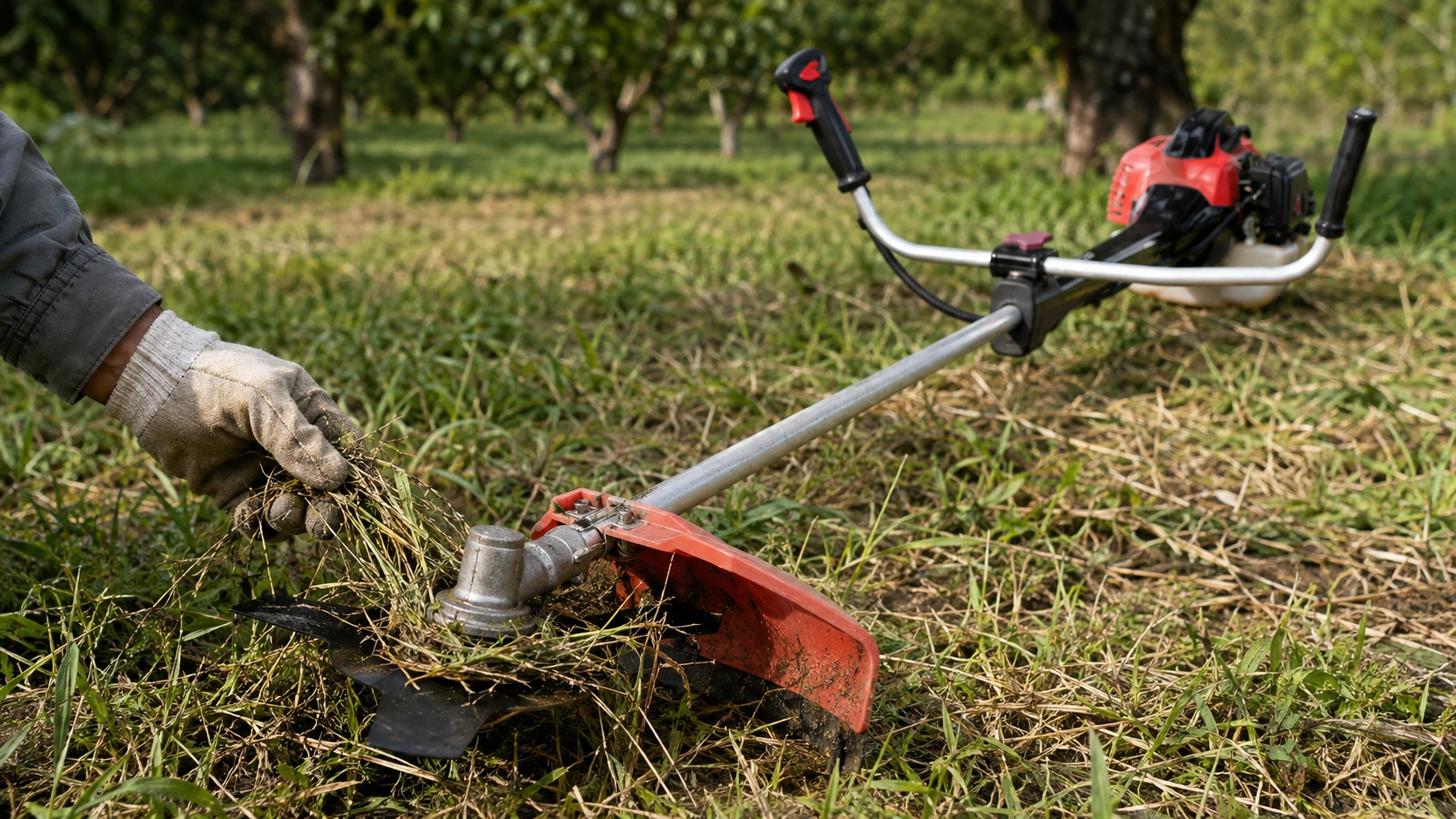
If grass keeps wrapping around a brush cutter head even though the engine continues running normally, the problem is usually not a lack of engine power. Long fibrous grass, vines and flexible weeds can bend instead of separating cleanly, then move inward toward the rotating center of the cutting attachment.
The first useful check is not the carburetor or engine. Identify exactly where the vegetation is winding. Grass collecting around the outer cutting area requires a different correction from material packed tightly around the spindle, blade mounting area or gearbox side. That distinction helps operators and dealers decide whether to change cutting technique, inspect the attachment or investigate a mechanical problem.
1. First Identify Where the Grass Is Winding
Wrapped vegetation is easier to diagnose when the location is recorded before everything is pulled away. Two brush cutters can show what looks like the same complaint while requiring different corrections.
| Where Grass Collects | What You May Observe | First Priority |
| Outer cutting area | Long stems remain around the working edge but are not packed around the spindle. | Check feed rate, cutting height and cutting-edge condition. |
| Central spindle area | Fibers form a tight coil around the rotating center. | Reduce inward feeding of long stems and inspect central clearance. |
| Mounting hardware | Vegetation becomes trapped between the attachment and adjacent parts. | Inspect installation, seating and visible damage. |
| Repeated uneven buildup | Grass returns quickly on one side or after vegetation is completely cleared. | Check for looseness, interference or an attachment that is not sitting squarely. |
Safety comes first: stop the engine completely, wait until the cutting attachment stops, disconnect the spark plug cap and wear suitable gloves before touching tangled vegetation. Never pull grass away from a moving attachment.
2. Why Long and Fibrous Grass Moves Toward the Rotating Center
A brush cutter performs best when the active cutting edge separates vegetation before the stem is carried inward. Shorter growth generally leaves the cutting zone quickly. Long flexible stems behave differently: they can fold around the rotating attachment, remain in contact for longer and begin winding around the spindle or mounting area.
The risk is greater in vegetation such as:
- long, soft grass that bends easily instead of standing upright;
- fibrous weeds with strong flexible stems;
- vines and creeping vegetation;
- partially flattened or lodged grass;
- dense growth being cut very close to the soil surface.
This symptom should be separated from an engine that loses speed under cutting load. If the engine remains responsive and the attachment continues rotating while vegetation accumulates around the center, begin with the cutting zone and operating method rather than engine adjustments.
3. Change the Cutting Method Before Assuming a Mechanical Fault
Tall grass wrapping problems are often influenced by how much material is being presented to the cutting attachment at one time. Three changes are worth testing before dismantling the drive system.
| 01 | Cut tall vegetation in stages.
Trying to remove the full height in one low pass allows long upper stems to fall across the rotating attachment. Cut the upper section first, let loose material fall away, then return to the required cutting height. |
| 02 | Reduce the width of each sweep.
A wide, slow sweep through dense growth can push a large bundle sideways instead of allowing smaller groups of stems to be cut and discharged. |
| 03 | Avoid forcing the attachment to ground level.
Soil, stones, fallen vegetation and the full length of tall stems can all enter the cutting zone when the first pass is unnecessarily low. |
Watch whether the machine is actually cutting or mainly pushing. If the vegetation bends sideways and collects in front of the attachment before being separated, reduce the feed rate or work with narrower sections.
4. Inspect the Cutting Edge and Central Mounting Area
If technique changes do not significantly reduce the problem, inspect the attachment after safely removing all wrapped material. A cutting edge that no longer separates the intended vegetation effectively may bend stems first, increasing the time they remain in contact with the rotating parts.
Around the center of the attachment, check for:
- plant fibers trapped between the cutting attachment and adjacent hardware;
- damaged, loose or incorrectly seated mounting components;
- debris packed tightly around the spindle area;
- an unusual gap where long stems can enter and wind;
- an attachment that does not appear to sit squarely after installation;
- abnormal resistance after all vegetation has been removed.
Do not assume the gearbox is damaged simply because grass has reached the spindle area. After cleaning, inspect and rotate the attachment only according to the normal service procedure for the machine. Cracked, severely damaged or incorrectly mounted rotating parts should not be put back into operation.
5. Do Not Let a Small Grass Bundle Become a Larger Mechanical Load
A few stems around the spindle may initially look like a cleaning inconvenience. Continued rotation can tighten the bundle as additional material is added, making the vegetation increasingly compact around the rotating center.
When working in vegetation known to wrap easily, inspect and clear the cutting area periodically rather than waiting for a large mass to form. If clearing is required every few minutes, use that frequency as a diagnostic clue: raise the first pass, reduce sweep width and compare whether wrapping decreases.
A clear improvement after changing the cutting method points toward vegetation handling. If the same severe buildup continues under lighter, shorter growth, inspect attachment installation and the central mounting area more closely.
6. TM-CG520TBV for Dense and Fibrous Vegetation Markets
For the TM-CG520TBV, the listed 28mm shaft diameter is one specification to verify when confirming compatible cutting-system components. Actual blades, trimmer heads, mounting hardware and replacement parts should still be checked according to the confirmed order configuration rather than assumed from shaft diameter alone.
7. Importer and Dealer Checklist for Grass-Wrapping Complaints
Repeated dealer complaints about grass wrapping around a brush cutter head should be recorded as a cutting-system and application issue until the actual cause is identified. Use the following checks when reviewing a model for wholesale supply or handling after-sales feedback.
01. Define the vegetation. Confirm whether customers mainly cut short grass, pasture growth, fibrous weeds, vines or mixed roadside vegetation.
02. Confirm the supplied cutting attachment. Do not evaluate the machine independently from the actual blade, trimmer head or other approved cutting setup supplied with the order.
03. Check mounting compatibility. Verify the attachment and related mounting parts against the selected machine configuration.
04. Record the exact wrapping location. Ask customers whether vegetation is around the outer attachment, spindle, mounting hardware or gearbox side.
05. Separate operating complaints from engine complaints. An engine that stays responsive while grass winds around the center should not automatically be treated as a carburetor or power-output fault.
06. Check cutting-edge condition. Worn or damaged working surfaces can increase bending and dragging of vegetation before separation.
07. Review spare mounting parts. Identify which wear or mounting components should be available to dealers for servicing the supplied cutting configuration.
08. Check repeat-order consistency. Make sure later batches use the agreed cutting-system and mounting configuration when compatibility is important to the dealer network.
09. Provide operating guidance for tall grass. Dealers should be able to explain staged cutting and narrower sweeps instead of treating every wrapping complaint as a machine defect.
8. When Grass Wrapping Needs a Mechanical Inspection
Occasional wrapping in unusually long vegetation can often be reduced by changing the cutting method. A mechanical inspection becomes more important when the machine begins wrapping much more severely in vegetation it previously handled normally.
| Observation | Recommended Response |
| Attachment has abnormal looseness | Stop operation and inspect mounting components before further use. |
| Attachment sits visibly unevenly | Confirm installation and inspect for damaged or incorrectly seated parts. |
| Strong resistance remains after cleaning | Do not continue simply because the grass has been removed; inspect for interference. |
| Unusual shaft or gearbox noise appears | Stop and investigate the drive area according to the applicable service procedure. |
| Parts repeatedly contact where clearance should exist | Correct the mechanical condition before returning the machine to service. |
FAQ About Grass Wrapping Around a Brush Cutter Head
Why does long grass keep wrapping around my brush cutter head?
Long flexible stems may bend instead of being cut immediately. If they remain in contact with the rotating attachment, they can move inward and wind around the spindle or mounting area. Cutting tall growth in stages and using narrower sweeps can reduce this tendency.
Does grass wrapping mean the brush cutter engine is too weak?
Not necessarily. If the engine continues running normally and the cutting attachment remains rotating, first inspect vegetation handling, cutting technique, attachment condition and the central mounting area. Engine power problems usually show additional symptoms such as bogging or loss of speed under load.
Can cutting grass too low cause more tangling?
Yes. A very low first pass through tall vegetation can allow long upper stems to fall across the attachment while the lower sections are still being cut. Progressive cutting usually gives the loose vegetation more opportunity to leave the cutting area.
Why does grass wrap around the brush cutter spindle instead of staying near the blade?
Flexible stems can slide inward if they are pushed across the attachment rather than separated quickly. If the buildup is consistently concentrated at the spindle, also inspect the mounting area for trapped fibers, unusual gaps, incorrect seating or other visible installation issues.
Should I keep operating if only a small amount of grass is wrapped around the head?
It is better to stop and clear the buildup safely. Additional stems can tighten the bundle around the rotating center and add resistance. The engine must be stopped, the attachment fully stationary and the spark plug cap disconnected before clearing tangled vegetation.
What should importers check when selling brush cutters for fibrous weeds?
Confirm the local vegetation, supplied cutting attachment, mounting configuration and spare-part compatibility together. For the TM-CG520TBV, the product page lists a 28mm shaft diameter, but actual cutting-system compatibility should still be confirmed for the selected order configuration.
|
Confirm the Brush Cutter Configuration for Your Market For importers and distributors handling dense grass, fibrous weeds or mixed vegetation, evaluate the TM-CG520TBV together with the intended cutting attachment, mounting components and local operating conditions before quotation. |
|