
Why Does a Small Chainsaw Kick Back When Pruning Branches?
Small chainsaw kickback during pruning often starts with bar-tip contact, branch pinching or poor cutting position. Check these risks before cutting again.
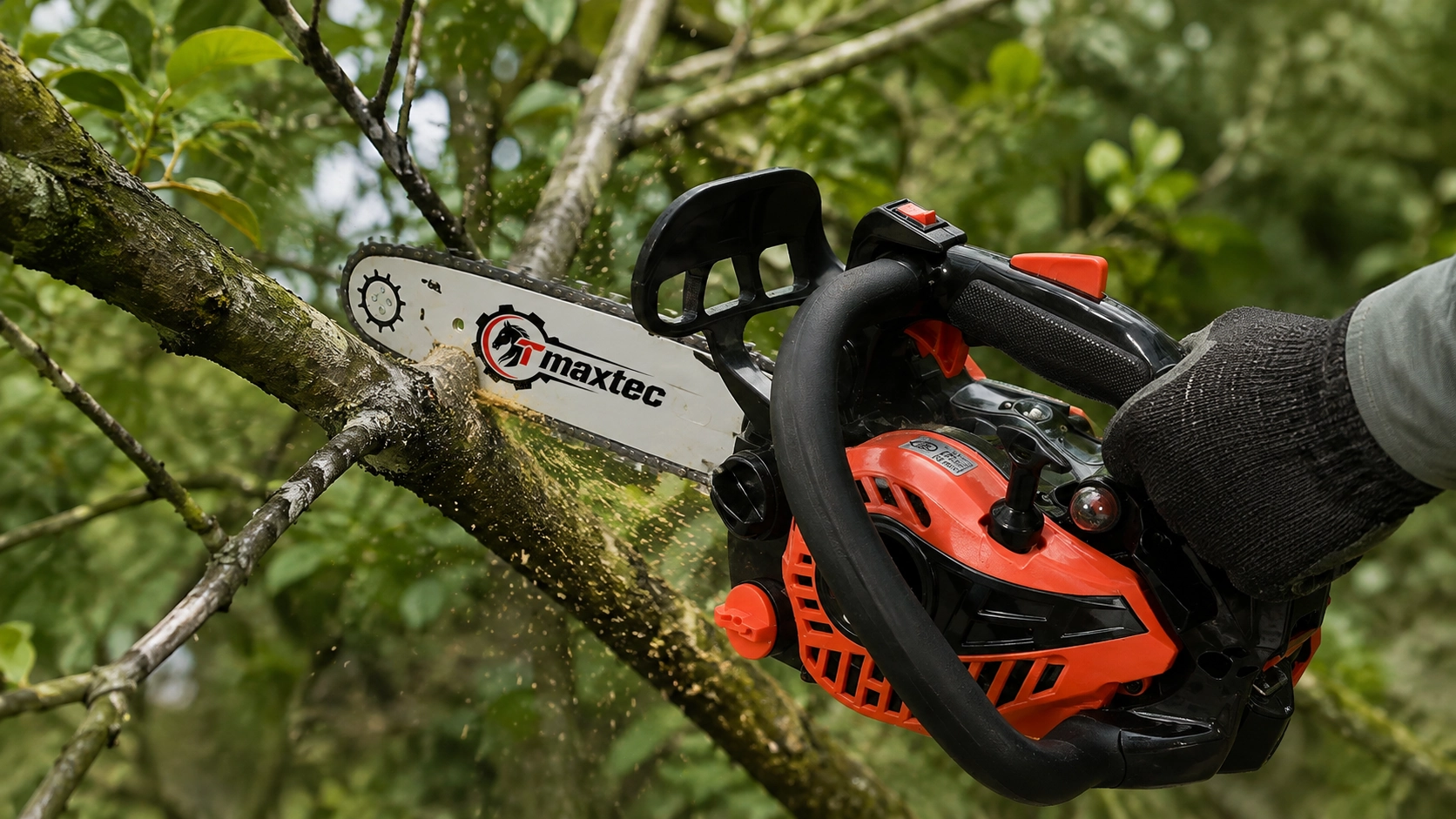
Small Chainsaw Kickback During Pruning: Causes, Checks and Dealer Safety Guide
A small chainsaw can kick back during pruning when the guide bar nose contacts another branch, when a closing cut pinches the chain and bar, or when the operator is forced into an unstable cutting position. A short guide bar and low machine weight can make a pruning saw easier to handle, but neither feature removes the possibility of sudden reactive movement.
If the saw jumps sharply toward the operator, do not treat the reaction as normal simply because the branch is small. Stop cutting and identify whether the trigger was bar-tip contact, branch tension, cutting-system condition or an unsuitable working position. For dealers, these distinctions are also important when investigating customer complaints that may otherwise be incorrectly reported as engine or clutch faults.
QUICK ANSWER
Quick answer: Kickback during pruning is most likely when the upper area of the guide bar nose touches wood unexpectedly, when branch tension closes the kerf around the guide bar, or when the operator reaches into a cut without stable two-hand control. First check the path of the entire guide bar, not only the intended cutting point. If cutting behavior has recently changed, inspect chain tension, sharpening, guide bar condition and component compatibility. Importers supplying compact pruning saws should confirm the intended branch size, bar-and-chain configuration and replacement cutting parts before quotation.
1. Identify Which Pruning Situation Triggered the Reaction
The direction and timing of the saw's movement provide useful diagnostic information. A sudden physical reaction should be investigated differently from an engine that loses speed or a chain that stops driving under load.
| Observed Situation | Likely Area to Check | Practical Response |
| Saw jumps sharply during contact | Guide bar nose and surrounding branches | Check for unintended nose contact before making another cut. |
| Bar becomes trapped deeper in the cut | Branch load and closing kerf | Stop forcing the saw and reassess how the branch is supported. |
| Operator must reach to make the cut | Working position and two-hand control | Change position instead of using the bar tip to reach. |
| Engine bogs as chain enters wood | Engine performance or cutting resistance | Treat this as an under-load power problem rather than kickback alone. |
| Engine revs but chain stops | Chain tension, clutch, sprocket or drive resistance | Inspect the cutting and drive system instead of adjusting pruning technique only. |
2. Keep the Guide Bar Nose Away From Unintended Contact
Rotational kickback is strongly associated with contact around the upper part of the guide bar nose. Pruning creates particular difficulty because branches are often close together and the operator may be concentrating on one branch while another sits directly behind or beside it.
Bar-tip contact can occur when:
- the guide bar is inserted between closely spaced branches;
- a second limb is hidden behind the intended cutting point;
- the nose reaches the wood before the intended working section of the chain;
- foliage prevents the operator from seeing the complete guide bar;
- the saw is pushed into a narrow branch junction.
Before each cut, consider where the entire guide bar will move. A compact guide bar may fit into a restricted area more easily, but restricted space can also place the nose closer to surrounding wood.
3. Watch Whether Branch Tension Is Closing the Cut
Pruning a supported branch is different from cutting a loose log. A branch may carry its own weight, support additional limbs or be bent under tension. As the cut becomes deeper, the load acting on the remaining wood changes.
The kerf may begin to close around the guide bar. If the bar or chain becomes pinched, the operator can experience an unexpected pull, push or other reactive movement depending on where the chain is trapped.
| Cut Appears to Stay Open
Continue observing branch movement and maintain a stable cutting position. Do not assume the branch will remain stationary as the remaining fibers become thinner. |
Cut Begins Closing Around the Bar
Do not force the chainsaw deeper. Stop and reassess the support, branch load and cutting sequence before continuing. |
Branches under significant tension may also spring, rotate or drop when the final fibers separate. If the direction is difficult to predict, applying more throttle is not the solution. A different cutting sequence or working method may be required.
4. Do Not Use a Compact Chainsaw as a One-Hand Pruning Tool
Small gasoline chainsaws are attractive for orchard, farm and garden work because operators may need to move frequently between trees and make repeated smaller cuts. That portability should not change the basic requirement for stable control.
Using the end of the guide bar to reach a branch increases risk in two ways. It brings the kickback-sensitive nose closer to the wood and usually places the operator's arms and body in a weaker position.
Move your body position instead of extending the chainsaw toward a difficult branch. The branch should be visible, the guide bar should have adequate clearance and both hands should remain on the designated handles while cutting.
- you need to remove one hand from the saw to reach the branch;
- you need to lean from a ladder while cutting;
- the branch is above shoulder height;
- the bar nose disappears behind leaves or surrounding limbs;
- your body would be directly in the likely path of the guide bar.
5. Inspect the Chain When the Saw Becomes Harder to Control
If kickback-like reactions have become more frequent even though the pruning method has not changed, inspect the cutting system before continuing. A dull chain does not automatically create kickback, but poor cutting can encourage the operator to push harder and reduce control of the guide bar.
Check whether the chain is:
- Correctly tensioned according to the chainsaw instructions.
- Installed in the correct cutting direction.
- Sharpened evenly rather than having noticeably different cutter conditions around the chain.
- Free from damaged cutters or drive links.
- Matched with the actual guide bar and drive system.
Avoid changing cutter geometry or depth gauges by guesswork. Incorrect sharpening or excessive depth-gauge removal can change how aggressively the cutters engage the wood.
For the TM-CS2511, the listed chain pitch is 3/8 inch. Replacement chain selection should not be based on pitch alone. Compatibility also depends on the actual guide bar, sprocket and chain configuration supplied with the machine.
6. Watch the Final Part of the Cut, Not Only the First Contact
The highest-risk moment is not always when the chain first enters the branch. As the cut approaches completion, the remaining fibers may stop supporting the branch and the load can change immediately.
Before the branch separates, consider:
- whether the branch will drop, rotate or spring away;
- whether its weight is opening or closing the kerf;
- whether another branch could contact the bar after separation;
- where the guide bar will travel when cutting resistance suddenly disappears;
- whether the operator is standing beneath the section that may fall.
Do not simply accelerate through the final fibers. The branch may move at the same moment that resistance disappears, leaving less time to control the saw.
7. TM-CS2511 Compact Gasoline Chainsaw for Pruning-Oriented Applications
8. Dealer Inspection and Procurement Checklist
For importers and distributors, a compact chainsaw should be evaluated as a complete cutting system rather than by engine displacement alone. This is particularly important when the machine is being supplied for orchard or pruning-oriented markets.
| Before Ordering | Dealer / After-Sales Check |
|
|
For repeat orders, the actual guide bar and chain configuration should be confirmed in the quotation or proforma invoice rather than assuming that every production batch will use exactly the same cutting setup.
9. When the Chainsaw Should Be Inspected Before Further Use
Stop using the chainsaw if a reactive movement is followed by a mechanical change that was not present beforehand. Continuing to cut after a severe impact can turn a pruning-technique problem into a cutting-system or safety-component problem.
Inspect before restarting if you find:
- a damaged or bent guide bar;
- damaged chain components;
- abnormal chain looseness;
- a chain that no longer runs correctly in the bar groove;
- visible damage around the front handle or controls;
- unusual vibration after a sudden impact;
- cutting behavior that changed sharply after the kickback event.
If the chainsaw is equipped with a chain brake or other protective components, inspect and maintain them according to the actual model instructions. Damaged safety-related parts should not be ignored.
FAQ About Small Chainsaw Kickback During Pruning
Why does my small chainsaw kick back when pruning branches?
Common triggers include contact around the guide bar nose, a branch closing the cut around the bar, or an unstable working position that makes it difficult to control the saw. Check the cutting position before assuming the engine is responsible.
Does a shorter chainsaw bar reduce kickback risk?
A shorter guide bar can make a compact saw easier to position, but it does not eliminate kickback. The bar nose can still contact surrounding wood, especially when pruning between closely spaced branches.
Can a dull chainsaw chain cause kickback?
A dull chain does not automatically cause kickback, but it can make the operator push harder to maintain cutting progress. That extra force can reduce control and move the guide bar into an unsafe position. Chain condition should therefore be checked whenever cutting behavior changes.
Why does the guide bar get pinched while pruning?
A branch may be carrying weight or stored tension. As wood is removed, the kerf can close around the guide bar. If you see the cut closing, stop forcing the saw and reassess branch support and the cutting sequence.
Is the TM-CS2511 suitable for pruning work?
The TM-CS2511 product information lists pruning among its intended applications and specifies a 25.4cc engine, 0.9kW rated output, 10-inch or 12-inch guide bar options and a listed weight of 3.0kg. Actual suitability still depends on branch dimensions, wood condition and working position.
What should importers confirm when ordering replacement chains for a compact pruning chainsaw?
Do not purchase replacement chains from pitch alone. For the TM-CS2511, the listed pitch is 3/8 inch, but the complete chain should be matched to the actual guide bar, sprocket and cutting-system configuration supplied with the order.
|
Compare the TM-CS2511 for Pruning-Oriented Markets Small chainsaw kickback during pruning is mainly a cutting-position and reactive-force issue rather than a simple question of engine size. For wholesale evaluation of the TM-CS2511, confirm the intended branch range, 10-inch or 12-inch guide bar configuration and compatible replacement chain system together before quotation. |
|