
Why Does a Push Lawn Mower Scalp Uneven Areas of the Lawn?
A push lawn mower can scalp uneven lawn when the cutting height is too low, wheels drop into dips, or the deck tilts. Check these causes before mowing again.
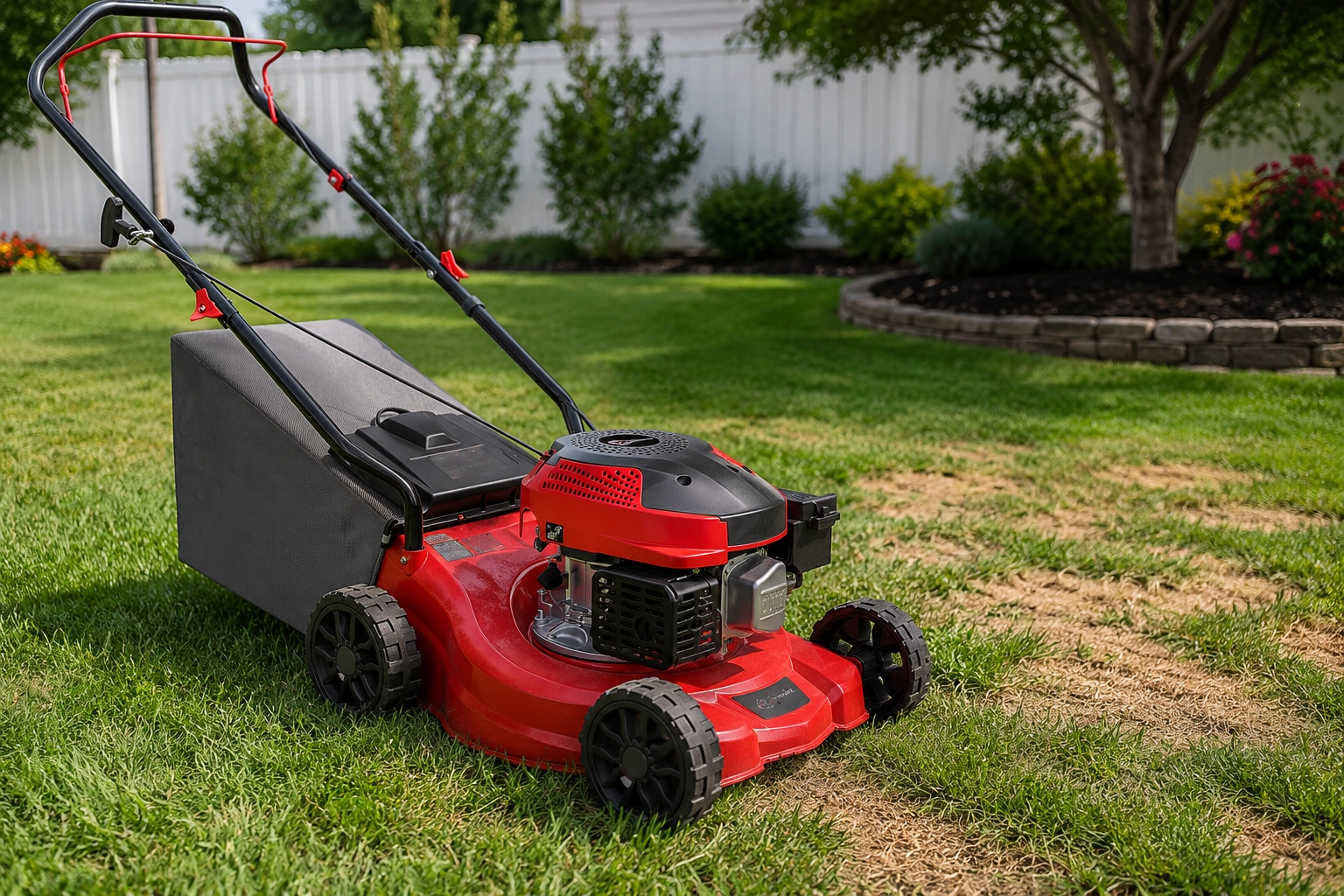
Push Lawn Mower Scalping Uneven Lawn: Causes, Checks and Fixes
A push lawn mower scalping uneven lawn areas usually has a deck-clearance or terrain-following problem rather than an engine-performance problem. If isolated patches are being cut almost down to the soil while most of the lawn remains at the expected height, check the cutting-height setting, wheel movement and ground contour before looking at engine power.
The useful distinction is between scalping and missing grass. Scalping means the blade cuts excessively low in specific locations. Uncut strips, weak cutting under load or generally poor mowing performance require a different diagnostic path.
| Quick Answer |
Quick answer: If a push mower scalps only certain high spots, dips or sloping areas, first raise the cutting height and watch how the wheels and deck move across the affected ground. A wheel dropping into a depression, a raised patch passing beneath the deck, fast travel over uneven terrain or an incorrect height setting can all lower the blade temporarily. If the same lawn was previously cut evenly and scalping started suddenly, inspect wheel mounting, height-adjustment components and the blade before continuing to mow. |
1. Confirm That the Lawn Is Actually Being Scalped
Before adjusting the mower, identify whether the visible problem matches true scalping. A uniformly short lawn is not necessarily being scalped. The more useful sign is a sudden local reduction in cutting height while surrounding grass remains noticeably taller.
| What You See | Likely Category | Where to Start |
| Small pale or brown patches cut much shorter | Scalping | Cutting height, terrain and wheel support |
| Soil or lower stems exposed in isolated areas | Severe scalping | Raise deck clearance and inspect the ground contour |
| Repeated short patches on the same ridge or hump | Terrain-related | Inspect the high spot and mowing direction |
| Grass remains taller in strips | Not scalping | Blade condition, overlap or cutting performance |
This distinction prevents unnecessary engine or blade work when the real problem is simply that the deck is moving too close to irregular ground.
2. Raise the Cutting Height Before Changing Anything Else
A low height setting leaves little clearance between the blade and uneven ground. A lawn that looks flat from standing height may still contain shallow depressions, compacted ridges, exposed roots or repaired areas that change the deck's position during mowing.
Simple diagnostic test
Move the mower up by one available cutting-height position and mow the same problem area again. If the scalping disappears or becomes much less severe, insufficient ground clearance was probably a major factor.
The TM400P specifies a 30–65mm cutting-height range with three positions. If scalping occurs mainly when the lowest position is selected, moving upward can provide more clearance without changing anything in the engine or drive system.
Do not choose mowing height only according to how short the finished lawn should look. Surface levelness determines how low a mower can realistically operate without contacting high spots.
3. Watch What the Wheels Do Over Dips and Raised Ground
On a hand-push mower, wheel position directly affects deck height. If one wheel drops into a depression while the other wheels remain on higher ground, the mower can tilt and bring one side of the blade closer to the turf.
This can create a scalped strip beside the low point rather than directly inside it. Move slowly across the problem area and watch the mower body from behind. A visible lean as one wheel enters the depression is a strong indication that terrain is controlling the effective cutting height.
The TM400P is specified with 6-inch front and rear wheels and a 400mm (16-inch) cutting width. As with other fixed wheel-and-deck arrangements, a change in wheel support can temporarily change the blade's relationship to the ground.
| Wheel Drops Into a Dip
The mower tilts because one wheel loses height. Scalping may occur on the lower side of the deck. |
High Spot Passes Under the Deck
The wheels may remain nearly level while raised soil or turf reaches farther upward toward the blade. |
4. Change Mowing Direction and Slow Down Over Uneven Areas
The angle at which a mower crosses a ridge, depression or gradual slope affects how many wheels remain supported at the same time. Crossing a narrow rise directly may lift the front wheels first and change the deck angle more sharply than approaching the same feature diagonally.
If one section repeatedly scalps, mow it from another direction during the next session. A significant change in the result suggests that the contour of the lawn is influencing deck movement.
Forward speed matters as well. Pushing quickly across rough ground can make the mower pitch or bounce as its wheels transition between different levels. Reduce walking speed before a known irregularity and let the wheels follow the terrain instead of forcing the deck rapidly across it.
5. Check Height Adjustment and Wheel Condition on Flat Ground
Terrain should not be blamed automatically. A mower that sits unevenly even on a suitable flat surface may have a height-adjustment or wheel-support problem.
After stopping the engine and disconnecting the spark plug according to the normal service procedure, inspect:
- Height-position engagement: confirm the selected setting is fully engaged rather than partially between positions.
- Deck attitude: place the mower on flat ground and check whether one side visibly sits lower.
- Wheel play: look for unusual sideways movement.
- Wheel hubs: inspect for visible damage.
- Mounting hardware: check for obvious looseness.
- Wheel alignment: compare whether the wheels sit at visibly different angles.
- Wheel rotation: investigate a wheel that does not rotate normally.
For the TM400P, the specification states three cutting-height positions across the 30–65mm range. The actual selected position should therefore be confirmed before moving to more complicated causes.
6. Inspect the Blade if Scalping Started Suddenly
If the lawn surface has not changed and the same mowing height previously produced an even result, inspect the cutting system. A damaged or incorrectly installed blade can alter the effective cutting path.
This check becomes particularly important when the problem starts immediately after the mower hits a stone, root, curb or another hard obstruction.
| Inspection Point | What Changes the Diagnosis |
| Visible blade deformation | Stop using the mower until the damaged cutting component is addressed. |
| Abnormal blade mounting | Confirm installation according to the actual mower configuration. |
| Scalping begins after an impact | Give the blade and mounting system priority over terrain diagnosis. |
Stop the engine, disconnect the spark plug and wait for all moving parts to stop before working near the blade. A severely damaged blade should not simply be straightened and returned to service.
7. TM400P Application Fit for Level and Uneven Lawns
|
TM400P Hand-Push Petrol Lawn Mower For buyers comparing push mowers for residential gardens and similar lawn applications, the TM400P combines a 400mm (16-inch) cutting width with a 30–65mm three-position cutting-height system and 6-inch front and rear wheels. It uses a 130cc 4-stroke OHV TM130V engine with listed output of 2.2kW / 3.0hp. Those engine specifications relate to cutting performance under load, but they do not prevent scalping caused by insufficient deck clearance or irregular terrain. |
|
A wider or more powerful mower does not automatically solve uneven-lawn scalping. The usable mowing height still depends on deck clearance, wheel support and how smoothly the surface changes beneath the mower.
8. Importer and Dealer Audit for Uneven-Lawn Applications
Dealers should discuss lawn condition together with cutting-height range. Customers maintaining relatively level residential turf have different requirements from customers mowing rough yards, orchard ground or poorly graded surfaces.
01 — Target lawn condition: Clarify whether customers normally mow level turf, slightly uneven gardens, rough yards or orchard-style ground.
02 — Cutting-height expectations: Do not present the lowest available setting as the normal choice for every lawn.
03 — Height adjustment: Confirm that all intended positions engage correctly before shipment or dealer delivery.
04 — Wheel support: Inspect wheel mounting and obvious play where deck level depends directly on wheel position.
05 — Blade condition: Explain that sudden scalping after an impact requires cutting-system inspection.
06 — User guidance: Dealers should be able to explain slower travel and alternative mowing directions on irregular ground.
07 — Application fit: Match the 30–65mm cutting-height range with the surface conditions expected in the target market.
08 — Replacement components: Confirm wheel, blade and adjustment-related replacement-part compatibility for the actual order configuration.
09 — Repeat orders: Confirm final configuration according to the actual specification and order rather than assuming every production batch uses identical components.
FAQ About Push Lawn Mower Scalping
Why does my push lawn mower scalp only certain parts of the lawn?
Those locations may contain high spots, shallow dips or slope transitions that temporarily move the deck closer to the ground. Raise the cutting height and observe how the mower wheels move across the affected area.
Can a mower wheel cause lawn scalping?
Yes. If one wheel drops into a depression or has excessive play, one side of the deck can move lower. A damaged or incorrectly supported wheel may also cause scalping on ground that was previously cut evenly.
Will raising the mower stop scalping on uneven ground?
It can reduce scalping by increasing blade clearance above small ground irregularities. For the TM400P, the specified cutting-height range is 30–65mm with three positions, so moving upward one position is a practical first test.
Why did my mower suddenly start scalping a lawn it previously cut evenly?
If the terrain and height setting have not changed, inspect wheel mounting, height-adjustment engagement and the blade. A sudden change after striking a root, stone or curb makes cutting-system inspection particularly important.
Does more engine power prevent lawn mower scalping?
No. Engine output affects performance under cutting load, while scalping on uneven ground is normally more closely related to deck clearance, wheel position and terrain shape. The TM400P's 130cc TM130V engine and 2.2kW / 3.0hp listed output do not remove those terrain effects.
What should importers check when selecting a push mower for uneven lawns?
Compare the cutting-height range, wheel arrangement, cutting width and intended lawn conditions together. For TM400P orders, the 30–65mm three-position system, 400mm cutting width and hand-push configuration are more directly relevant to scalping risk than comparing engine displacement alone.
|
Match Mowing Height to the Lawn, Not Just the Engine A push lawn mower scalping uneven lawn usually points to insufficient deck clearance, wheel movement across a depression, a raised section beneath the deck or a mechanical change in the wheel or blade system. For importers considering the TM400P, evaluate its 30–65mm cutting-height range, 400mm deck width and hand-push layout against the actual terrain conditions in the target market before quotation. |
|