
What Should Importers Check in a Knapsack Brush Cutter Supplier?
Evaluate a knapsack brush cutter supplier by backpack structure, drive-system checks, engine configuration, spare parts, and dealer handover needs.
What Should Importers Check in a Knapsack Brush Cutter Supplier?
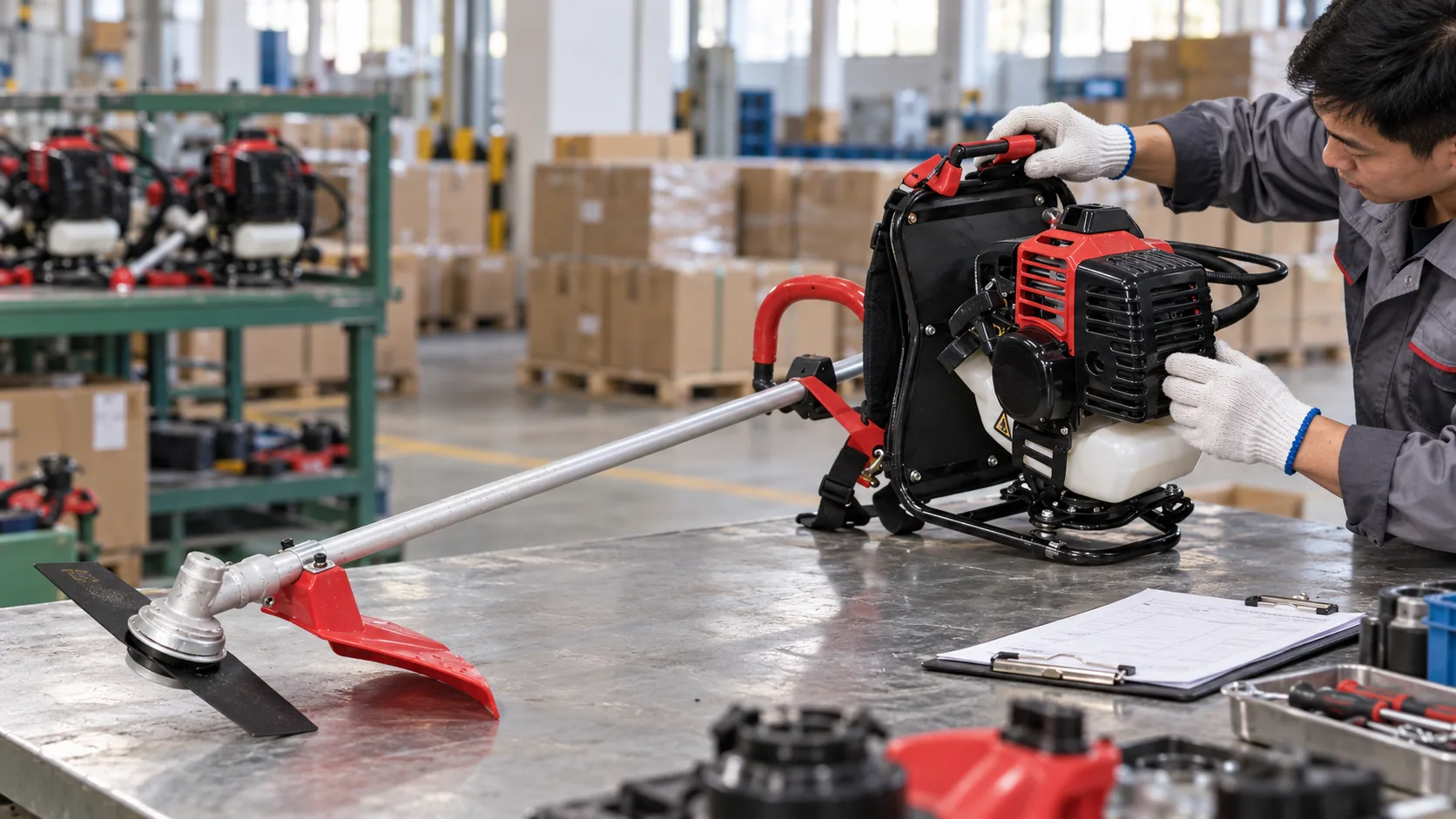
A knapsack brush cutter supplier should be evaluated differently from a supplier offering only conventional side-mounted machines. On a knapsack model, the engine is carried on the operator's back while power must still reach the cutting attachment through a separate transmission path. That means the backpack assembly, drive connection, engine specification and lower cutting system need to work as one complete machine.
For importers comparing a 52cc knapsack brush cutter, displacement alone is not enough. A sample can start normally and still create dealer problems if the backpack fit, flexible drive connection, service-parts identification or operating documentation does not match the approved configuration.
| Quick Answer |
Quick answer: evaluate a knapsack brush cutter supplier by checking whether the engine, backpack frame, flexible drive, shaft controls, cutting attachment and spare parts are supplied as one consistent system. For a 52cc model, verify the exact engine code and displacement rather than approving the machine only by its “52cc” description. The sample should be tested while worn and cutting, not only while idling on a bench. Before bulk production, record the approved engine, backpack assembly, transmission components, cutting setup and replacement-parts references in the order documents. |
Why Knapsack Structure Changes Supplier Evaluation
With a conventional brush cutter, the engine and shaft form a more direct rigid assembly. A knapsack machine separates the engine carried on the operator's back from the cutting end, adding another working section between the engine and cutting attachment.
The supplier therefore needs to confirm more than the gasoline engine and shaft. The backpack frame, shoulder straps, drive connection, throttle-control routing and lower cutting components must operate correctly together.
The backpack arrangement can reduce the amount of engine mass supported directly by the operator's arms, but it does not automatically make every machine more comfortable. Strap adjustment, machine weight, engine position, transmission flexibility and terrain all affect actual working feel.
| Supplier Audit Point | What to Inspect | Why It Matters |
| Backpack assembly | Frame, straps, engine mounting and adjustment | Affects fit and movement during operation |
| Drive system | Flexible connection, end fittings and routing | Transfers power while the operator moves |
| Working shaft | Handle, throttle, cable routing and cutting end | Determines control during actual cutting |
| After-sales support | Model-specific service parts and component codes | Prevents incorrect replacement-part supply |
Confirm the Engine Code Instead of Approving “52cc” Alone
The TM-BG520A knapsack brush cutter is listed with a 1E44F-5 two-stroke air-cooled engine, 51.7cc displacement and rated output of 1.8kW at 6500rpm. Its listed net weight is 10.2kg and gross weight is 11.2kg.
These details provide a better procurement reference than the general description “52cc gasoline backpack brush cutter.” Before bulk production, compare the engine code and displacement across the physical sample, quotation, machine label, operating documentation and spare-parts records.
Important compatibility point
Similar displacement does not prove interchangeability. If a distributor already sells other 52cc brush cutters, ignition parts, recoil components, carburetor connections, clutch components or engine mounting arrangements should not be assumed to fit the TM-BG520A unless the confirmed configuration supports that conclusion.
Inspect the Flexible Drive System Under Real Movement
The brush cutter flexible shaft or drive connection deserves particular attention because the backpack engine and cutting shaft move relative to each other as the operator turns, bends or changes the cutting angle.
Do not inspect this section only while the machine is standing still. Fit the confirmed cutting attachment, adjust the backpack correctly and move through a normal cutting range while observing the transmission path.
- Check whether the drive connection is forced into an unusually tight bend.
- Observe whether the outer casing rubs against the backpack frame or operator.
- Check both end connections while changing cutting direction.
- Listen for abnormal noise when the shaft is moved through different positions.
- Observe whether unusual vibration appears only at certain shaft angles.
- Stop the engine before inspecting the cutting head, connection fittings or transmission components.
If the lower shaft develops vibration only when moved into certain positions, the transmission path and assembly should be inspected before treating the engine itself as the cause.
Backpack Fit Should Be Part of Sample Approval
A supplier can provide the correct engine specification while still delivering a backpack assembly that is inconvenient for the target market. The carrying system should therefore be inspected during sample approval, not after the machines reach dealers.
Before Ordering
|
Do Not Approve From Catalogue Data Alone
|
For distributors deciding whether a knapsack model belongs beside standard straight-shaft brush cutters, an actual wearing and cutting test provides more useful information than catalogue weight by itself.
Ask for Knapsack-Specific Spare Parts
Brush cutter spare parts planning for a knapsack model should extend beyond common two-stroke engine service items. The extra transmission and carrying components also need clear identification.
| Parts Area | What the Supplier Should Identify | Ordering Risk |
| Engine | Parts linked to the confirmed 1E44F-5 configuration | Ordering only by “52cc” can be too broad |
| Backpack | Straps, frame-related parts and engine mounting components | Visually similar parts may not fit |
| Transmission | Flexible drive components and connection fittings | Wrong connector or drive component can prevent assembly |
| Cutting side | Throttle components and cutting-side transmission parts | Generic brush cutter descriptions may be insufficient |
For a wholesale order, important replacement items should be associated with the exact model or confirmed component code. A backpack brush cutter supplier should also be able to distinguish which components are shared with other models and which belong specifically to the knapsack structure.
Do Not Copy Fuel Instructions From Another 52cc Machine
The TM-BG520A uses a two-stroke engine, but importers should confirm its applicable fuel and lubrication instructions from the approved manual, machine label and order documents. A fuel ratio should not be copied automatically from another 52cc brush cutter.
This becomes particularly important when a distributor carries several similar gasoline models. Machines with comparable displacement can still use different engine versions or market-specific configurations.
Before shipment, the machine label, carton information and operating instructions should communicate the same engine identification and operating requirements. If the engine or related configuration changes for an order, the documents should be checked again before production is released.
Use a Cutting Test to Separate Engine Problems From Drive Problems
A gasoline backpack brush cutter should not be approved only because the engine starts and accelerates without cutting grass. A load test helps separate engine behavior from transmission-side behavior.
| Observed Symptom | First Area to Review | Reason |
| Engine runs normally but cutting becomes intermittent | Transmission path and cutting-side components | Power may not be reaching the attachment consistently |
| Engine itself loses speed under load | Engine-side diagnosis | The problem may not originate in the drive system |
| Vibration changes with shaft position | Flexible drive routing and connections | Relative movement can affect the transmission path |
Treating every cutting complaint as a carburetor or engine problem can lead to unnecessary adjustment or replacement. A knapsack machine adds another mechanical section that should be included in dealer troubleshooting.
Product Reference for Wholesale Evaluation: TM-BG520A
|
TM-BG520A Knapsack Brush Cutter Engine: 1E44F-5, two-stroke, air-cooled Displacement: 51.7cc Rated output: 1.8kW at 6500rpm Listed net / gross weight: 10.2kg / 11.2kg Relevant for farm grass cutting, garden maintenance and field clearing where a knapsack configuration matches local user habits and working conditions. |
|
This model is most useful as a supplier-evaluation reference when the importer checks the entire machine rather than comparing only the 52cc category. The approved backpack structure, drive system and service-parts arrangement should remain linked to the selected configuration.
Importer / Dealer Bulk Order Checklist
- Record the exact model: identify TM-BG520A rather than ordering only a generic 52cc knapsack machine.
- Verify engine identification: compare the 1E44F-5 engine code with the quotation, sample and service records.
- Confirm displacement and output: record 51.7cc and 1.8kW at 6500rpm in the approved specification.
- Inspect backpack fit: test frame security, strap adjustment and control access with the machine worn.
- Check flexible drive movement: observe bending, routing, rubbing, vibration and end connections during operation.
- Approve the working shaft: verify handle position, throttle routing and cutting-side stability.
- Confirm the cutting attachment: test the actual attachment included in the wholesale order.
- Record model-specific spare parts: separate engine, backpack, transmission and cutting-side parts where necessary.
- Check fuel instructions: make sure manual, label and order documents agree for the selected configuration.
- Run a loaded cutting test: do not approve the sample only from starting and no-load acceleration.
- Match the machine to dealer customers: confirm that local users actually need a knapsack layout.
- Prepare dealer handover information: explain adjustment, assembly and drive-system handling before first use.
- Freeze the bulk-order setup: compare production specifications with the exact sample that passed inspection.
Engine, accessories, branding, packing and other available configurations may vary depending on the confirmed order. Final specifications should therefore be written into the quotation or proforma invoice rather than assumed from a general product description.
Frequently Asked Questions
What should importers check in a knapsack brush cutter supplier?
Check the engine specification, backpack frame, strap adjustment, flexible drive system, shaft controls, cutting attachment, documentation and model-specific spare-parts support as one complete configuration.
Is the TM-BG520A exactly 52cc?
The TM-BG520A is listed with a 1E44F-5 engine and actual displacement of 51.7cc. The 52cc description is a product category reference and should not replace the confirmed technical value.
Why is the flexible drive important on a gasoline backpack brush cutter?
It transfers power between the backpack engine and cutting shaft while the operator moves. Routing, bending, connection security and vibration should therefore be checked during real working movement.
Can 52cc brush cutter spare parts be shared between different models?
Not automatically. Similar displacement does not confirm compatibility. Engine code, mounting arrangement, transmission components and service-part references should be checked for the exact model.
Should importers test a knapsack brush cutter under load?
Yes. The sample should be warmed up and tested with the confirmed cutting attachment so the importer can observe both engine behavior and transmission-side response during actual cutting.
What should a wholesale brush cutter supplier keep consistent for repeat orders?
The approved engine, backpack assembly, transmission components, cutting configuration, operating documentation and spare-parts references should remain consistent with the confirmed order unless a change is agreed and documented.
|
Evaluate the Complete Knapsack Configuration Before Ordering For importers searching for a knapsack brush cutter supplier, the important question is not simply whether a factory can offer a 52cc backpack model. Confirm whether the engine, backpack structure, flexible drive system, cutting components, documentation and spare parts can remain consistent from the approved sample through bulk production and dealer delivery. |
|