
Plastic Deck Lawn Mowers: What Should Importers Inspect?
Plastic deck lawn mower inspection should cover mounting points, deck clearance, wheel alignment and packing support before importers approve a bulk order.
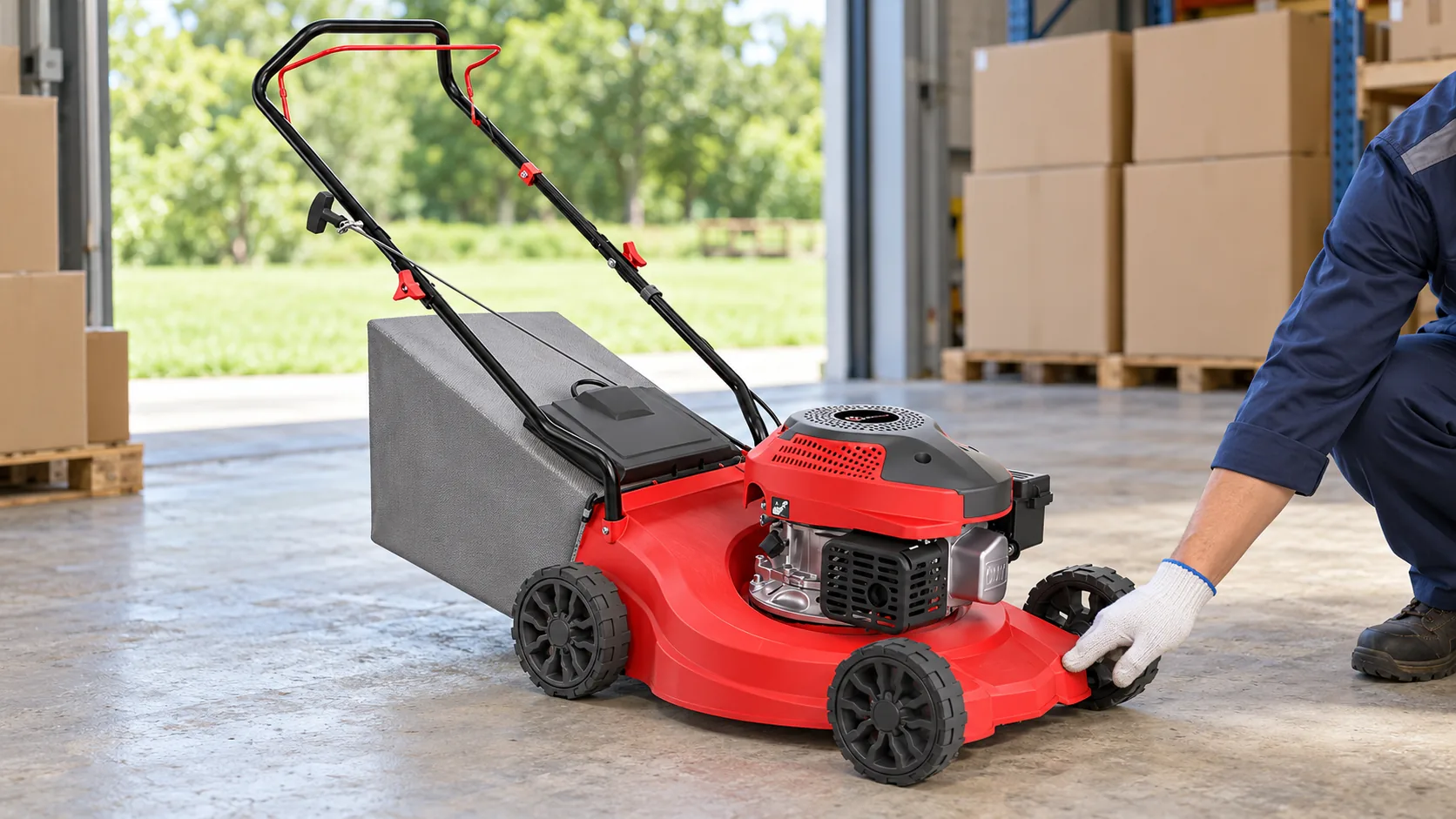
Plastic Deck Lawn Mower Inspection: What Importers Should Approve Before Shipment
A plastic deck lawn mower inspection should establish how the assembled deck supports the engine, wheels and handle, maintains the required clearances and receives protection during shipment. A clean surface and an engine that starts do not establish that the deck assembly is ready for bulk approval.
For importers supplying dealers, the objective is a defined production configuration that can be inspected consistently. Material claims need supporting specifications, mounting details need an approved reference, and packing needs to protect the assembly. This guide concerns sample approval and shipment inspection, rather than uneven-cut repairs or mowing-height selection.
Quick answer: Approve the complete plastic-deck assembly, not just its appearance or material name. Request the quoted material specification, inspect engine, wheel and handle mounting areas, and verify deck geometry and cutting-system clearances against the manufacturer’s criteria. Follow a satisfactory static inspection with an agreed operating demonstration and a post-run examination. Review internal packing separately, since sample assembly does not prove transport protection. For the TM400P, retain the deck reference alongside the specified engine, wheels and height-adjustment configuration. Keep unresolved structural or clearance concerns open until the supplier provides an assessment and an acceptable result.
Define What “Plastic Deck” Means in the Quotation
The TM400P hand push petrol lawn mower lists a plastic deck and a 400mm cutting width. Neither detail identifies the polymer, reinforcement, wall thickness or resistance to impact and weathering. Cutting width also does not describe the deck’s external dimensions or structural design.
Ask the supplier to identify the material used for the quoted production configuration. Where reinforcement, recycled content, impact performance or UV resistance forms part of the offer, request the corresponding specification or test evidence. Do not transfer claims from another plastic mower deck into this model’s dealer literature.
Keep the material specification separate from approval of the finished component. A resin description alone does not establish that the assembled deck meets the agreed requirements. Retain the deck reference, material details and inspection criteria together.
An unsupported plastic-versus-steel ranking adds little to this decision. Assess the selected deck design against its intended service conditions and the evidence available for it.
TM400P: A Defined Sample for Importer Approval
The TM400P is relevant to this inspection because its specified plastic deck can be reviewed as part of an identified hand-push petrol mower assembly. Approval should connect the deck to the following configuration:
- Cutting width: 400mm.
- Engine: TM130V, 130cc, four-stroke OHV.
- Wheels: 6-inch front and 6-inch rear.
- Height adjustment: three positions within a 30–65mm cutting-height range.
For bulk purchasing, use these details to identify the sample and request its deck material, mounting and clearance documentation. They do not independently establish structural performance or transport protection.
| Review the TM400P Assembly |
Inspect the Mounting Areas That Carry the Assembly
Engine, wheel and handle mounting areas deserve closer attention than broad cosmetic surfaces. Examine them on the assembled sample and compare their condition with the supplier’s drawings or approved reference photographs.
Look for visible cracks, damaged holes, incomplete seating, unusual gaps and distortion around fasteners. Where the design specifies inserts, brackets, washers or reinforcing parts, confirm their presence and position. Different mounting points may use different reinforcement methods.
The TM400P’s TM130V 130cc four-stroke OHV engine should be identified in the approval record alongside the deck. An engine substitution should trigger a review of the mounting arrangement and associated clearances. Obtain the fastening instructions: torque, sequence and hardware must follow the approved design, rather than an inspector tightening parts by feel.
Check that the handle sits in its intended assembled position and uses the specified mounting components. A handle that looks straight while unloaded may still reveal an assembly problem during a controlled pushing demonstration.
Establish Deck Geometry and Clearance Before Running
Place the assembled mower on a flat inspection surface. Confirm that the wheels sit as intended, the deck is not visibly twisted and no wheel rubs against the body. Determine whether an irregularity comes from the deck or from an incorrectly fitted wheel, axle or adjustment component before assigning the defect.
Use the specified 6-inch front and rear wheels as the TM400P reference. Photographs or assembly expectations from a mower with larger rear wheels are unsuitable for this comparison. Check all three height-adjustment positions within the 30–65mm range for secure location and consistent assembled geometry.
Blade-to-deck clearance requires the manufacturer’s inspection procedure. Stop the engine, let it cool and prevent accidental starting as instructed before examining the cutting system. Never reach underneath a running mower or improvise a powered test to investigate suspected contact.
If dimensions or clearance limits are unavailable, request them before setting pass-or-fail criteria. A visual estimate must not become an undocumented production standard.
Plastic Deck Lawn Mower Inspection: Resolve These Findings Before Approval
- Visible mounting damage: Record the location and obtain the supplier’s assessment against the approved component reference.
- Wheel rubbing or uneven stance: Check wheel, axle and adjustment assembly before concluding that the deck is distorted.
- Unclear blade clearance: Obtain the specified limit and checking method before any operating demonstration.
- Missing reinforcement or different hardware: Compare with the approved drawing and resolve the configuration difference before release.
Use the Demonstration to Detect Changes in the Approved Assembly
After the static inspection passes, a trained operator can perform the agreed demonstration under the model’s operating instructions. Define the setup, ground conditions and observations beforehand so the supplier and importer assess the same behaviour.
Observe mounting security, rubbing, abnormal movement and contact. Investigate new noise rather than automatically attributing it to the plastic deck; a loose attachment or another component may be responsible.
After shutdown, re-examine the recorded mounting points using the safe inspection procedure. Compare them with the pre-run photographs. A successful cutting demonstration does not override a new crack, displaced mounting component or unresolved clearance concern.
If the intended market requires drop, impact or extended operating tests, agree on the method, conditions and acceptance criteria first. Do not invent a test load, drop height or duration. Record the scope accurately: one sample demonstration does not establish service life.
Review Internal Packing Around the Deck and Its Attachments
An approved assembled sample does not establish that production units will arrive in the same condition. Review how the mower is supported inside the carton and identify places where movement or concentrated contact could affect the deck.
Check separation of loose accessories and whether folded or detached parts can press against the body. Assess wheel and handle protection together with deck protection, since damage at their mounting points may not be visible from the outside of the carton.
Where dealers complete assembly, inspect the unpacking instructions and supplied hardware. The mounting order, component positions and removal of protective packing should be clear. Retain photographs of the approved internal arrangement; carton artwork approval alone does not establish protection.
Any proposed packing test should reflect the agreed shipping arrangement. An unsupported claim that a carton suits every route is not an inspection criterion.
Release the Order With a Usable Deck and Service Reference
Obtain a replacement-deck reference and identify the mounting components included with it. Engine holes, wheel attachments, handle brackets and other interfaces must match the supplied production configuration. A 400mm cutting width alone is not a replacement-part identifier.
Dealer guidance should require removing the mower from service when the deck shows cracks, deformation or suspected cutting-system contact, followed by the manufacturer’s assessment. Do not prescribe adhesive repairs or additional drilled fasteners without an approved repair procedure.
| Importer / Dealer Checklist | Evidence retained for release |
| 1. Identify the deck | Approved deck reference and quoted material specification |
| 2. Verify material claims | Supporting specification or test evidence for any offered reinforcement, recycled content, impact or UV properties |
| 3. Confirm the engine pairing | TM130V, 130cc, four-stroke OHV configuration and reviewed mounting arrangement |
| 4. Verify mounting components | Drawings or reference photographs, specified hardware and fastening instructions |
| 5. Check assembled geometry | Flat-surface observations using the 6-inch front and rear wheel configuration |
| 6. Check adjustment and clearance | Results for all three adjustment positions and the manufacturer’s blade-clearance criteria |
| 7. Record the demonstration | Agreed conditions, observations and pre-run/post-run mounting photographs |
| 8. Approve internal packing | Packed-sample photographs showing support and separation of loose or folded parts |
| 9. Prepare dealer assembly and service | Unpacking instructions, hardware list, replacement-deck reference and included mounting parts |
FAQ: Approving a Plastic-Deck Mower for Dealer Supply
What does “plastic deck” establish in a mower specification?
It identifies the stated deck category, but not the polymer, reinforcement, thickness, impact resistance or weathering performance. Request the specification for the quoted production component.
Which areas matter most during a plastic deck lawn mower inspection?
Prioritise engine, wheel and handle mounting areas, assembled geometry, required cutting-system clearances and internal packing. Cosmetic condition alone cannot establish assembly acceptance.
Does the TM400P’s 400mm cutting width identify its replacement deck?
No. Replacement identification also requires the deck reference and matching engine, wheel, handle and other interfaces. Cutting width does not define those connections.
Should an engine substitution trigger another mounting review?
Yes. The approved TM400P sample identifies a TM130V 130cc four-stroke OHV engine. Review the mounting arrangement and associated clearances if that engine configuration changes.
Can a cutting demonstration prove deck durability?
It can reveal movement, rubbing or changes under the agreed conditions, but it does not establish service life. Any durability testing needs a defined method and acceptance criteria.
What should a dealer do when a deck has cracks or suspected blade contact?
Remove the mower from service and obtain the manufacturer’s assessment. Adhesive repairs or extra drilled fasteners require an approved repair procedure.
Request the Documents Behind the Approved SampleFor a TM400P bulk enquiry, request the deck material specification, mounting drawings, assembly instructions, inspection limits and packed-sample photographs. These records turn plastic deck lawn mower inspection into a defined approval process and give dealers a reference for receiving stock and ordering replacement parts.
|