
Are Earth Auger Bits Interchangeable Between 63cc and 71cc?
Check earth auger bit compatibility between 63cc and 71cc machines by comparing shaft connections, retaining hardware and approved drilling configurations.
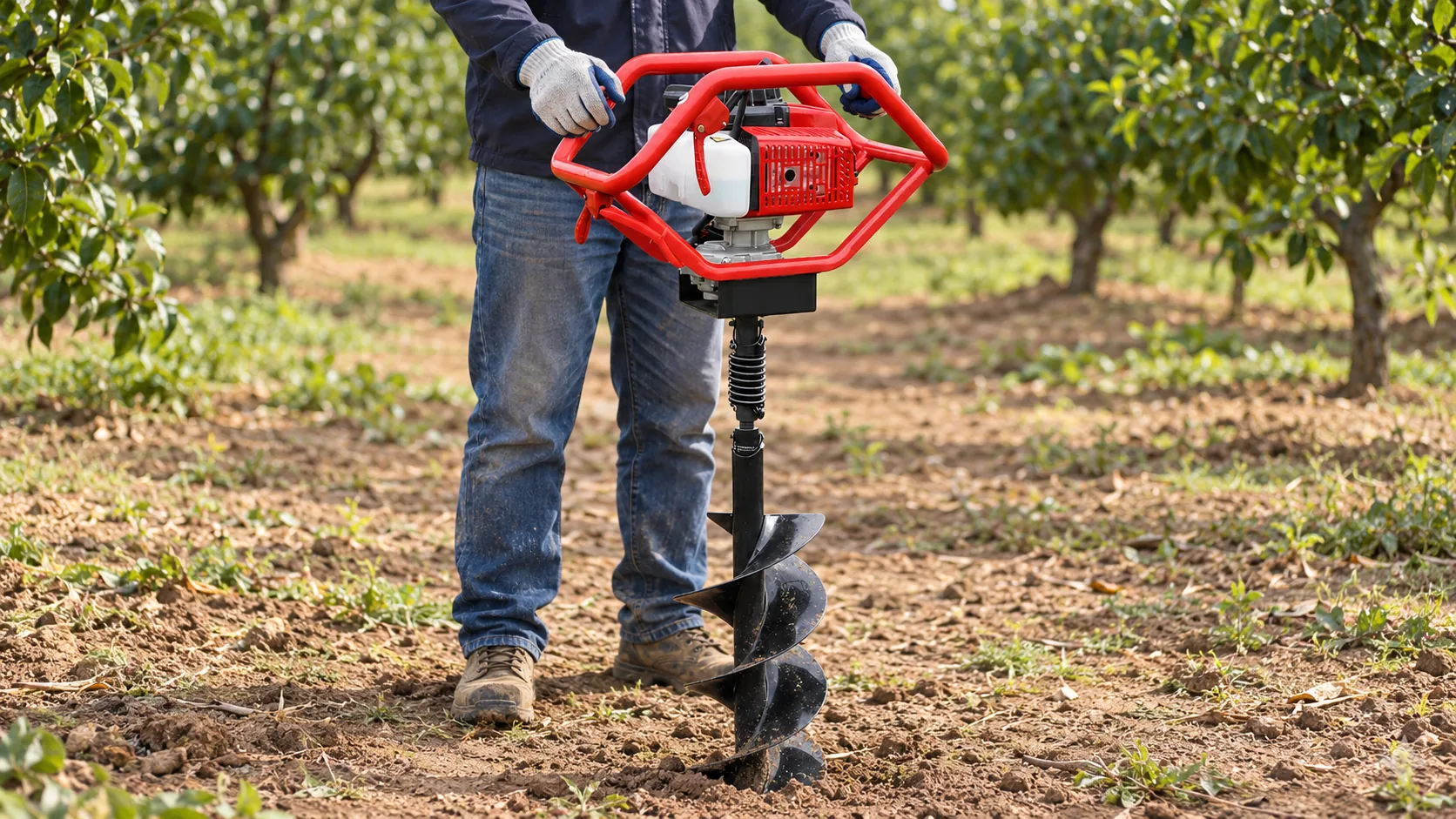
DEALER PARTS GUIDE / CROSS-MODEL COMPATIBILITY
Are Earth Auger Bits Interchangeable Between 63cc and 71cc Machines?
Earth auger bits may be interchangeable between a 63cc and a 71cc machine, but engine displacement cannot confirm the fit. The gearbox output connection, bit socket, retaining arrangement and approved operating configuration must match. A bit that slides onto the output shaft is only a candidate for compatibility.
For dealers stocking both engine classes, the useful question is whether one identified replacement bit can serve two confirmed powerheads. This guide addresses that cross-model decision, rather than choosing hole diameter or diagnosing a bit that wobbles, jams or fails to cut.
| Quick answer: |
| Earth auger bit compatibility depends on the complete connection and the approved bit configuration, not the engine’s cc rating. Compare shaft and socket profiles, dimensions, insertion depth, retaining features and specified hardware for both powerheads. Then confirm that the exact bit diameter and length are permitted on each machine. Treat any adapter as a separately documented configuration. A successful engine-off fit check screens the proposed pairing; it does not replace the manufacturer’s approval or operating validation. Until the evidence is complete, mark the replacement as unverified rather than selling it as a shared bit. |
Identify Both Powerheads Before Comparing Earth Auger Bits
Displacement describes the engine, while the bit attaches to the gearbox output. Two machines with different engine sizes may share a connection. Two machines sold under the same displacement class may use different ones.
A listing marked “63cc auger bit” therefore does not prove that the part fits every 63cc machine or a larger engine class. A supplier listing several engine sizes without identifying the connection leaves the fit unresolved.
The TM-EA710 earth auger lists a 1E50F two-stroke engine with 71cc displacement. That identifies the power unit, but it does not specify the bit socket or gearbox output-shaft dimensions. The supplied product information does not provide those connection dimensions, so a bit from a 63cc machine needs separate confirmation.
Record the exact model and confirmed configuration of the existing 63cc powerhead as well. “Fits our smaller auger” is too vague for a replacement order, particularly where a dealer has supplied more than one production configuration.
Compare the Connection Drawing, Seating Position and Retention
Request a dimensioned connection drawing or measurements from the actual components. A photograph helps identify the general shape, but perspective and scale make it a poor substitute for dimensions.
A common nominal shaft size is only one reference. The socket may accept the shaft while the retaining hole remains misaligned. A fastener may also pass through the joint without providing the specified retention.
| Connection detail | Evidence to compare | Reason to withhold approval |
| Shaft and socket | Output-shaft profile and critical dimensions against the socket’s internal profile and dimensions | A nominal size matches, but the actual mating geometry is undocumented or different |
| Insertion and seating | Required insertion depth and final seating position | The bit slides on but cannot reach the specified position |
| Retaining features | Hole size and position, where applicable, plus the specified pin, bolt, clip or other locking components | Forced alignment or an unidentified hardware substitution is needed |
| Surrounding clearance | Clearance around the installed connection under the assembly requirements | The fitted connection interferes with surrounding parts |
Judge fit against the drawing’s tolerances and the manufacturer’s assembly requirements. Do not invent an acceptable clearance because two parts appear close in size. If neither supplier can identify the required dimensions, keep the replacement unapproved until a controlled comparison is available.
Give Any Adapter Its Own Configuration and Parts Reference
An adapter adds another connection, another retention point and potentially a different assembled length. It does not automatically make two auger systems compatible.
Obtain confirmation that the proposed adapter is intended for the particular powerhead and bit. Document its connection dimensions, retaining hardware, permissible use and installation instructions together. “Universal” is not enough to establish those details.
Drilling new retaining holes, grinding the output shaft or substituting an unidentified bolt changes the connection without establishing its suitability for service. Reject workshop modifications intended to make an unconfirmed pairing fit.
Parts-counter requirement: An approved adapter needs its own reference. State whether it is required, included with the replacement bit or supplied separately, and identify the associated retention kit. This prevents a customer receiving an incomplete assembly.
Approve the Exact Diameter and Length on Each Machine
Connection compatibility establishes whether the components can be assembled correctly. It does not approve every bit that uses the same socket.
The TM-EA710 page lists optional bit diameters from 10 to 30cm and drill lengths of 80, 100, 120 and 140cm. These are configuration references, not permission to transfer any bit within those dimensions from another powerhead.
A 10cm and a 30cm bit may share an upper connection while presenting different drilling demands. An 80cm and a 140cm bit can have matching sockets but different handling and depth requirements. Approval must identify the complete bit reference, including diameter and length.
Approval for a particular 71cc configuration must not be carried backward to a 63cc machine simply because the attachment fits. Establish the permitted combination separately for each powerhead.
Product Reference: TM-EA710 Earth AugerPower unit: 1E50F two-stroke engine, 71cc displacement. For dealers evaluating shared replacement-bit stock, this model provides an identified 71cc powerhead to compare with the existing 63cc machine. The procurement focus is its actual gearbox connection and the approved bit configuration; the engine specification alone cannot settle compatibility.
|
Screen the Sample Without Forcing the Joint
Use identified sample components in serviceable condition. Worn sockets and enlarged retaining holes can make a mismatched joint appear easier to assemble, obscuring the intended fit.
Stop the engine, allow it to cool and prevent accidental starting according to the operating instructions before handling the output connection. Wear gloves when handling the bit and keep hands clear of its cutting edges.
Follow the approved installation procedure. The bit must reach its specified seating position, the retaining features must align, and the correct locking components must install without improvised modification. Reject an assembly that requires hammering, forced alignment or unexplained replacement hardware.
An engine-off fit check is a screening step. Any operating validation must follow the manufacturer’s procedure, using a cleared drilling location, suitable ground conditions and a trained operator. A drilling trial must not be used to settle an unresolved dimensional mismatch.
Control Shared-Bit Stock With a Documented Approval Record
Link one bit reference to each approved powerhead configuration and any required adapter or retention kit. Keep three outcomes distinct: approved for the identified machine, approved only with a specified adapter, and not yet verified.
Retain the connection drawing, sample identification, assembly observations and approval source. If the supplier changes the socket, retaining-hole position or locking hardware, review affected pairings before reusing the old compatibility label.
Before Ordering: Importer Checklist
|
Before Sale: Dealer Checklist
|
FAQ: Earth Auger Bit Compatibility Across Engine Classes
Can a 63cc earth auger bit fit a 71cc machine?
It may, but the cc rating does not confirm compatibility. Verify the complete connection, retention arrangement and permitted diameter and length for both identified machines.
Is a matching nominal shaft size enough?
No. Socket geometry, insertion depth, seating position, retaining-hole dimensions and specified locking hardware must also match the assembly requirements.
Does a universal adapter establish compatibility?
No. The adapter must be documented for the particular powerhead and bit, including its dimensions, retention components, permissible use and installation instructions.
Can every TM-EA710 bit option be transferred to a 63cc powerhead?
The listed 10–30cm diameters and 80, 100, 120 and 140cm lengths do not establish cross-model approval. Confirm each complete bit configuration on the exact 63cc machine.
Should a dealer drill a new hole to align the retaining pin?
No. Altering the connection to make an unconfirmed bit fit does not establish suitability for service. Resolve the mismatch through the correct component specification.
How should an unconfirmed shared bit be recorded?
Mark it as not yet verified. Keep it separate from approved pairings until the required dimensional comparison, configuration approval and validation are complete.
Send a Specific Replacement-Bit Comparison
For a TM-EA710 enquiry, provide the existing bit’s reference, connection measurements, retaining details, diameter and length, together with the exact 63cc machine it currently serves. That information lets the supplier resolve earth auger bit compatibility for the complete pairing and gives the dealer a documented basis for shared stock.
| Discuss Replacement-Bit Compatibility |