
Brush Cutter Starts but Dies on Throttle: What to Check
A brush cutter starts but dies on throttle? Check fuel mix, air flow, carburetor, spark plug and exhaust issues before replacing engine parts.
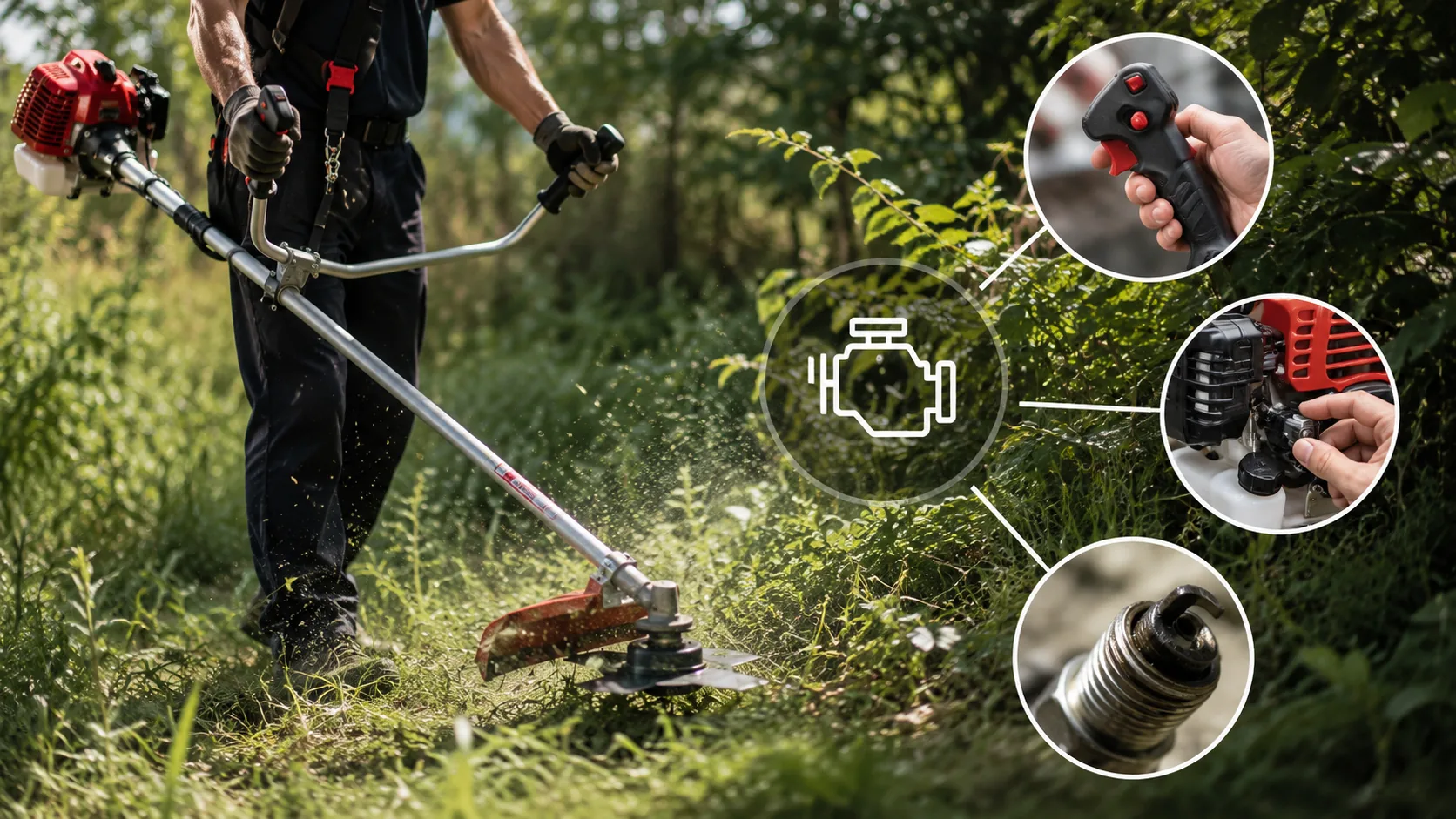
| Service Guide | Fuel System · Airflow · Ignition · Carburetor |
|
A practical fault-diagnosis and purchasing guide for operators, repair shops, garden machinery dealers and brush cutter importers. |
Inspection Order
1. Fuel and choke
2. Air filter
3. Fuel delivery
4. Spark and exhaust
5. Carburetor and leaks
|
A brush cutter that starts and idles but stops when the throttle is applied usually has a fuel-delivery, airflow or mixture problem. The most common causes are old fuel, an incorrect choke position, a dirty air filter, a restricted fuel filter, damaged fuel lines, a blocked tank vent or contaminated carburetor passages.
Start with the simple external checks before adjusting the carburetor or replacing engine components. A machine that stalls during acceleration does not automatically have a damaged cylinder, and replacing parts without testing can increase repair time and after-sales cost.
|
Quick Answer
|
Check fresh fuel, the choke position and the air filter first. If the engine runs with partial choke but dies when the choke is opened, fuel flow may be restricted or unmetered air may be entering the engine. If it accelerates briefly and then stops, inspect the fuel filter, tank vent and fuel lines. |
| ! | Safety notice: Stop using the machine if fuel is leaking, the engine is overheating or the cutting attachment moves unpredictably. Disconnect the spark plug cap before removing covers, filters or fuel-system parts. |
| 01 |
Observe Exactly When the Engine Stalls |
Start the engine using the correct procedure and allow it to warm at idle. Apply the throttle gradually instead of opening it fully in one movement. The timing and behavior of the stall can help identify which system should be inspected first.
| Observed Symptom | Most Relevant Checks |
| Dies immediately when throttle is pressed | Choke position, carburetor transition circuit and fuel supply |
| Accelerates briefly, then loses speed | Fuel filter, tank vent, fuel hose and primer system |
| Runs only with partial choke | Lean mixture, blocked fuel passage or intake air leak |
| Produces heavy smoke and hesitates | Incorrect fuel ratio, closed choke or blocked air filter |
| Runs freely but stalls while cutting | Engine output, attachment load and transmission resistance |
| 02 |
Make Sure the Choke Is Fully Open |
The choke reduces incoming air to help a cold engine start. After the engine fires, the choke must be moved toward the normal running position according to the model’s starting procedure.
Leaving the choke closed creates an overly rich mixture. The machine may idle briefly but smoke, hesitate or stall as soon as the throttle is applied.
| Cold Engine
Use the choke only as required for starting and allow a short warm-up period. |
Running Position
Confirm that the choke plate is fully open before demanding working speed. |
Linkage Check
A loose lever may appear open while the choke plate remains partially closed. |
Increase engine speed gradually after starting. Full throttle immediately after a cold start can produce hesitation even when the machine has no mechanical fault.
| 03 |
Replace Old or Incorrectly Mixed Fuel |
Fuel quality is one of the first items to inspect when a two-stroke brush cutter starts but will not accelerate. Old fuel can leave deposits inside the carburetor, while an incorrect gasoline-to-oil ratio can cause smoke, plug fouling, poor combustion or inadequate lubrication.
| The fuel has been stored for an extended period | The gasoline-to-oil ratio is unknown |
| Water, dirt or separation is visible | The machine was stored with fuel in the tank |
| Different fuel batches were mixed together | The engine smokes excessively or fouls plugs repeatedly |
Refill the tank with fresh fuel mixed according to the actual product label and manual. Do not assume that all two-stroke brush cutters use the same ratio.
| 04 |
Inspect the Air Filter Before Carburetor Adjustment |
A dirty air filter restricts the air required at higher engine speed. The brush cutter may start and idle normally but hesitate, smoke or stall when the throttle is opened.
| Filter Material
Check for dust, oil saturation, grass fragments and damaged foam or mesh. |
Installation
Confirm that the filter is seated correctly and that no gaps allow dirt to bypass it. |
| Cleaning Method
Clean or replace the filter according to its material and the machine instructions. |
Dealer Stock
Keep spare filters for markets with roadside dust, dry soil or long operating hours. |
Do not operate the brush cutter for an extended period without an air filter. Dust can enter the carburetor and cylinder, increasing wear and creating a more expensive repair.
| 05 |
Check the Fuel Filter, Fuel Lines and Tank Vent |
A two-stroke engine may idle with a limited fuel supply but stall when the throttle opens and fuel demand increases. Inspect the complete path from the tank to the carburetor.
| Component | What to Inspect | Typical Complaint |
| Fuel filter | Contamination, poor flow and incorrect position | Engine starves when speed increases |
| Fuel lines | Cracks, hardening, folds and loose connections | Air enters the system or fuel leaks |
| Tank grommet | Seal condition and line fit | Fuel seepage or unstable supply |
| Tank vent | Blocked cap valve or damaged vent hose | Machine runs briefly, then gradually stops |
A temporary improvement after slightly loosening the fuel cap may indicate a blocked vent. Use this only as a brief diagnostic test and do not continue working with an unsecured cap.
Replace damaged hoses instead of sealing them temporarily. A leaking line can admit air, interrupt fuel flow and create a fire risk.
| 06 |
Examine the Primer Bulb and Carburetor Fuel Supply |
A cracked primer bulb may draw air instead of fuel. Loose fuel connections or incorrectly routed lines can produce the same symptoms.
Press the primer bulb and observe whether fuel moves through the return line. The bulb does not need to remain completely full on every carburetor design, but it should not stay dry when fuel is available in the tank.
Possible Carburetor Faults
| Blocked internal fuel passages | Stiff metering diaphragm |
| Damaged pump diaphragm | Sticking inlet needle |
| Contamination from old fuel | Incorrect mixture adjustment |
| Loose mounting screws | Damaged mounting gasket |
Carburetor disassembly should be performed in a clean area. When replacing the complete carburetor, compare the mounting pattern, throttle linkage, choke arrangement and fuel connections rather than selecting only by engine displacement.
| 07 |
Read the Spark Plug After the Engine Stalls |
A spark plug may produce enough spark for starting but fail when cylinder pressure and engine speed increase. Remove the plug after the engine has stalled and inspect its condition.
|
Wet Plug
Possible causes include excessive choking, repeated starting attempts, an overly rich mixture, weak ignition or incorrect carburetor adjustment. |
Dry Plug
Possible causes include restricted fuel flow, a blocked carburetor passage, damaged fuel lines or an intake air leak. |
Heavy carbon deposits may also reduce ignition performance. Clean or replace the plug using the specified type and electrode gap. Do not substitute a spark plug only because its thread appears to fit.
| 08 |
Check the Muffler and Exhaust Outlet |
A restricted exhaust prevents the engine from clearing combustion gases at higher speed. The brush cutter may idle but lose power or stop when the throttle is opened.
After the engine has cooled completely, inspect the muffler outlet and spark-arrestor screen, where fitted, for carbon accumulation. Frequent carbon buildup may indicate an unsuitable fuel mixture, prolonged low-speed operation or an engine running too rich.
| 09 |
Look for Intake Air Leaks Before Adjusting the Carburetor |
A carburetor cannot maintain the correct fuel mixture if unmetered air enters the engine. This may cause difficult acceleration, unstable idle, unexpectedly high idle speed or a need to use partial choke.
| Possible Leak Point | Dealer or Technician Check |
| Carburetor mounting gasket | Damage, poor seating or loose screws |
| Intake manifold | Cracks, distortion or loose connection |
| Primer and fuel hoses | Air bubbles, hardening or split surfaces |
| Cylinder and crankshaft seals | Pressure testing by an experienced technician |
Crankcase-pressure testing and seal diagnosis require appropriate tools. If basic fuel and filter checks do not identify the cause, test the intake and crankcase before repeatedly changing carburetor settings.
Match the Brush Cutter Configuration to Local Use
Engine displacement alone does not determine whether a brush cutter will perform well in a market. Vegetation density, fuel quality, operator maintenance habits, spare-parts availability and local service capability all affect customer satisfaction.
| Model | Listed Configuration | Recommended Market Focus |
| TM-CG430TB | TB43 two-stroke engine, 42.7 cc, 1.40 kW at 6,500 rpm, 28 mm shaft | Routine grass cutting, weed trimming and general field maintenance |
| TM-CG520TB | TB52 two-stroke engine, 51.7 cc, 1.8 kW at 6,500 rpm, 28 mm shaft | Denser weeds, agricultural maintenance and heavier cutting demand |
| TM-CG520TBV | Similar listed engine, displacement, output, fuel ratio and shaft diameter to TM-CG520TB, with different listed weight | Importers comparing handle, clutch housing, starter, guard and packaging configurations |
Brush Cutter Models for Dealer Comparison
Compare application demand, engine configuration and after-sales requirements before placing a mixed-model order.
|
Routine Maintenance
TM-CG430TB42.7 cc · 1.40 kW · 28 mm shaft
|
A practical option for importers serving normal grass cutting, garden maintenance, roadside work and routine agricultural use.
|
|
Heavier Cutting Demand
TM-CG520TB51.7 cc · 1.8 kW · 28 mm shaft
|
Suitable for markets where operators regularly handle denser weeds and need a higher-displacement two-stroke configuration.
|
|
Alternative Configuration
TM-CG520TBVTB52 type · 51.7 cc · 28 mm shaft
|
Importers should confirm the actual handle, clutch housing, starter, guard, weight and packaging configuration before ordering.
|
What Dealers Should Test Before Bulk Purchasing
A sample brush cutter should be tested through its complete operating range, not simply started for a few seconds. The engine should move from idle to working speed without repeated hesitation or stalling.
| Test Stage | What to Confirm | Risk Controlled |
| Cold starting | Correct choke response and primer operation | Starting complaints after delivery |
| Warm restarting | Restart after short shutdown | Hot-engine carburetion problems |
| Idle stability | Stable idle without attachment movement | Unsafe clutch engagement |
| Throttle response | Gradual and rapid acceleration tests | Fuel starvation and transition hesitation |
| Cutting-load test | Operation in vegetation similar to the target market | Hidden power and transmission problems |
| Leak inspection | Tank, lines, primer and carburetor connections | Safety and warranty claims |
Before rejecting a sample, verify that the correct fuel ratio, choke procedure and warm-up method were used. Incorrect operation can create symptoms that resemble a carburetor or ignition fault.
Spare Parts Planning for Importers
For wholesale orders, confirm whether common service parts are interchangeable across the selected models. Similar displacement does not guarantee that carburetors, starters or ignition parts are identical.
|
Fuel System
Fast-Moving PartsFuel filters, fuel hoses, tank grommets, primer bulbs, tank caps and carburetors. |
Air and Ignition
Routine ServiceAir filters, filter covers, spark plugs, ignition coils and spark-plug caps. |
Starting System
Dealer InventoryStarter assemblies, recoil ropes, pulleys, springs, handles and choke-linkage parts. |
Importer and Dealer Checklist
Quality and Performance
|
Spare Parts
|
Packaging and Instructions
|
Supply and Market Fit
|
How Dealers Can Reduce Throttle-Stalling Complaints
Many post-sale complaints can be prevented before the machine reaches the end user. Dealers should provide clear fuel-mixing instructions, starting labels and basic maintenance guidance.
| Before Delivery | Check air-filter installation, fuel-line routing, spark-plug connection and carburetor screw position. |
| Customer Instructions | Explain fuel ratio, choke use, warm-up time and correct throttle application. |
| Dealer Test | Run an acceleration test and inspect for leakage before dispatch. |
| After-Sales Diagnosis | Check fuel, choke, filter, vent and hoses before replacing the carburetor. |
A step-by-step diagnosis is usually faster and less expensive than replacing parts without confirming the cause.
Frequently Asked Questions
Why does a brush cutter idle but die when I press the throttle?
The engine may not receive the correct fuel-and-air mixture during acceleration. Check the choke, fuel quality, air filter, fuel filter, tank vent and carburetor passages.
Why does the engine run better with the choke partly closed?
Partial choke enriches the mixture. If the engine needs it after warming, fuel flow may be restricted or extra air may be entering through an intake leak.
Can a blocked fuel tank vent cause throttle stalling?
Yes. A blocked vent creates negative pressure inside the tank and gradually reduces fuel flow. The engine may restart after sitting or improve briefly when the cap is loosened.
Should I adjust the carburetor first?
No. First verify fresh fuel, correct choke use, a clean air filter, unrestricted fuel flow and no intake leaks. Carburetor adjustment cannot repair a blocked filter or damaged hose.
What spare parts should brush cutter dealers stock?
Useful service parts include air filters, fuel filters, fuel lines, primer bulbs, tank grommets, spark plugs, carburetors, ignition coils and starter assemblies.
What should importers test before ordering brush cutters in bulk?
Test cold starting, warm restarting, idle stability, gradual acceleration, rapid throttle response, operation after heating, cutting under load and fuel leakage.
Is a 52 cc brush cutter always better than a 43 cc model?
No. A 52 cc model may suit heavier vegetation, while a 43 cc machine may be lighter and more practical for routine maintenance. Local demand and service conditions should guide model selection.
|
Wholesale Brush Cutter Supply
Compare Engine Configurations for Your Target MarketTeamax Power provides different brush cutter models for routine trimming, agricultural maintenance and regional dealer requirements. |
|