
Brush Cutter Head Stops Under Load: Troubleshooting Guide
Learn how to diagnose a brush cutter head that stops under load by checking the blade, clutch, drive shaft, gearbox, engine speed and attachment setup.
|
Technical Fault-Finding Guide
A systematic troubleshooting guide for users, repair shops, distributors and brush cutter importers. |
Main Fault Areas
01. Cutting Head
02. Clutch
03. Drive Shaft
04. Gearbox
05. Engine Speed
|
A brush cutter head that spins freely in the air but stops when it enters grass usually has excessive resistance, poor power transmission or insufficient engine speed. Possible causes include wrapped vegetation, incorrect blade installation, a slipping centrifugal clutch, worn shaft splines, gearbox damage or an engine that cannot maintain speed under load.
The fastest way to locate the problem is to inspect the machine in sequence. Begin at the blade or trimmer head, then move backward through the gearbox, drive shaft and clutch before adjusting the engine or carburetor.
| Quick Answer | If the engine remains fast while the cutting head slows down, inspect the clutch, shaft and gearbox. If both engine speed and cutting-head speed fall together, inspect the air filter, fuel system, spark plug, exhaust and carburetor. |
Stop the engine, wait until the cutting attachment has completely stopped and disconnect the spark plug cap before touching the blade, trimmer head, shaft or gearbox. Allow the clutch housing and gearbox to cool before inspection.
Compare No-Load Speed With Cutting-Load Speed
Before removing parts, observe exactly what happens when the brush cutter enters vegetation.
Run the machine in a safe, clear area and gradually increase the throttle. Check whether the blade or nylon head reaches normal speed without touching grass. Then test the machine on a small section of vegetation.
| Observed Result | Likely Fault Area | First Checks |
| Engine and head both slow | Engine cannot maintain power | Air filter, fuel supply, spark plug, muffler and carburetor |
| Engine stays fast but head slows | Power transmission is slipping | Clutch, drive shaft, shaft splines and gearbox |
| Head rotates unevenly | Attachment or gearbox problem | Blade mounting, wrapped grass, bearings and output shaft |
Do not repeatedly force the blade into thick vegetation during testing. Continued operation with a slipping clutch or damaged shaft connection can increase heat and damage additional components.
Check for Grass Wrapped Around the Gearbox
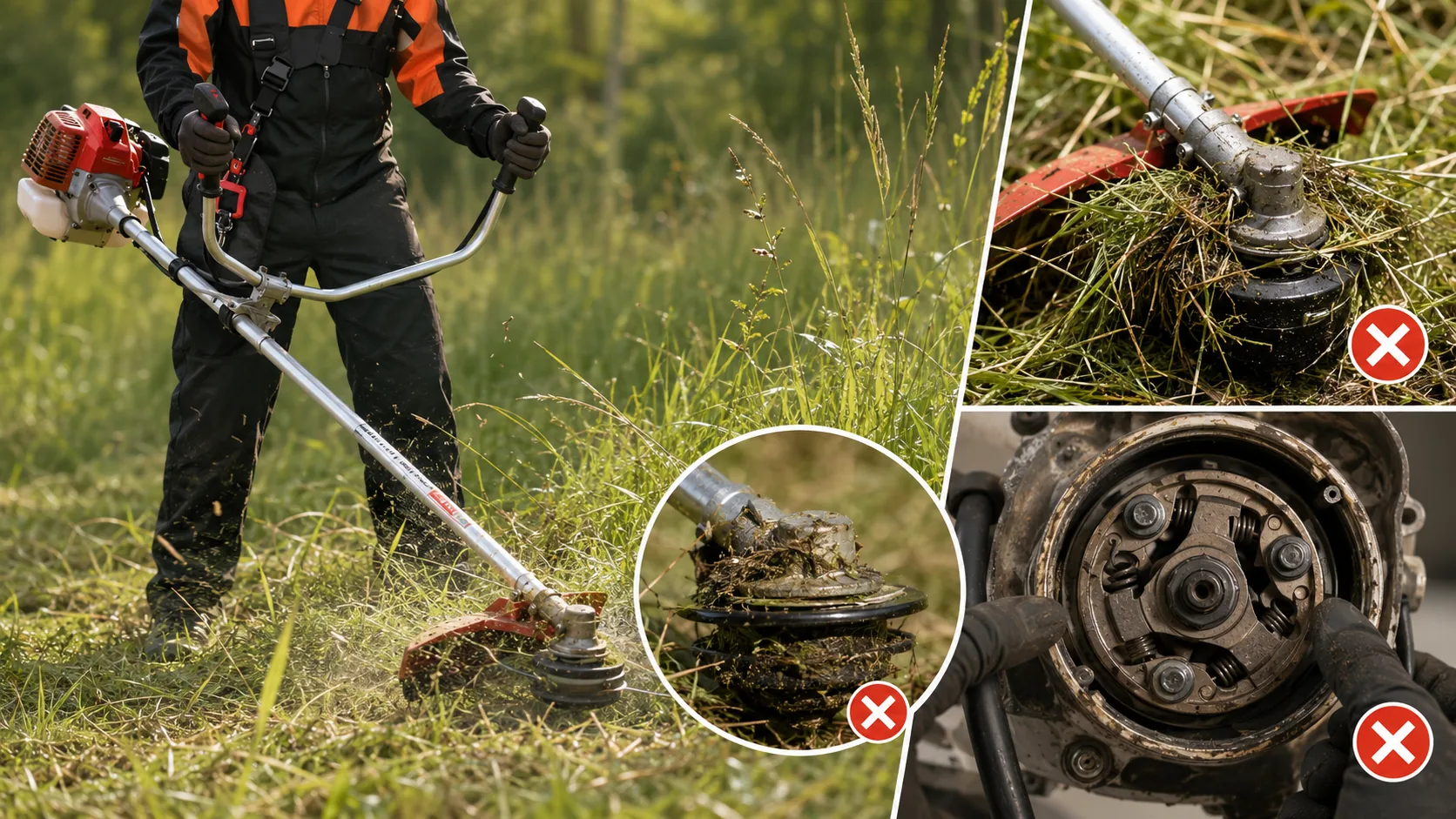
Long grass, vines, plastic twine and fibrous weeds can wrap around the gearbox output shaft. The material may be hidden behind the mounting washer or inside the narrow space above the trimmer head.
|
01
Loss of SpeedThe cutting head gradually becomes slower as grass accumulates around the shaft. |
02
Excessive HeatFriction from wrapped material may make the gearbox hotter than normal. |
03
Hard Hand RotationAfter shutdown, the head may be difficult to rotate because the shaft is restricted. |
Remove the cutting attachment according to the model instructions. Clean the output shaft, blade adapter, washers and the area between the gearbox and guard.
Also check the nylon line length. Line extending too far beyond the guard creates additional resistance. Confirm that the line-cutting blade on the guard is present and correctly positioned.
Inspect the Blade, Trimmer Head and Mounting Set
An incorrectly installed blade can slip, wobble or overload the gearbox. Inspect the complete mounting assembly instead of checking only the fixing nut.
| ✓ Blade center hole matches the locating flange | ✓ Upper and lower washers are in the correct order |
| ✓ Fixing nut uses the correct thread direction | ✓ Blade is centered on the output shaft |
| ✓ Locking pin has been removed before starting | ✓ Blade is not bent, cracked or excessively dull |
| ✓ Trimmer-head thread matches the gearbox | ✓ Attachment size suits the machine and vegetation |
A blade that is too large, too heavy or unsuitable for the vegetation may cause repeated stopping. Importers should confirm which attachments are included with each model and which alternative blade sizes are approved.
Identify a Slipping Centrifugal Clutch
The centrifugal clutch connects the engine to the drive shaft when engine speed increases. Worn shoes, weak springs or a damaged drum may allow the engine to accelerate while the cutting attachment loses speed under resistance.
| Clutch Symptom | What It May Indicate |
| Engine speed rises but blade speed does not | Clutch shoes are slipping against the drum |
| Burning smell near the clutch housing | Excessive friction and clutch overheating |
| Scraping or rattling noise | Damaged drum, spring or loose component |
| Cutting speed changes at steady throttle | Uneven clutch contact or worn friction surfaces |
Inspect the clutch shoes, springs and drum as a complete system. Do not apply grease or oil to clutch contact surfaces because the assembly depends on dry friction.
Confirm That the Internal Drive Shaft Is Fully Engaged
The internal shaft transfers rotation from the clutch drum to the gearbox. If either end is only partially engaged, the head may rotate without resistance but stop as soon as the blade enters grass.
This issue commonly appears after gearbox replacement, clutch housing repair, shaft-tube replacement, transportation assembly or installation of an incorrect spare shaft.
| Dimension to Verify | Why It Matters |
| Internal shaft length | A short shaft may not fully enter the clutch drum or gearbox. |
| Spline shape and tooth count | Incorrect splines can rotate loosely and slip under load. |
| Shaft-tube length | The tube controls the final engagement depth. |
| Clutch and gearbox connection | Both ends must match the actual machine configuration. |
Examine the Gearbox and Output Shaft
The gearbox transfers power from the shaft to the cutting attachment. Internal gear wear, bearing damage or insufficient lubrication may allow the head to turn freely in the air but slow down under resistance.
With the engine stopped and spark plug cap disconnected, rotate the cutting attachment by hand. The movement should not feel severely rough, loose or jammed.
| Grinding or clicking
Possible gear-tooth wear, bearing damage or poor lubrication. |
Output-shaft movement
Possible bearing, shaft or gearbox-housing wear. |
| Rapid heat increase
Possible internal friction, unsuitable grease or bearing damage. |
Input turns but output does not
Possible stripped, disconnected or broken internal gears. |
Do not completely fill the gearbox with an unspecified grease. Lubricant type, quantity and service interval should match the actual gearbox design.
Check Whether the Engine Maintains Speed
If the blade, clutch, shaft and gearbox are operating correctly, the engine may not be producing enough speed to keep the clutch fully engaged.
| System | Possible Causes of Power Loss |
| Air intake | Dirty air filter or blocked intake passage |
| Fuel system | Old fuel, incorrect mixture, blocked filter, damaged hose or dirty carburetor |
| Ignition | Fouled, worn or incorrectly gapped spark plug |
| Exhaust | Blocked muffler or restricted spark-arrestor screen |
| Engine condition | Incorrect carburetor adjustment or low cylinder compression |
Listen to the engine during the load test. If engine sound drops sharply together with blade speed, begin with the air filter and fuel system before dismantling the transmission.
Do not increase carburetor speed only to compensate for a mechanical fault. Excessive adjustment can create overheating or unsafe clutch engagement without repairing the underlying problem.
Match the Brush Cutter to the Cutting Work
Repeated cutting-head stopping is not always caused by a defective part. The engine size, cutting attachment and vegetation may simply be mismatched.
| Model | Configuration | Suitable Market Demand | Buying Focus |
| TM-CG430 | 42.7 cc two-stroke, 28 mm shaft | Routine farm, garden and roadside maintenance | Weight, fuel use and general spare-parts availability |
| TM-CG520B | 51.7 cc two-stroke, listed 1.80 kW, 28 mm shaft | Denser weeds and regular metal-blade work | Clutch durability, gearbox load and attachment matching |
| TM-CG520BV | TB52 engine configuration, 28 mm shaft | Markets comparing alternative 52 cc configurations | Carburetor, clutch, starter and cylinder-parts compatibility |
Brush Cutter Models for Different Market Needs
|
General Maintenance
TM-CG430A 42.7 cc configuration for normal grass cutting, garden work and routine field maintenance. |
Suitable for distributors serving users who need a practical 28 mm shaft brush cutter without selecting a heavier engine for every application.
|
|
|
Heavier Vegetation
TM-CG520BA 51.7 cc model for markets where users regularly cut dense weeds or use suitable metal blades. |
Importers should evaluate clutch durability, gearbox temperature and attachment compatibility during sample testing.
|
|
|
Alternative Engine Type
TM-CG520BVA TB52 engine configuration for buyers comparing parts systems and regional repair requirements. |
Confirm carburetor, starter, clutch and cylinder compatibility instead of assuming that every 52 cc engine uses identical components.
|
Test the Transmission Before Shipment
A brush cutter can operate smoothly without load and still fail during real cutting. Importers should include a cutting-load test in sample approval and pre-shipment inspection.
| Inspection Item | Practical Test | Risk Controlled |
| Cold and warm starting | Test before and after continuous cutting | Carburetor and ignition inconsistency |
| Clutch engagement | Accelerate and cut dense vegetation | Shoes, spring or drum slip |
| Gearbox temperature | Check after continuous operation | Bearing, lubrication or gear problems |
| Shaft engagement | Inspect spline contact and shaft length | Rounded splines or incorrect assembly |
| Production consistency | Compare sample and random production units | Unapproved component changes |
Use vegetation similar to the target market. Soft lawn grass does not reproduce the resistance created by tall weeds, fibrous plants or dense roadside growth.
Spare Parts Planning for Importers and Dealers
Dealers should confirm whether frequently replaced parts are shared between models. Standardized components can reduce inventory pressure, but compatibility should be verified with actual dimensions, drawings or samples.
Transmission PartsClutch shoes, clutch springs, drums, internal shafts, shaft tubes, bearings and gearboxes. |
Engine Service PartsAir filters, fuel filters, fuel hoses, spark plugs, carburetors and starter assemblies. |
Cutting AttachmentsBlade washers, nuts, guards, trimmer heads, nylon line and approved metal blades. |
Importer and Dealer Procurement Audit
Machine Quality
|
Accessories and Packaging
|
After-Sales Support
|
Supply Stability
|
How to Prevent the Cutting Head From Stopping Again
Remove wrapped grass regularly, use the correct attachment and stop the machine when unusual vibration, heat or noise appears.
Avoid pushing the entire blade continuously into dense vegetation. Use controlled sweeping movements and reduce the cutting width if the engine begins to lose speed.
After transportation or repair, confirm that the shaft tube, internal shaft and gearbox are fully seated. Check attachment tightness before each work period and maintain gearbox lubrication according to the actual model requirements.
Replacing parts at random is rarely efficient. Inspecting the machine from the cutting attachment toward the engine usually identifies the fault faster and gives dealers a clearer basis for repair and spare-parts planning.
Frequently Asked Questions
Why does a brush cutter spin in the air but stop in grass?
The machine can overcome no-load resistance but cannot transmit enough torque during cutting. Common causes include wrapped grass, poor blade mounting, clutch slip, damaged shaft splines, gearbox wear or low engine power.
How can I tell whether the clutch is slipping?
The engine usually continues to rev while blade speed drops. A burning smell, unusual heat and irregular engagement also indicate possible clutch wear.
Can a worn shaft still rotate the cutting head?
Yes. Rounded or partially engaged splines may rotate the head in the air but slip as soon as cutting resistance increases.
Can excessive nylon line reduce cutting speed?
Yes. Line that extends too far beyond the guard creates additional resistance. The guard’s line-cutting blade should keep the line at the correct length.
What spare parts should a brush cutter dealer stock?
Common inventory includes clutch shoes, springs, drums, drive shafts, gearboxes, air filters, fuel filters, spark plugs, carburetors, starter assemblies and mounting hardware.
What should importers test before a bulk brush cutter order?
Test cold and warm starting, clutch engagement, cutting under load, gearbox temperature, shaft engagement, vibration and consistency between samples and production units.
Is a 52 cc brush cutter always better than a 43 cc model?
No. A 52 cc machine may suit heavier weeds, while a lighter 43 cc model may be easier for routine trimming. The correct choice depends on vegetation, working time, attachment type and local user preferences.
|
For Importers and Distributors
Compare Brush Cutter Configurations for Your MarketTeamax Power can provide different brush cutter models for routine trimming, dense weed cutting and regional after-sales requirements. |
|