
Mini Tiller Stock Planning: Lightweight or Higher-Output Model?
Compare lightweight and higher-output mini tillers for dealer stock, small-farm demand, transport, spare parts, pricing tiers, and bulk purchasing.
|
Mini Tiller Inventory Decision Report
A practical guide for importers and agricultural machinery dealers comparing transport convenience, engine output, soil conditions, customer budgets, spare-parts requirements and retail positioning. |
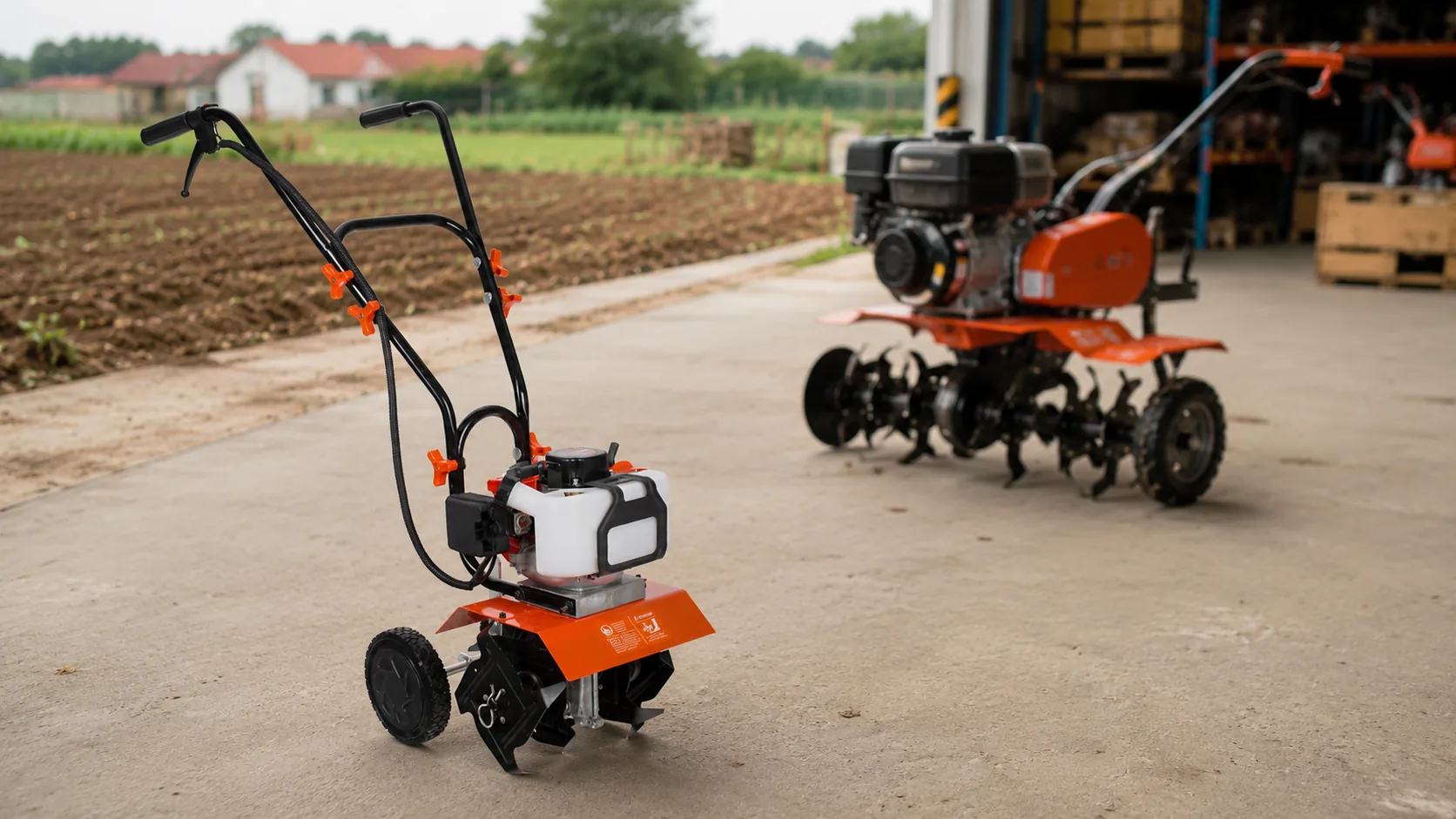
Dealers should stock a lightweight mini tiller when local buyers prioritize easy transport, narrow-field operation and an accessible retail price. A higher-output model is more appropriate when customers work more demanding soil, expect faster cultivation or are willing to operate a heavier machine.
The correct inventory decision depends on the complete market environment. Importers should compare farm size, soil structure, cultivation frequency, customer budgets, transport methods, technical support and spare-parts availability before selecting the main model for a wholesale order.
|
Quick Answer
|
Choose a lightweight mini tiller for small plots, frequent transport, narrow rows and price-sensitive buyers. Choose a higher-output model for more intensive cultivation, compacted ground and customers who place engine capacity above minimum machine weight. |
Which Mini Tiller Fits Which Buyer?
|
Portable Market Segment
TM-WG520A
52cc lightweight mini tiller
|
Higher-Output Segment
TM-WG144F
63cc higher-output mini tiller
|
Which Customers Usually Buy a Lightweight Mini Tiller?
Lightweight mini tillers are commonly suited to customers working in vegetable gardens, orchards, greenhouses, nurseries and small plots where frequent turning and movement are required.
These users may need to carry the machine through narrow entrances, load it into a small vehicle, move it between separate plots or operate around trees and established crop rows. Machine weight can therefore influence the buying decision as much as engine output.
|
Typical User
Small-plot grower Vegetable farms, gardens, nurseries and frequently cultivated soil. |
Transport Habit
Frequent movement Customers using motorcycles, small pickups or limited storage space. |
Sales Channel
Retail and rental Garden shops, entry-level machinery dealers and rental businesses. |
The TM-WG520A lightweight mini tiller uses a 52cc two-stroke engine with a listed rated output of 1.8kW. Its 30cm working width and 10–15cm working depth make it suitable for narrow cultivation areas, while the listed 10kg net weight supports easier transport and handling.
For machinery shops, a lighter unit can also be easier to display, demonstrate, move inside the showroom and deliver to retail customers.
When Does a Higher-Output Model Fit the Market Better?
A higher-output mini tiller can be more attractive in markets where buyers expect longer working periods or need to cultivate soil that requires more engine capacity.
The TM-WG144F mini tiller has a listed 63cc two-stroke engine and a rated output of 2.5kW. It shares the same listed 30cm working width and 10–15cm working depth as the lighter model, while its net weight is 16kg.
A higher-output model may be easier to position for:
| A | Farmers working compacted or previously uncultivated soil |
| B | Commercial vegetable farms and rural machinery users |
| C | Agricultural contractors and intensive seasonal users |
| D | Markets where customers compare products mainly by engine capacity |
Dealers should not describe the heavier model as suitable for every buyer. A customer cultivating a small, regularly maintained garden may still prefer lower weight and easier control, even when a higher-output machine is available.
Lightweight vs Higher-Output Mini Tiller Comparison
| Comparison Point | TM-WG520A | TM-WG144F | Dealer Buying Focus |
|---|---|---|---|
| Engine | 52cc two-stroke | 63cc two-stroke | Check local preference for displacement and fuel use. |
| Rated output | 1.8kW | 2.5kW | Match output to soil demand and daily workload. |
| Working width | 30cm | 30cm | Do not justify the higher tier by working width alone. |
| Working depth | 10–15cm | 10–15cm | Actual depth depends on soil and machine setup. |
| Net weight | 10kg | 16kg | Consider operator strength and transport method. |
| Best market position | Portable entry-level cultivation | Higher-output cultivation | Give each model a clearly different sales message. |
| Main commercial risk | May not meet demanding-user expectations | May feel unnecessarily heavy for small plots | Train sales staff to identify the actual application. |
Does More Engine Power Always Produce Better Sales?
A model with higher output does not automatically sell better. Retail customers normally purchase according to the work they need to complete, the price they can accept and the machine they feel comfortable operating.
A heavier tiller may look stronger on a specification sheet, but it can be unnecessary for customers maintaining small and regularly cultivated plots. Dealer sales conversations provide useful evidence about which factor matters most.
|
|
Buyers who ask about portability first may be better matched with the lightweight model. Buyers who focus on engine displacement, compacted ground and longer operation may prefer the higher-output machine.
How Soil and Crop Conditions Change the Decision
Mini tillers are not selected only according to farm size. Soil condition, crop arrangement and cultivation purpose also affect which model customers will consider.
| Regularly cultivated soil | A lighter machine may be sufficient for vegetable beds, gardens, nurseries and orchard maintenance. |
| Compacted ground | Customers may prefer higher output, but the actual result still depends on blades, soil moisture and operating method. |
| Narrow crop rows | Working width, turning space and machine control may matter more than maximum engine output. |
| Stony or root-filled soil | Neither model should be promoted without confirming field suitability, blade configuration and operator expectations. |
Wet clay, dry compacted ground, stones, roots, crop residue and incorrect blade installation can all affect actual performance. Importers should test samples under soil conditions similar to those faced by local users before making broad performance claims.
Should Importers Stock Both Mini Tiller Types?
Stocking both models can help an importer cover two customer groups, but the quantities should not automatically be divided equally.
During the first sales cycle, dealers should record:
- Which model receives more inquiries
- Which customer group prefers each model
- The most common reason for rejecting a model
- The acceptable retail price difference
- Which spare parts customers request
- Whether buyers value weight or output more
- Which model produces repeat orders
How to Build Two Clear Retail Price Positions
The two mini tillers should normally occupy different product tiers instead of being sold as nearly identical alternatives.
The TM-WG520A can be presented as a portable cultivator for smaller plots, orchard rows and buyers entering mechanized soil preparation. The TM-WG144F can be positioned for users who require more engine output and accept a heavier machine.
|
|
A higher purchase price is easier to explain when the difference in customer application is clear. It is more difficult to justify when customers only see a similar working width and do not understand the difference in output, machine weight and intended workload.
Spare-Parts Planning for Mini Tiller Dealers
Spare-parts planning is especially important for agricultural machinery sold outside major cities. Farmers may avoid purchasing a machine when they believe common replacement parts will be difficult to obtain.
| Tilling System Blades, blade pins, fasteners and gearbox parts | Fuel System Fuel filters, pipes, carburetor parts and air filters | Drive Parts Clutch components, seals, bearings and starter assemblies | Control Parts Throttle cables, handles, switches and control fittings |
Dealers stocking both models should identify which parts are shared and which are model-specific. Common components can reduce inventory complexity, while separate engine and transmission parts require more careful forecasting.
Importer and Dealer Bulk Order Checklist
| Engine and performance | Confirm engine type, displacement, rated output, fuel requirements, working width and working depth. |
| Machine configuration | Check blade quantity, blade design, gearbox structure, handles, throttle arrangement and controls. |
| Weight and transport | Confirm machine net weight, gross weight, carton dimensions, loading quantity and warehouse requirements. |
| Accessories and parts | Review standard tools, accessories, recommended spare parts and compatibility between models. |
| Branding and packaging | Confirm labels, carton type, customized color-box requirements and the applicable MOQ. |
| Order consistency | Write all sample-to-bulk requirements into the order documents and reconfirm production lead time before deposit. |
The product information lists kraft carton or customized color-box packaging and a bulk-order production period of approximately 40–60 days after deposit. Final packaging, production timing and customization requirements should be reconfirmed for each purchase order.
Frequently Asked Questions
Is a higher-output mini tiller always better for farm use?
No. Higher output can be useful for more demanding soil and intensive work, but a lighter machine may be more practical for small plots, orchard rows, frequent transport and regularly cultivated soil.
Which mini tiller is easier to sell to small farmers?
The TM-WG520A may be easier to position when buyers are sensitive to machine weight, transport convenience and retail price. The final choice should still reflect local soil and cultivation habits.
Does the TM-WG144F cultivate a wider area in one pass?
The listed working width for both the TM-WG144F and TM-WG520A is 30cm. The main differences are engine output, displacement and machine weight rather than working width.
Should dealers stock both lightweight and higher-output tillers?
Carrying both models can reduce market risk when customers have different budgets and applications. The quantities should be based on the local customer mix rather than divided equally.
What spare parts should be ordered with the first shipment?
Importers should consider tilling blades, blade pins, gearbox parts, starter assemblies, filters, spark plugs, fuel pipes, carburetor parts, clutch components, seals, bearings and throttle cables.
How should importers test mini tillers before bulk ordering?
Samples should be tested in soil conditions similar to those in the target market. Buyers should review starting, control, vibration, blade performance, transport convenience, maintenance access and sample-to-bulk consistency.
|
Select Your Main Inventory Model
Compare Mini Tillers for Your Local Dealer MarketTeamax Power offers mini tiller configurations for portable small-plot cultivation and higher-output farm applications. Compare both models according to local soil, transport habits, repair capability and customer budget.
|
2
Models for Different Market Positions
|