
Cordless Leaf Blower Runs but Airflow Is Weak: What to Check
Cordless leaf blower weak airflow may result from a blocked tube, dirty intake, low battery output, worn motor brushes, or unsuitable debris conditions.
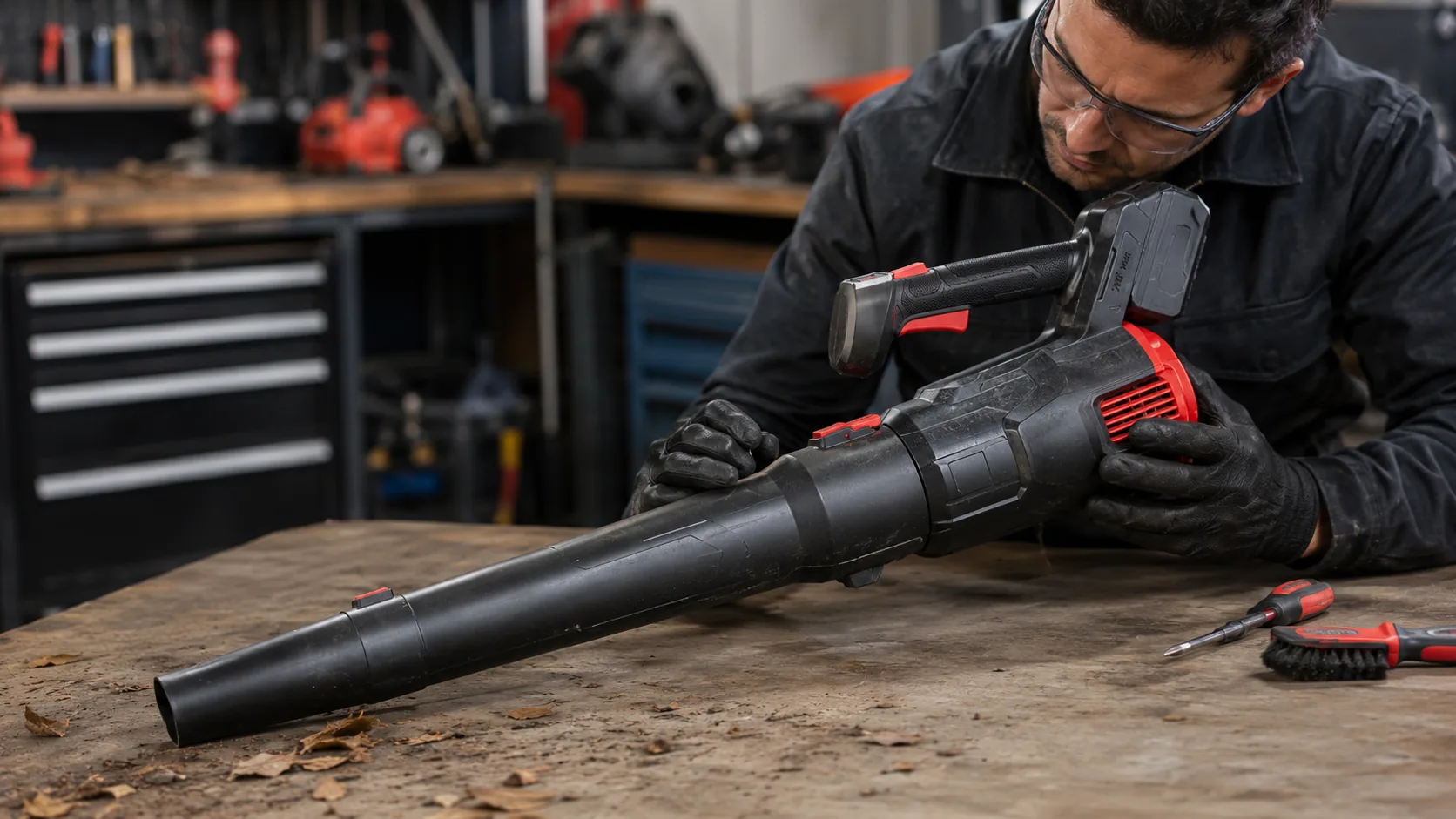
Cordless Garden Tool Diagnostic Guide
A practical inspection guide covering blocked air paths, battery voltage loss, fan damage, motor speed, operating technique, model selection, spare parts, and bulk-order quality checks.
A cordless leaf blower with weak airflow may still start, run continuously, and sound almost normal. The loss of performance can come from a blocked blower tube, restricted intake grille, leaking tube connection, weak battery output, damaged impeller, worn motor brushes, or a trigger that does not allow the motor to reach full speed.
For importers, wholesalers, garden tool dealers, repair shops, and regional distributors, weak airflow should be diagnosed in a fixed order. Replacing the motor before checking the tube, intake, battery, connection, and working conditions can create unnecessary warranty costs and complete-machine returns.
Quick answer: A cordless leaf blower normally produces weak airflow when the blower tube is blocked, incorrectly installed, cracked, or leaking; when the intake grille is covered; or when the battery cannot maintain voltage under load. Before replacing the motor, remove the battery and inspect the complete air path, battery contacts, locking mechanism, impeller noise, vibration, and trigger movement. Test the blower with a fully charged compatible battery and compare it with a known good unit. Importers can reduce complaints by confirming tube fit, battery consistency, motor type, spare-parts availability, and realistic applications before approving a bulk order.
| 01 |
What Weak Airflow Usually Indicates |
Weak airflow does not automatically mean that the blower is defective. Wet leaves, compacted grass, mud, stones, incorrect nozzle installation, excessive working distance, and a restricted air intake can make normal blower output appear insufficient.
The symptom should first be divided into three groups: restricted airflow, insufficient motor speed, and unsuitable working conditions. This distinction helps dealers decide whether the problem is caused by assembly, maintenance, battery performance, internal damage, or customer expectations.
| Observed Symptom | Likely Area | First Inspection | Dealer Decision |
| Motor sounds normal but outlet air is weak | Tube, nozzle, joint, or intake restriction | Remove the battery and inspect the complete air passage | Correct assembly or remove the blockage before electrical testing |
| Airflow becomes weaker after several seconds | Battery voltage drop, heat, or protection system | Test a fully charged compatible battery under load | Compare batteries before replacing the blower motor |
| Weak airflow with strong vibration or rattling | Impeller damage, loose fan, debris, or bearing problem | Stop the blower and listen for internal contact | Arrange technician inspection |
| Blower moves dry leaves but not wet debris | Application and operating technique | Test dry leaves at a practical nozzle distance | Explain working limits rather than approving a defect claim |
| Motor never reaches normal speed | Trigger, speed control, brushes, motor, or electrical resistance | Compare speed with a normal unit of the same model | Inspect the switch and motor system |
| 02 |
Check the Air Path Before Testing Electrical Parts |
The blower tube, nozzle, tube joint, intake grille, and impeller opening form one airflow system. A restriction or leak in any part can reduce air speed or air volume even when the motor continues to operate normally.
| Tube Installation | Check whether the tube is fully inserted, the locking tabs are engaged, the nozzle faces the correct direction, and all sections align internally. A loose joint can leak air before it reaches the nozzle. |
| Hidden Blockage | Look for leaves, paper, plastic film, grass clippings, packaging inserts, and other material inside the complete tube. Even a partial blockage can cause weak or pulsing airflow. |
| Restricted Intake | Remove dry leaves, dust, grass fibers, storage debris, and mud from the intake grille. Keep the intake away from clothing, walls, plastic bags, and the operator’s body during use. |
Remove the battery before inspecting or removing the tube. Look through the tube from both ends under adequate lighting. Do not insert fingers near the fan or impeller, and do not dismantle housing parts that are not intended for routine user access.
Common blockage clues: pulsing air, whistling, increased motor noise, vibration, air escaping around the tube joint, or airflow that changes when the tube is moved.
| 03 |
Battery and Connection Checks Under Load |
A battery indicator can show remaining charge while the battery is still unable to maintain sufficient voltage when the blower motor demands current. The machine may start normally, slow after several seconds, or operate continuously at a lower speed.
| CHECK A | Charge completely: Test the blower with a fully charged battery rather than relying only on the indicator. |
| CHECK B | Compare batteries: Install another compatible battery in known good condition and compare airflow and motor speed. |
| CHECK C | Inspect the fit: Check locking tabs, excessive movement, cracked housings, loose connectors, and whether movement changes the airflow. |
| CHECK D | Inspect the terminals: Look for dust, oxidation, moisture, heat marks, burns, discoloration, and damaged tool-side contacts. |
Do not use water or conductive metal objects to clean battery contacts. A loose or contaminated connection increases resistance and can prevent the motor from reaching normal speed without causing a complete shutdown.
For bulk orders, importers should test several batteries across several blowers. Checking one battery and one machine may not reveal tolerance problems in the locking system, battery rails, or electrical terminals.
| 04 |
Fan, Motor and Speed-Control Faults |
The motor can continue running even when the impeller cannot produce normal airflow. Broken fan blades, loose mounting, debris accumulation, bearing resistance, or internal contact can reduce output and create vibration or abnormal noise.
Impeller Warning Signs
|
Motor and Trigger Clues
|
Some cordless blowers use brushed motors. Carbon brushes gradually wear and may cause reduced speed, unstable airflow, excessive sparking, difficulty starting, or a burning smell. Brush and commutator inspection should be performed by trained technicians.
A variable-speed trigger or selector can also limit output. Check whether the trigger moves through its complete range, returns normally, and produces the same maximum speed during repeated tests. Do not bypass the trigger or connect the motor directly to the battery.
| 05 |
Application Limits Buyers Often Misinterpret |
Wet leaves, compacted grass, soil, stones, and debris trapped in corners require more force to move than dry leaves on a smooth path. A blower that performs normally on dry garden material may appear weak when used on heavy or waterlogged debris.
| Working Condition | Why Airflow Feels Weak | Recommended Action |
| Wet leaves on concrete or soil | Water increases weight and causes leaves to stick | Work closer, use a direct angle, and move smaller quantities |
| Compacted piles or grass clippings | Air cannot easily lift dense material from below | Break up the pile or use a rake before blowing |
| Nozzle held too far from the ground | The air stream spreads and loses useful force | Aim toward the lower edge of the debris at a practical distance |
| Dense pile blown directly downward | Air becomes trapped instead of moving material forward | Start from the outer edge and use sweeping movements |
A customer who previously used a large gasoline blower may expect the same performance from a compact cordless model. Dealers should define the intended applications clearly, including garden paths, residential areas, workshops, yards, and routine outdoor cleaning.
Reduced output after extended use may also indicate heat buildup in the battery, motor, switch, controller, wiring, contacts, or bearings. Stop the tool if the housing or battery becomes unusually hot, airflow suddenly drops, or a burning smell appears. Allow the blower and battery to cool naturally in a dry, ventilated area.
| 06 |
Fast Dealer Diagnostic Workflow |
A fixed sequence helps service staff diagnose a cordless leaf blower with weak airflow without replacing expensive parts unnecessarily.
| 1 | Confirm the customer’s material: dry leaves, wet leaves, grass, workshop dust, or heavier debris. |
| 2 | Install a fully charged battery and listen for normal motor speed. |
| 3 | Inspect the tube and nozzle for incorrect installation, leakage, cracks, and blockage. |
| 4 | Clean the intake grille and ensure the inlet is not covered during operation. |
| 5 | Compare another battery and inspect the locking system and terminals. |
| 6 | Listen for fan and bearing noise and check for abnormal vibration. |
| 7 | Compare with a normal unit of the same model before approving motor, trigger, controller, or impeller replacement. |
| 07 |
Cordless Leaf Blower Models for Dealer Evaluation |
The TM-EB803Li and TM-EB804Li product pages list 21V DC battery systems and brushed motors. Their listed no-load speed, maximum air speed, maximum air-volume specifications, battery package, charger, tube configuration, and accessories should be confirmed against the final order specification before purchasing.
|
Routine garden cleaning TM-EB803Li Lithium Battery Leaf BlowerThis model can be evaluated for garden paths, yard maintenance, residential cleaning, workshop dust removal, and other light outdoor cleaning tasks. Buyers should confirm the battery quantity, charger, tube, packaging, and service-parts package. |
|
TM-EB804Li Cordless Leaf Blower
The TM-EB804Li can also be assessed for leaf blowing, garden cleaning, yard maintenance, and outdoor cleaning applications described on its product page.
Procurement focus: Compare final air-performance specifications, battery compatibility, brushed-motor service parts, trigger consistency, tube locking strength, carton protection, and local user expectations.
| Compare This Model |
| Model | Suitable Evaluation | Buying Focus | Service Planning |
| TM-EB803Li | Routine garden, path, yard, and light outdoor cleaning | Battery package, charger, tube assembly, and market expectations | Battery, charger, trigger, carbon brushes, and motor availability |
| TM-EB804Li | Garden cleaning, leaf blowing, yard maintenance, and outdoor use | Final speed, airflow, battery, charger, packaging, and tube configuration | Impeller, switch, motor assembly, contacts, and battery-lock parts |
| 08 |
Importer and Dealer Bulk Order Checklist |
A bulk-order inspection should test complete blower performance and configuration consistency instead of checking only whether each machine switches on.
| 01 | Airflow consistency: Compare random units using the same battery and tube configuration. |
| 02 | Tube fit: Check locking strength, joint leakage, alignment, cracks, and packaging protection. |
| 03 | Battery compatibility: Confirm voltage system, capacity options, locking fit, contacts, labels, and repeat-order consistency. |
| 04 | Charger configuration: Verify plug type, input voltage, labels, charging time, and carton identification. |
| 05 | Motor and trigger consistency: Compare speed, sound, vibration, startup, and full-trigger output across samples. |
| 06 | Intake and impeller inspection: Check grille strength, debris protection, fan balance, internal noise, and vibration. |
| 07 | Spare-parts plan: Confirm batteries, chargers, switches, carbon brushes, motors, impellers, contacts, and locking components. |
| 08 | Packaging: Confirm carton strength and internal protection for the blower housing, tube, battery, and charger. |
| 09 | Dealer instructions: Include tube assembly, intake cleaning, battery care, working distance, and overheating guidance. |
| 10 | Commercial terms: Confirm MOQ, delivery time, accessory configuration, after-sales responsibility, and repeat-order supply stability. |
| 09 |
Frequently Asked Questions |
Why does my cordless leaf blower run but have weak airflow?
The tube may be blocked or leaking, the intake may be restricted, the battery may lose voltage under load, or the fan and motor may not reach normal speed. Wet or heavy debris can also make normal airflow appear weak.
Can a fully charged battery still cause low blower power?
Yes. A battery can show charge but fail to maintain sufficient voltage under load. Compare performance with another compatible battery in good condition before replacing the motor.
How can dealers reduce weak-airflow complaints?
Dealers should demonstrate correct tube assembly, keep the intake clear, explain realistic working distance, distinguish dry leaves from wet debris, and teach customers how to test and maintain the battery.
What spare parts should importers stock for brushed cordless blowers?
Useful service stock may include batteries, chargers, switches, carbon brushes, motor assemblies, impellers, electrical contacts, battery-locking parts, tube sections, and selected housing components.
When should a cordless leaf blower be sent for repair?
Arrange technical inspection when airflow remains weak with a known good battery, the impeller scrapes or rattles, vibration is strong, the motor sparks excessively, a burning smell appears, or the tool repeatedly overheats.
What should importers confirm before a cordless leaf blower bulk order?
Confirm the final battery and charger configuration, tube design, motor type, listed airflow specifications, packaging, service-parts supply, sample consistency, MOQ, delivery time, and suitability for local cleaning applications.
Weak cordless leaf blower airflow usually comes from a restricted or leaking air path, insufficient battery output, unstable electrical contacts, impeller damage, motor wear, overheating, or unsuitable working conditions. Checking these areas in order helps dealers solve simple assembly and maintenance problems before replacing the complete machine.
|
Wholesale cordless blower inquiry Compare battery packages, airflow requirements and service-parts configurations. Evaluate the TM-EB803Li and TM-EB804Li according to your destination market, application, packaging, order quantity, and after-sales plan. |
|