
Why Is a Wheeled Brush Cutter Hard to Push in Tall Grass?
A wheeled brush cutter can become hard to push in tall grass because of wrapped weeds, low cutting height, wheel drag or engine overload. Learn what to check.
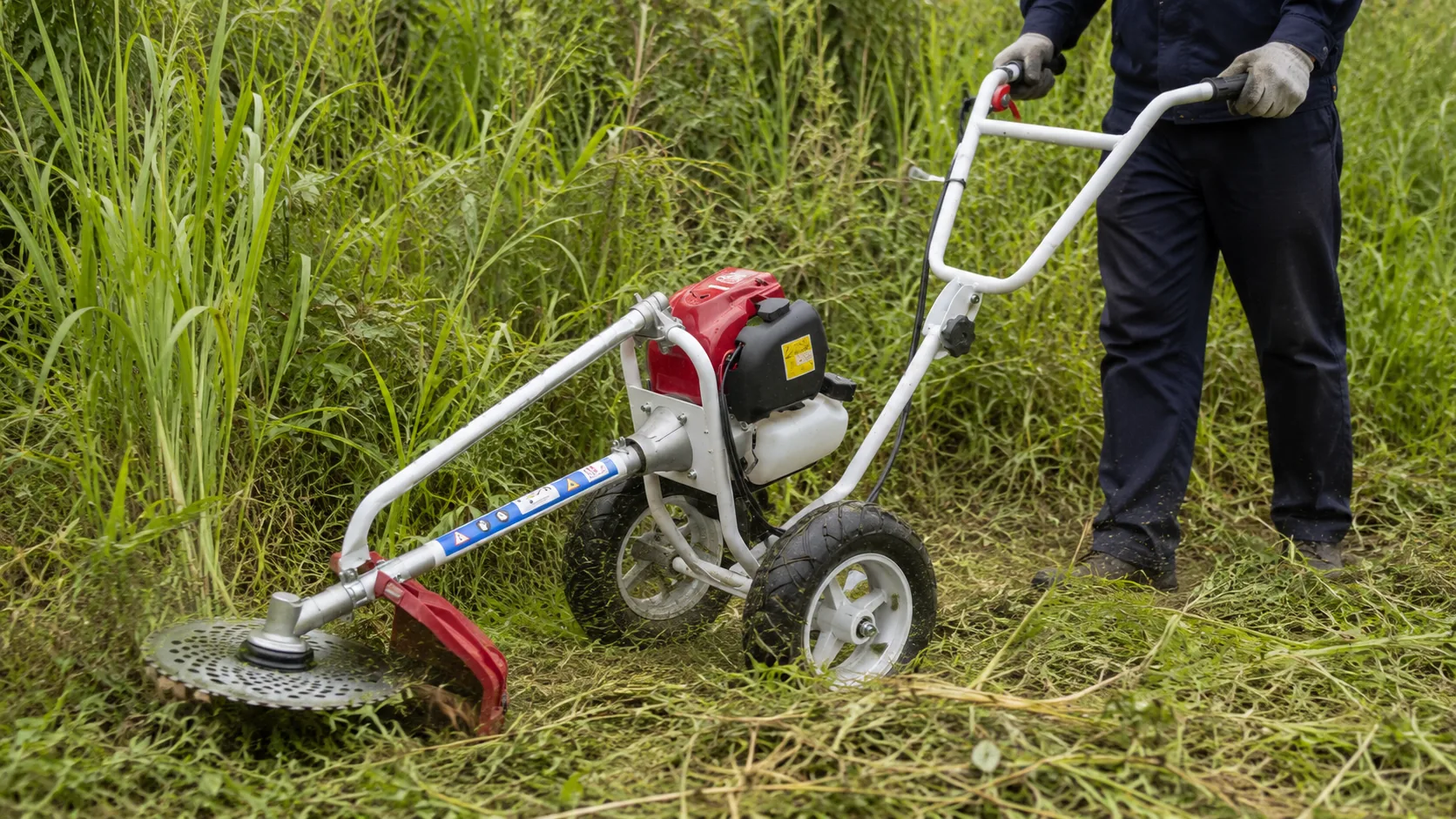
| Wheeled Brush Cutter Troubleshooting |
A wheeled brush cutter can become difficult to push when long grass wraps around the cutting shaft, the cutting head runs too close to the ground, one or both wheels cannot rotate freely, or the machine is being forced through vegetation faster than the cutting system can clear it.
The correct response is not to apply more force to the handle. Operators should first determine whether the resistance comes from the wheels, cutting attachment, engine, frame, or vegetation. For importers and dealers, this symptom also highlights the importance of wheel alignment, ground clearance, attachment selection, packaging protection, and real working-load tests before a bulk order is approved.
Safety warning: Stop the engine and disconnect the spark plug cap before reaching under the guard, removing wrapped material, turning the cutting head, inspecting the blade, or touching the gearbox. Forcing the machine forward can bend the shaft, damage the cutting attachment, overload the clutch, or cause loss of control on uneven ground.
1Locate the Resistance Before Adjusting the Engine
A simple inspection sequence can separate wheel resistance, cutting-system resistance, and application overload without immediately disassembling the machine.
| Test 1: Engine off | Push the machine across a clean, flat surface. If it is still difficult to move, inspect the wheels, axles, fasteners, frame alignment, and anything rubbing against the wheels. |
| Test 2: Cutting head | If the machine rolls normally, inspect the cutting head for wrapped grass, ground contact, damaged mounting parts, or gearbox resistance. |
| Test 3: No-load operation | Start the machine in a clear area and listen for grinding, rattling, or abnormal vibration. Confirm that the cutting attachment reaches a stable speed. |
| Test 4: Ordinary grass | Test a small area of normal grass before returning to dense weeds. If the problem appears only in heavy growth, operating speed or attachment selection may be the main issue. |
This order prevents unnecessary carburetor adjustment when the actual problem is an overtightened wheel bolt, wrapped grass, insufficient ground clearance, or an unsuitable cutting attachment.
2Check for Grass Wrapped Around the Cutting Shaft
Wrapped vegetation is one of the most common reasons a wheeled brush cutter suddenly becomes hard to push. Tall weeds, vines, plastic string, crop residue, and fibrous grass can wind around the output shaft behind the trimmer head or blade.
As more material accumulates, the attachment requires more torque, the guard fills with residue, and the rotating parts may begin dragging against the ground. The resistance often increases gradually, so the operator may continue pushing without noticing the blockage.
Typical blockage symptoms
|
Areas to inspect
|
After removing the blockage, turn the cutting head carefully by hand where the machine design allows. It should rotate without grinding, severe resistance, or repeated tight spots. Continued resistance may indicate a damaged gearbox, bent output shaft, worn bearing, or incorrectly installed cutting attachment.
3Confirm the Cutting Head Is Not Running Too Low
A cutting head positioned too close to the ground may continuously strike soil, stones, roots, and dense plant bases. The machine then feels heavier because the operator is pushing the wheels forward while the cutting attachment is dragging against the terrain.
Problems caused by insufficient ground clearance
A low cutting position can cause rapid trimmer-line wear, blade damage, dirt entering the gearbox area, uneven cutting on rough ground, excessive handle vibration, and engine speed loss during normal work. Cutting height may be affected by wheel size, frame angle, shaft position, handle pressure, or attachment installation.
Check whether the cutting attachment touches the ground while the machine stands on level terrain. A handle set too low can also encourage the operator to push downward, forcing the front of the machine closer to the ground.
For very tall growth, use a higher first pass where the machine allows it. A second pass can reduce the remaining grass. Trying to cut dense vegetation to ground level in one pass creates unnecessary load on the engine, clutch, gearbox, cutting head, and operator.
4Inspect Wheel Movement, Axle Alignment and Frame Clearance
The cutting system may be operating correctly while one or both wheels create excessive rolling resistance. This issue is particularly important on a new machine because an overtightened wheel fastener, bent axle, or incorrectly assembled spacer can make the product feel heavy before it reaches vegetation.
Lift the machine according to its safe handling procedure and rotate each wheel by hand. Compare both sides rather than checking only whether the wheels move at all.
| Inspection Point | Possible Problem | Recommended Action |
| Wheel axle | Grass, wire, or mud wrapped around the axle | Remove accumulated material and check whether the wheel rotates normally afterward. |
| Wheel fastener | Bolt or nut tightened enough to clamp the wheel | Adjust according to the machine specification so the wheel remains secure but turns freely. |
| Bearing or bushing | Wear, contamination, damage, or insufficient movement | Clean, inspect, lubricate where specified, or replace damaged components. |
| Frame clearance | Wheel rubbing against the frame or guard | Inspect wheel spacing, washers, axle position, frame deformation, and assembly order. |
| Wheel alignment | One wheel points inward or outward | Check axle straightness and frame dimensions. Misalignment can make the machine pull sideways. |
One wheel that turns less freely than the other forces the operator to push forward while continuously correcting the direction. Dealers should therefore check straight-line tracking during pre-delivery assembly, not only whether both wheels are attached.
5Match Forward Speed and Cutting Attachment to the Vegetation
Tall, wet, or dense grass does not automatically mean the machine has a mechanical defect. Vegetation can bend instead of cutting cleanly, wrap around the shaft, collect beneath the guard, drag against the frame, and require more engine torque than dry lawn grass.
Reduce forward speed and cut a narrower path when engine speed begins to fall. Extremely tall growth may require an initial higher pass. Pushing faster does not increase productivity when the cutting head cannot clear material at the same rate.
| Vegetation | Suggested Attachment | Buying Focus | Common Risk |
| Soft grass and lawn edges | Compatible trimmer head and specified line | Line diameter, line length, head balance, and ground clearance | Line too long or too thick increases engine load |
| Dense weeds | Approved metal blade where permitted | Blade type, diameter, guard, mounting, and rotation direction | A blunt blade pushes vegetation instead of cutting it |
| Wet tropical growth | Attachment selected for repeated wet-grass clearing | Debris discharge, guard clearance, torque, and cleaning access | Wet material accumulates quickly beneath the guard |
| Fibrous farm residue | Model-specific blade or head recommended by the supplier | Wrapping resistance, shaft protection, clutch load, and spare parts | Fibrous material wraps around rotating components |
A bent, blunt, incorrectly mounted, or unsuitable blade can push plants over rather than cutting them. Blade diameter, mounting method, guard, and rotation direction must match the machine specification. Severely deformed attachments should be replaced rather than reshaped by hand.
6Observe Engine Speed, Clutch Engagement and Gearbox Condition
Engine behavior helps determine whether the machine is overloaded or losing power through the transmission. Dealers should ask what happens to engine speed when the machine enters grass.
Engine speed falls sharplyCheck for:
|
Engine keeps revving but head slowsInspect:
|
Do not continue running the engine at full throttle while the cutting attachment is blocked. If the engine is turning but the transmission cannot move normally, clutch temperature can rise quickly and damage clutch shoes, springs, or the drum.
7Dealer Product Recommendation and Market Fit
A wheeled brush cutter is a practical option for users who prefer guiding a machine on wheels instead of carrying the full engine and shaft weight. However, it may be unsuitable for narrow terraces, very steep slopes, heavily obstructed land, or locations where the machine cannot roll safely.
Dealers should explain that forward speed must match vegetation density. A short working demonstration can prevent customers from assuming that the machine should be pushed through every type of growth at the same speed.
8Importer and Dealer Procurement Checklist
A wheeled brush cutter should be evaluated as a complete system. The engine, frame, handle, axle, wheels, shaft, guard, and cutting attachment must work together under real field conditions.
| Before Ordering | Before Shipment |
|
|
Recommended dealer stock may include trimmer heads, cutting line, compatible blades, wheel components, axle hardware, clutch parts, drive shafts, gearboxes, air filters, and spark plugs. These parts cover both normal wear and the most common after-sales complaints.
Frequently Asked Questions
Why does my wheeled brush cutter suddenly become hard to push?
The most common causes are wrapped grass, a cutting head dragging against the ground, debris around the guard or axles, a binding wheel, or vegetation that is too dense for the current forward speed.
How can I tell whether the wheels or cutting head are causing resistance?
Switch off the engine and push the machine on a flat surface. If it is still difficult to move, inspect the wheels, axles, frame, and alignment. If it rolls normally, inspect the cutting head, gearbox, ground clearance, and wrapped vegetation.
Can an overtightened wheel bolt make a new machine hard to push?
Yes. A wheel fastener that clamps the wheel, bearing, or bushing too tightly can create substantial rolling resistance. Dealers should compare both wheels during pre-delivery assembly.
Is trimmer line or a metal blade better for dense weeds?
Trimmer line is generally suited to soft grass and light weeds. A compatible metal blade may work better in dense weeds and thicker stems, but the blade type, diameter, guard, mounting system, and rotation direction must match the machine specification.
How can dealers reduce wheeled brush cutter complaints?
Dealers should check wheel movement, handle assembly, ground clearance, cutting-head installation, straight-line tracking, engine performance under load, and grass buildup. They should also demonstrate the correct cutting speed and first-pass method.
What should importers inspect before a wheeled brush cutter bulk order?
Importers should inspect wheel and axle consistency, frame alignment, handle strength, ground clearance, guard design, cutting-head installation, vibration, engine performance under load, packaging protection, spare-parts availability, and repeat-order consistency.
When should a wheeled brush cutter be taken out of service?
Stop using the machine when a wheel locks or repeatedly loosens, the machine pulls strongly to one side, the cutting head cannot rotate freely, severe vibration begins, the gearbox grinds, the engine revs while the attachment stops, or the frame, axle, handle, or guard is cracked.
Wholesale Model Evaluation
Evaluate Wheel Movement and Cutting Performance TogetherA wheeled brush cutter should roll steadily while the cutting attachment clears vegetation at a controlled rate. Checking wheel alignment, cutting height, vegetation match, engine speed, gearbox condition, and spare-parts support helps importers reduce after-sales risk and maintain repeat-order consistency. |
|