
Why Does an Earth Auger Kick Back or Jump While Drilling?
Why does an earth auger kick back or jump while drilling? Check the bit, soil, drilling angle, throttle control, gearbox, and operator technique.
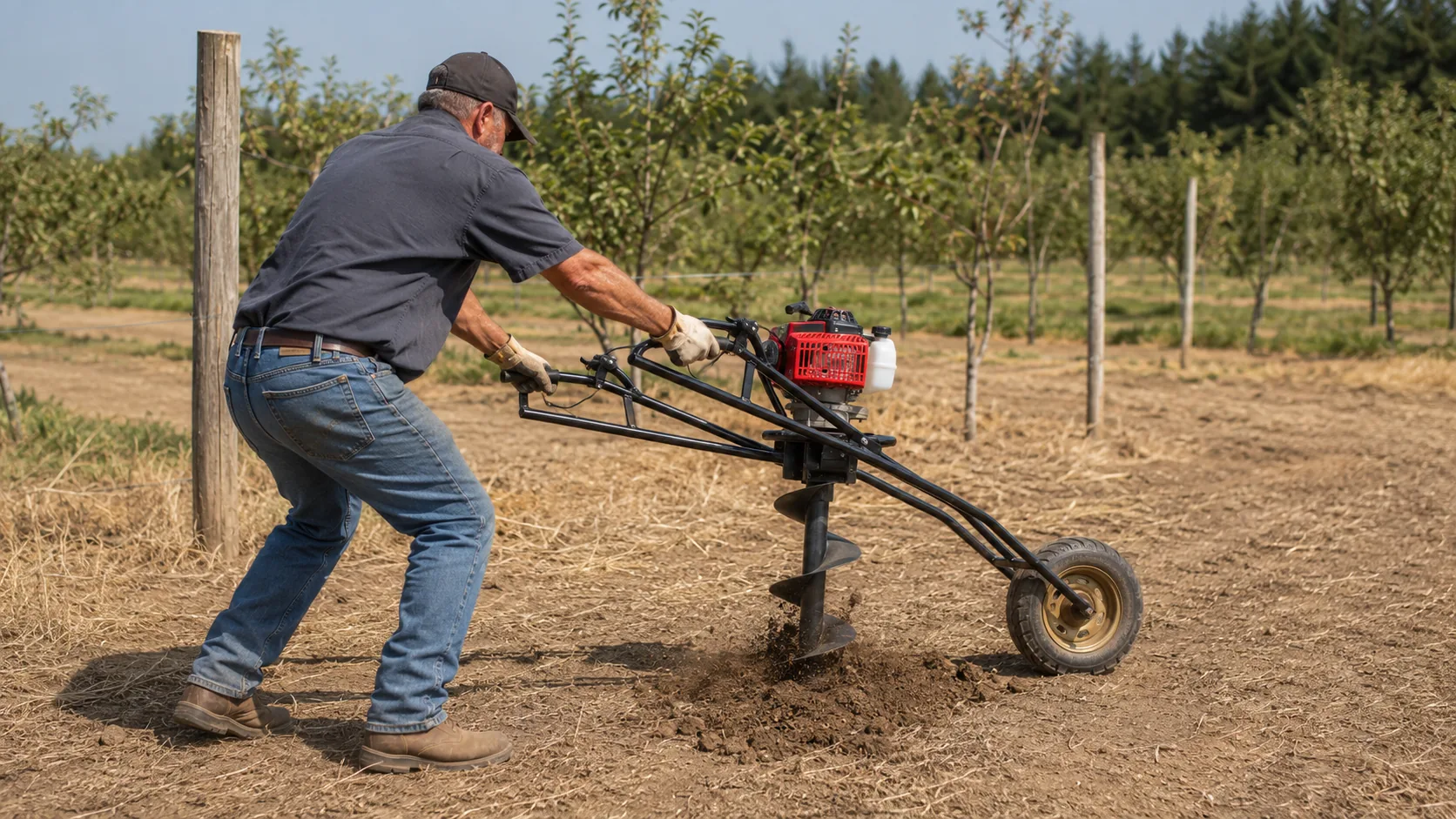
| Field Guide |
Earth Auger Kickback Diagnosis and Procurement Advice |
An earth auger usually kicks back, jumps, or pulls sideways when the drill bit meets uneven resistance from stones, buried roots, compacted clay, construction debris, or another hard object. Similar symptoms can also result from a blunt bit, excessive downward pressure, incorrect drilling angle, unstable engine speed, or looseness between the bit and gearbox output shaft.
Operators should not try to control severe auger kickback by pressing harder on the handles. The correct response is to stop drilling, remove the bit, and check the soil, cutting edges, mounting connection, machine alignment, and transmission. For importers and dealers, real-soil testing and correct bit selection are essential because drilling stability depends on the complete machine-and-bit configuration.
Quick answer:
An earth auger normally jumps when one side of the drill bit hits a stone, root, compacted soil layer, or other obstruction that the cutting edges cannot penetrate evenly. First release the throttle, remove the auger from the hole, and inspect the center point, cutting teeth, flighting, bit mounting, and soil condition. If the bit also wobbles above the ground, inspect the shaft, retaining pin, output shaft, and gearbox. Importers can reduce complaints by matching bit diameter to local soil, testing several units under load, confirming stable engine speed, and stocking common wear parts.
Safety priority: Stop the engine before inspecting the drill bit, clearing packed soil, touching the retaining pin, or checking the gearbox connection. Never assume a drilling location is free of irrigation pipes, cables, old posts, or other buried objects.
01 What Auger Kickback Usually Means
A sharp sideways movement normally means that only one cutting edge has contacted a hard object. Instead of continuing downward, the rotating bit tries to move around the obstruction. The operator may feel the handles twist, rise, or pull strongly toward one side.
The type of movement provides useful diagnostic information. A sudden impact usually points to an underground obstruction, while repeated bouncing may indicate a blunt bit, packed flighting, unsuitable bit diameter, poor alignment, or unstable power delivery.
| Observed Symptom | Likely Cause | First Check | Recommended Action |
| Sharp sideways kick | Stone, root, old post, buried debris, or hard clay edge | Bottom and sides of the hole | Stop drilling and identify the obstruction before continuing |
| Repeated bouncing | Blunt center point, worn cutting teeth, packed soil, or bit too large | Bit condition and flighting | Clean, sharpen where permitted, or replace damaged wear parts |
| Bit pulls continuously to one side | Uneven edge wear, bent bit, angled drilling, or shaft movement | Bit straightness and cutting-edge symmetry | Correct alignment or replace the damaged bit |
| Strong vibration above ground | Bent shaft, loose mounting, gearbox wear, or output-shaft movement | Retaining pin, connector, shaft, and gearbox | Take the machine out of service for mechanical inspection |
02 Check the Soil and Underground Obstructions First
Stones and roots are the most common causes of sudden earth auger kickback, but they are not the only risks. Buried construction material, old fence-post remains, irrigation components, metal scraps, and compacted layers can all create uneven resistance.
| Rocky or gravel soil | Small stones can deflect the center point, while larger stones can stop the bit suddenly. Use controlled throttle and stop when impacts become severe. |
| Root-filled ground | One cutting edge may catch a root before the opposite side engages. Inspect the hole and avoid forcing the bit through roots beyond its intended capacity. |
| Dry compacted clay | The bit may scrape and bounce instead of cutting. A smaller bit or pilot hole may be more controllable, depending on the application. |
| Unknown work area | Confirm underground utility and site-clearance requirements according to local procedures before drilling. |
If the machine kicks sharply, release the throttle and remove loose soil from the hole. Restarting immediately without identifying the obstruction can damage the cutting teeth, bend the bit, increase gearbox load, or enlarge the hole unevenly.
03 Inspect Bit Sharpness, Balance and Diameter
A sharp bit enters the soil progressively. A blunt center point or damaged cutting edge may skid, scrape, and bounce. If one side is more worn than the other, the auger may pull sideways and create an angled hole.
Inspect before drilling
|
Replace the bit when
|
Bit diameter is also important. A wide drill bit removes more soil per rotation and places greater load on the engine, clutch, gearbox, and operator. A size that works well in cultivated soil may be difficult to control in rocky ground or dry clay.
Dealers should not recommend drill-bit diameter based only on the required hole size. Soil type, hole depth, powerhead capacity, operator experience, and daily workload should also influence model selection.
04 Improve Throttle Control, Drilling Angle and Soil Clearing
Full throttle before the center point has established a guide hole can make the auger skate away from the drilling mark. Sudden torque is especially difficult to control on compacted or uneven soil.
- Step 1: Place the center point directly on the drilling mark.
- Step 2: Hold the machine upright with a stable stance and clear working area.
- Step 3: Apply throttle gradually until the center point creates a shallow guide hole.
- Step 4: Increase working speed only after the bit is centered and cutting evenly.
- Step 5: Lift the auger periodically so loose soil can leave the flighting.
Excessive downward pressure can make the bit bite too aggressively when it enters a softer soil layer. This may cause sudden sinking, handle kickback, bit jamming, clutch overload, or difficulty removing the machine from the hole.
The machine should also remain vertical. When the auger is held at an angle, one cutting edge works harder while the other drags. Correcting a deep angled hole by forcing the handles sideways can place heavy side load on the shaft and gearbox.
Wet clay and sticky soil should be cleared before the flighting becomes fully packed. Stop the engine before manually removing attached material. Continuous drilling with a buried, soil-filled bit increases resistance and makes kickback more likely.
05 Check Bit Mounting, Gearbox and Clutch Condition
Movement between the drill bit and gearbox output shaft can create knocking, vibration, and unstable drilling. A retaining pin may still be installed while the mounting hole, connector, or output shaft has enough wear to allow the bit to move.
| Inspection Point | Common Risk | Warning Sign | Dealer Advice |
| Retaining pin and clip | Incorrect diameter, wear, or incomplete installation | Knocking between the bit and output shaft | Use the specified hardware and check security before delivery |
| Mounting hole | Oval wear or poor alignment | Bit moves even when the pin is fitted | Replace worn connectors rather than using an oversized bolt |
| Gearbox | Gear wear, bearing damage, insufficient lubrication, or output-shaft play | Clicking, heat, leakage, or irregular rotation | Inspect before continued load testing |
| Clutch | Slipping, overheating, delayed engagement, or worn components | Engine revs while the bit slows or stops | Inspect the transmission instead of adjusting the carburetor first |
A brief no-load observation can help. If the bit visibly wobbles before entering the soil, focus on the bit shaft, mounting connection, gearbox output shaft, and transmission. If the machine runs smoothly above ground but kicks only in difficult soil, the bit, ground condition, and operating method are more likely causes.
06 Engine Stability and Fuel Mixture Checks
A two-stroke engine that surges, hesitates, or loses torque can make the bit alternately slow down and bite into the ground. This unstable power delivery may feel like mechanical jumping even when the auger bit itself is not damaged.
| Basic engine checks | Correct fuel mixture, fresh fuel, clean air filter, unrestricted fuel flow, open tank vent, serviceable spark plug, and clean carburetor passages. |
| Avoid premature adjustment | Do not adjust the carburetor before checking the fuel mixture, filters, spark plug, tank vent, and mechanical resistance. |
TM-EA630C Gasoline Earth AugerModel: TM-EA630C Engine: 63cc two-stroke engine Fuel-mixing ratio: 1:30, subject to the actual instructions supplied with the machine The TM-EA630C supports multiple drill-bit diameters and lengths. Buyers should match the selected configuration to local soil, drilling depth, expected workload, and operator experience rather than choosing the largest bit only by hole size. |
Procurement focus:
|
07 Dealer Pre-Delivery and After-Sales Checks
An earth auger should be delivered as a tested drilling system, not as an engine powerhead and separate bit that have never been assembled together. Many customer complaints can be prevented by checking fit, straightness, throttle response, and drilling technique before handover.
- Install the drill bit and confirm the retaining pin and clip are secure.
- Check that the bit shaft and flighting are straight.
- Inspect the center point, cutting teeth, and welded joints.
- Confirm handle fasteners and controls are correctly assembled.
- Check throttle response and stable clutch engagement.
- Listen for gearbox clicking, grinding, or abnormal output-shaft movement.
- Explain the correct fuel-mixing requirement for the actual model.
- Demonstrate gradual hole starting and periodic soil clearing.
- Explain which bit diameters are suitable for local soil conditions.
- Confirm which cutting teeth, pins, filters, plugs, clutch parts, and gearbox parts are available.
Useful dealer stock may include cutting teeth, center points, retaining pins, locking clips, clutch parts, gearboxes, fuel filters, air filters, spark plugs, and commonly requested drill-bit sizes.
08 Importer Bulk-Order Checklist
Importers should test sample earth augers in more than one soil condition whenever possible. A clean factory-floor test confirms that the engine and bit rotate, but it does not show how the machine behaves in dry clay, cultivated farmland, root-filled orchard soil, or rocky ground.
| No. | Audit Item | What the Importer Should Confirm |
| 1 | Bit balance | Sample bits rotate without visible wobble before entering the soil. |
| 2 | Cutting consistency | Center points and cutting teeth have consistent shape, position, and wear resistance. |
| 3 | Retaining-pin fit | The pin fits securely without excessive bit movement or an oval mounting hole. |
| 4 | Gearbox condition | Gearbox lubrication, output-shaft play, temperature, noise, and leakage remain within the product specification. |
| 5 | Engine stability | The engine maintains stable speed and torque under a moderate drilling load. |
| 6 | Bit-size compatibility | The powerhead, gearbox, shaft, and clutch are suitable for the offered bit diameters and lengths. |
| 7 | Handle strength | Handles, joints, fasteners, and controls remain secure during load testing. |
| 8 | Soil application | Recommended bit configurations reflect local clay, sand, roots, rocks, farmland, and fence-installation work. |
| 9 | Spare parts | Cutting teeth, pins, clutch parts, gearboxes, filters, spark plugs, and common bit sizes are available. |
| 10 | Packaging protection | Long drill bits, flighting, center points, handles, and powerheads are protected from bending and impact. |
| 11 | Instructions and labels | Fuel ratio, starting, drilling method, safety warnings, bit installation, and maintenance guidance are clear. |
| 12 | Repeat-order consistency | Future batches retain the approved shaft, pin, gearbox, bit, fuel-ratio, packaging, and accessory specifications. |
Frequently Asked Questions
1. Why does an earth auger jump when it first touches the ground?
The center point may not be established, full throttle may be applied too early, or the surface may be hard and uneven. Start with gradual throttle and allow the center point to create a shallow guide hole.
2. Can a blunt auger bit cause kickback?
Yes. A blunt center point or cutting edge may scrape across the soil instead of cutting progressively. Uneven wear can also make the bit pull sideways and produce an angled hole.
3. Is a larger drill bit more likely to jump?
A larger bit removes more soil and requires more torque. It can be harder to control in dry clay, rocky ground, or compacted soil, especially if the engine, clutch, gearbox, or operator technique is not matched to the bit size.
4. How can users tell whether the problem is the soil or gearbox?
Run the auger briefly above the ground in a clear area. Visible wobble, clicking, output-shaft movement, or irregular rotation points to a mechanical issue. Smooth no-load operation with jumping only in difficult soil usually points to the bit, ground, or operating method.
5. How can dealers reduce earth auger kickback complaints?
Dealers should test the complete machine and bit, confirm retaining-pin fit, inspect bit straightness, explain gradual throttle and periodic soil clearing, and recommend bit sizes according to local soil rather than hole diameter alone.
6. What spare parts should earth auger importers stock?
Recommended stock includes cutting teeth, center points, retaining pins, locking clips, clutch components, gearboxes, fuel filters, air filters, spark plugs, and the drill-bit sizes commonly required in the local market.
7. When should an earth auger be taken out of service?
Stop using the machine when the bit wobbles above ground, the mounting connection is loose, the shaft is bent, the gearbox clicks or overheats, grease leaks, the engine revs while the bit stops, or severe kickback continues in ordinary soil.
|
Earth Auger Wholesale Evaluation Match the Drill Bit to Soil Conditions Before OrderingEarth auger kickback is usually caused by uneven resistance, unsuitable bit selection, worn cutting parts, poor drilling technique, or movement in the mounting and transmission system. Real-soil testing, suitable bit options, clear operating guidance, and matching spare parts help importers reduce after-sales risk. |
|