
How to Cut Tall, Thick Grass With a Walk-Behind Brush Cutter
Learn how to cut tall, thick grass with a walk-behind brush cutter without overloading the engine, wrapping the head, or leaving flattened weeds.
Field Cutting Guide
How to Cut Tall, Thick Grass With a Walk-Behind Brush Cutter
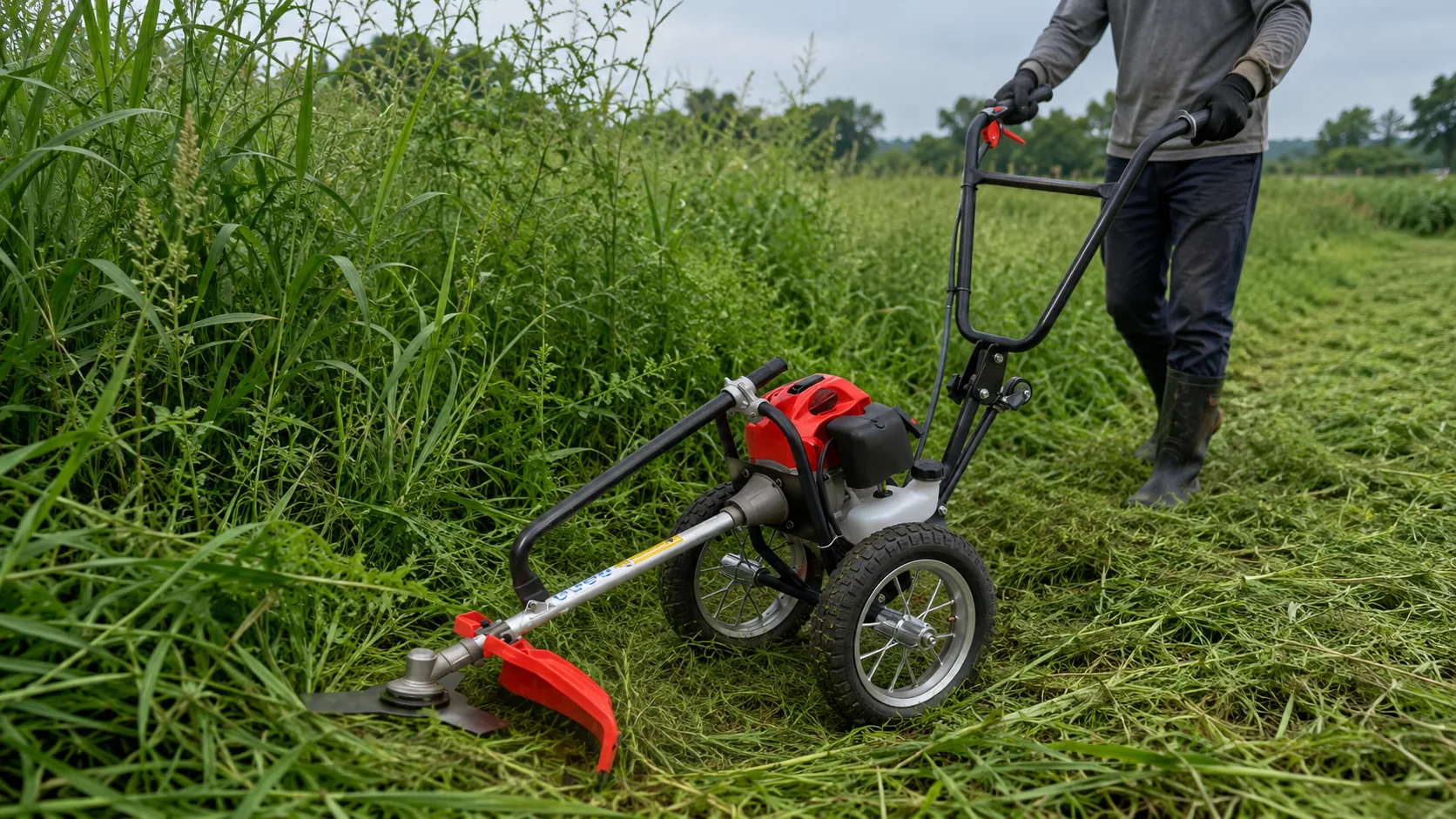
To cut tall, thick grass with a walk-behind brush cutter, start from a visible outside edge, allow the cutting system to reach working speed and advance in narrow, overlapping passes. Trying to use the full cutting width in waist-high, wet or tangled vegetation can pull engine speed down, press stems flat and increase grass wrapping around the cutting head.
The objective is controlled vegetation removal, not maximum walking speed. This guide explains how to inspect the field, choose a cutting route, respond to flattened or wet grass and match the machine configuration to the conditions faced by farms, orchards, roadside contractors and land-maintenance users.
1. Inspect Hidden Ground Before Entering Tall Growth
Waist-high grass can conceal stones, wire, irrigation pipes, tree stumps, bottles, metal scraps and drainage holes. A wheeled machine may reach these objects before the operator can see them, especially when the frame and wheels press the vegetation forward.
Walk through the area first and remove loose debris. Mark obstacles that cannot be moved. Field edges, fence lines, orchard rows and roadside drainage areas deserve extra attention because discarded wire, concrete borders and buried fittings are more common there.
Ground condition also affects the cutting angle. If one wheel drops into a concealed hole or soft rut, the machine can tilt suddenly and bring the cutting attachment closer to the soil or a solid obstacle.
Remove Before Cutting
|
Mark and Avoid
|
2. Choose a Cutting Route That Leaves Material Room to Escape
Do not begin in the centre of an overgrown plot. Entering from the middle surrounds the cutting head with long stems and leaves no clear side for discharged vegetation. Cut material can collect around the guard, shaft or drive area before the operator has established a stable working speed.
Start from an open outside edge and work inward. On a rectangular field, clear the perimeter first and then continue in parallel lanes. In an orchard, begin beside an access track and follow one row at a time. Keep one wheel close to the previously cleared path so the operator can see the ground and maintain a consistent cutting angle.
The first few metres are a test section. Use them to judge stem density, hidden ground roughness, discharge direction and the forward speed the machine can maintain without repeated engine-speed loss.
Recommended Field Route
- Clear an entry point: Create enough space to start the engine and bring the cutter to working speed without touching vegetation.
- Open the outside edge: Cut a narrow strip that provides a visible wheel path and discharge area.
- Work in overlapping lanes: Keep part of the machine over the cleared section instead of feeding the full width into fresh grass.
- Change approach direction: Return from the opposite side where stems have been pressed flat.
- Leave tight finishing work: Areas beside young trees, fences and irrigation equipment may require a handheld tool after the open ground is cleared.
3. Adjust Pass Width to Grass Density
A listed cutting width describes how much ground the machine can cover under suitable conditions. It does not mean the full width should be forced into every type of vegetation. Tall grass overlaps, leans and forms a deeper mass than short upright weeds.
In the densest sections, overlap each pass. Keep one side of the machine over the cleared strip and expose only the remaining section to fresh vegetation. A controlled partial-width pass often clears more ground per hour than a full-width attempt interrupted by wrapping, stalling and repeated cleaning.
| Observed Condition | Pass Adjustment | Operator Response | Main Risk |
| Tall but upright grass | Moderate overlap | Maintain steady speed and watch discharge | Entering too quickly |
| Dense seasonal growth | Use only part of the cutting width | Stop forward travel when engine speed falls | Overloading the cutting system |
| Flattened or matted grass | Light first pass, crossed second pass | Approach from the opposite direction | Wheels pressing stems below the cutter |
| Wet grass or vines | Narrowest practical pass | Clear buildup before vibration increases | Wrapping and compacted clumps |
| Uneven or soft ground | Short controlled sections | Keep one wheel on visible ground | Machine tilt and wheel drop |
4. Keep the Cutting System at Working Speed
Bring the cutting attachment to its normal working speed in a clear area before advancing into heavy grass. Pushing the machine forward while the engine is still accelerating places an immediate load on the drive system and can bend stems instead of cutting them cleanly.
Use a steady throttle position rather than repeatedly increasing and releasing the throttle while pushing against the same clump. Irregular cutting speed can allow long material to collect around the head and makes it difficult to judge whether the problem is vegetation density, forward speed or cutting-consumable condition.
| 1 | Stop moving forward while maintaining control of the handle. |
| 2 | Allow the cutting attachment to clear the material already inside its working area. |
| 3 | Move back slightly if the head remains heavily loaded. |
| 4 | Re-enter with a narrower overlap instead of forcing the same full-width pass. |
5. Change Technique for Flattened, Wet or Wrapping Grass
Use Two Directions for Flattened Grass
Tall grass often falls in front of the wheels and frame. If every stem is lying in the same direction, the cutting attachment may pass above part of the flattened layer. Make a controlled first pass to reduce the height, then return from the opposite direction or cross the first route at an angle. The second approach exposes stems that were pressed down during the first pass.
```Wait for Surface Moisture to Dry When Practical
Wet vegetation is heavier and sticks together. It can form compacted clumps around the guard and cutting system, particularly when long grass is already lying flat. If the work is not urgent, allowing surface moisture to dry can improve separation and discharge.
When wet cutting cannot be avoided, reduce forward speed, use narrower passes and clear accumulated material more frequently. Stop when the soil becomes too soft for stable wheel movement. A sinking wheel can change the cutting plane more sharply than wet grass alone.
Respond to Wrapping Before It Becomes Severe
Long flexible stems may wind around the drive area rather than separating cleanly. Early signs include increasing vibration, slower cutting, a change in operating sound or vegetation rotating with the head.
Stop the engine, disconnect the spark plug cap and wait for all moving parts to stop before inspection. Remove wrapped material with gloves and a suitable hand tool. Do not pull grass from the cutting system while the engine is running or idling.
```
Wrapping Often Indicates
|
Corrective Action
|
6. Match the Walk-Behind Brush Cutter to the Work Pattern
Engine displacement alone does not determine whether a walk-behind brush cutter can clear tall, thick grass. Vegetation density, cutting-head condition, working width, ground stability and operator speed remain part of the selection decision.
The TM-WBC520A and TM-WBC435 provide two different reference engine configurations. Both have a listed net weight of 18 kg, so buyers should compare fuel handling, expected vegetation, operating habits and local service familiarity rather than assuming that one is simply the lighter model.
Specification note: The listed values are reference configurations. Final engine, cutting attachment, accessories and packing should be confirmed according to the quotation or proforma invoice.
7. Stop Cutting When the Machine Gives Warning Signs
Continuing to push through a difficult section can turn a removable blockage into damaged fastening parts, a worn cutting connection or a wheel and handle problem. Stop the engine when the operating condition changes clearly rather than repeatedly forcing the same route.
After an impact, inspect the cutting attachment, fastening parts, wheel assembly and shaft connection before restarting. An engine that still runs does not confirm that the cutting system remains correctly aligned or secured.
8. Importer and Dealer Checklist for Overgrown-Grass Markets
Markets clearing farms, orchards, vacant land and roadside vegetation may require a different setup from markets using the machine weekly on lighter grass. Confirm the complete configuration instead of comparing engine displacement alone.
| 01 | Confirm the cutting-head or blade configuration supplied with each model. |
| 02 | List compatible replacement cutting consumables for dealer stock. |
| 03 | Verify guard design and replacement-guard availability. |
| 04 | Confirm wheel dimensions, wheel fasteners and commonly replaced wheel parts. |
| 05 | Check handle fasteners, throttle controls and control-cable components. |
| 06 | Select two-stroke or four-stroke engines according to local fuel-handling habits. |
| 07 | Prepare routine engine-service parts that local repair shops can identify and replace. |
| 08 | Confirm carton protection around the wheels, handle and cutting assembly. |
| 09 | Define whether the target users clear dense seasonal growth or maintain lighter vegetation regularly. |
| 10 | Confirm final accessories, packing and specifications in the quotation or proforma invoice. |
Frequently Asked Questions
Can a walk-behind brush cutter cut waist-high grass?
It can be used for tall grass when the field is inspected first and the operator enters from a clear edge using narrow, overlapping passes. Vegetation density, moisture, ground condition and the installed cutting attachment affect the practical working rate.
Should the full cutting width be used in thick grass?
Not necessarily. In dense or tangled vegetation, keep part of the machine over the cleared strip and feed only part of the listed width into fresh growth. This reduces loading and gives cut material more room to escape.
Why does tall grass wrap around the cutting head?
Common operating causes include excessive forward speed, entering with too much cutting width, long flexible stems, a worn cutting consumable or a blocked discharge path. Stop the engine before removing wrapped material.
How should flattened grass be cut?
Make a lighter first pass to open the area, then return from the opposite direction or cross the first route at an angle. Repeating the same direction may continue pressing the stems below the cutting path.
Is it safe to cut wet, thick grass?
Dry surface conditions are preferable when the work can be delayed. If wet cutting is necessary, reduce forward speed, narrow each pass and stop when soft soil prevents stable wheel movement.
Should a dealer choose the TM-WBC520A or TM-WBC435?
The TM-WBC520A provides a reference 51.7 cc two-stroke configuration with 1.80 kW rated output and 700 mm cutting width. The TM-WBC435 uses a 35.8 cc four-stroke GX35 engine rated at 1.1 kW at 6,500 rpm. Compare expected vegetation, fuel preference, service familiarity and confirmed cutting configuration before ordering.
Compare a Walk-Behind Brush Cutter for Tall, Thick GrassConfirm the grass type, field condition, preferred engine structure, cutting attachment and local spare-parts requirements before selecting a model for wholesale or distributor orders. |
|
A practical cutting method starts with visible ground, controlled overlap and steady cutting speed. Model selection should then reflect the vegetation, fuel habits, maintenance capability and confirmed order configuration.