
Earth Auger Spins but Won’t Dig: What Stops the Bit Biting?
An earth auger that spins but will not dig usually has a worn cutting tip, packed soil, or a bit that is too aggressive for the ground. Check the cause first.
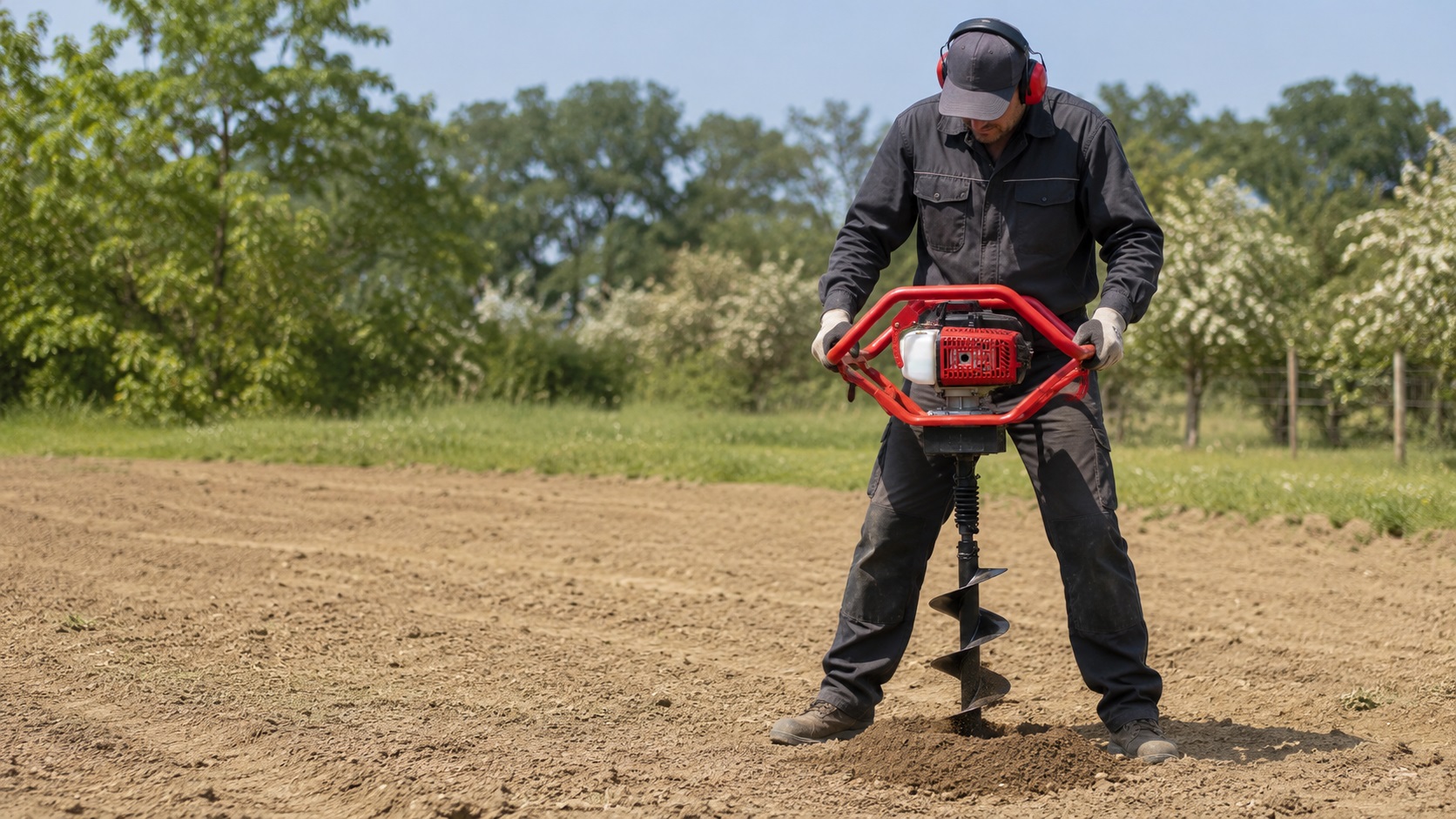
Earth Auger Spins but Will Not Dig: Causes and Checks
An earth auger that spins but will not dig usually has a problem at the lower cutting end rather than an immediate engine failure. The pilot point may be worn, the cutting lips may be blunt, sticky soil may be covering the blades, or the selected bit may be too wide for the ground condition.
This symptom must be separated from an auger that stops rotating under load. In this case, the bit continues turning but scrapes, polishes, bounces, or moves sideways instead of pulling itself into the soil. For dealers and importers, identifying that difference prevents unnecessary carburetor adjustments, engine-part replacement, and avoidable customer complaints.
Quick answer: First stop the engine and inspect the pilot point, cutting edges, packed soil, blade fasteners, and bit connection. If the bit rotates at normal speed but cannot establish a centered hole, the lower cutting components are more likely at fault than the powerhead. Clear clay from the bottom, confirm that the point reaches the soil before the wider blades, and test a smaller compatible diameter where possible. Importers can reduce repeat complaints by matching bit diameter and length to local soil, confirming replaceable wear parts, and ordering compatible points, blades, pins, bolts, and clips with the machine.
Confirm the Symptom Before Opening the Engine
A rotating bit does not automatically mean that the complete drilling system is working correctly. The powerhead can turn the shaft while the pilot point and cutting edges fail to remove soil. Observe what happens during the first few seconds of contact with the ground.
If the engine accelerates normally and the bit continues rotating at a steady speed, begin at the cutting end. Engine checks become a higher priority only when the machine hesitates, loses speed, requires partial choke, smokes unusually, or cannot maintain rotation when the cutting edges contact the soil.
| Observed Behavior | Likely Inspection Area | First Action |
| Bit spins and slides sideways | Pilot point, starting angle, surface crust | Check whether the point contacts the soil first |
| Bit rotates but only polishes the surface | Blunt blades or packed clay | Clean and inspect the lower cutting edges |
| Bit enters slowly and requires heavy pressure | Worn edges, excessive diameter, compacted soil | Compare with a smaller compatible bit |
| Engine speed becomes irregular before digging | Fuel, air filter, spark plug, fuel system | Restore normal engine operation before retesting |
Inspect the Pilot Point and Cutting Edges
The pilot point starts the hole and keeps the larger cutting section centered. When it becomes rounded, bent, loose, missing, or unevenly worn, the bit may rotate without establishing a stable entry point. The wider cutting edges can then touch the ground first and make the auger skate in a circle.
- Look for a rounded tip that no longer penetrates the surface.
- Compare both sides for uneven wear or bending.
- Confirm that the point is not loose or partly detached.
- Remove soil that completely covers the point.
- Check for damage caused by repeated contact with stone or concrete.
Next inspect the blades or cutting lips at the bottom of the flighting. Their exact structure depends on the selected bit, but the working edges should not be severely rounded, bent upward, cracked, or worn to different heights. An engine may continue turning dull blades, giving the false impression that the machine lacks power.
Uneven cutting components can make one side of the hole remove soil faster than the other. The auger may bounce, lean, vibrate, or require excessive downward pressure. Replacement blades, points, bolts, and related wear parts must match the actual bit design. A component from another diameter or supplier may not have the same mounting-hole position, cutting angle, or required fastener dimensions.
Remove Packed Clay and Adjust the Drilling Method
Wet or sticky clay can form a compacted layer around the point and cutting edges. The bit remains in motion, but the metal no longer contacts fresh soil. This commonly happens when the operator continues drilling without periodically lifting the auger to discharge loosened material.
After stopping the engine, remove packed material with an appropriate hand tool while wearing gloves. Do not clean the lower edges with bare hands. A blade may still be sharp enough to cause injury even when it is no longer cutting soil efficiently.
- Start the hole at controlled speed. Keep the machine vertical while the pilot point establishes the center.
- Drill a limited distance. Do not bury the complete lower flighting in one continuous movement.
- Lift the bit periodically. Use a controlled rotational speed to carry loosened soil upward.
- Discharge soil away from the opening. Prevent removed material from falling directly back into the hole.
- Re-enter the same center. Repeat the process until the required depth is reached.
This staged method reduces clay buildup and makes hidden stones or other obstructions easier to detect before the bit becomes deeply buried.
Hard surface crust
Very dry soil may develop a hard upper crust while the material below remains easier to drill. Applying full throttle immediately can make a worn or poorly centered point skate faster across the surface. Begin with controlled throttle until the point creates a centered opening. For unusually hard surfaces, a small manual starting hole may help, but it must be prepared with the engine stopped.
Do not repeatedly drop the running auger onto the ground. Impact can damage the pilot point, shaft connection, retaining components, and lower cutting assembly.
Match Bit Diameter and Length to the Ground
A powerhead may be capable of rotating several bit sizes, but each increase in diameter creates a larger cutting area. In dry or compacted soil, a wide bit can continue turning while failing to feed downward. The operator then applies more body weight, increasing fatigue and reducing control without correcting the actual cutting problem.
| Selection Factor | What It Changes | Procurement Consequence |
| Bit diameter | Determines hole width and cutting resistance | Larger is not automatically better in hard ground |
| Drill length | Determines available hole depth | Extra length can make starting and balancing harder |
| Cutting-edge condition | Determines whether soil is removed or only rubbed | Wear parts should be available for the selected bit |
| Pilot point | Controls initial penetration and centering | Point design must match the bit assembly |
A useful diagnostic test is to install a smaller compatible bit and try it in the same soil. If the smaller diameter enters normally, the powerhead may be operating correctly while the larger bit, cutting edges, or application method needs further attention.
Length and diameter should be treated as separate ordering decisions. A longer bit allows a deeper hole, but it does not increase cutting ability. For repeated shallow holes, unnecessary length can make the machine harder to keep vertical and can exaggerate small alignment errors.
Check the Bit Connection and Engine Speed
A bit can appear to rotate while a worn or loose connection reduces useful force under load. Stop the engine and inspect the output-shaft connection, retaining pin, bolt, clip, and any locking component used by the confirmed configuration.
Look for enlarged holes, bent fasteners, missing clips, metal wear, or movement between the output shaft and the auger bit. A worn joint may rotate normally in the air but knock, shift, or partly slip when the cutting edges meet the ground. Continuing to operate it can enlarge the mounting holes and make later repair more difficult.
Replacement fasteners must match the required diameter, length, and strength. A general-purpose bolt that passes through the hole may not provide the correct retention or load capacity.
Engine condition still matters when the powerhead cannot reach working speed. Before the bit touches the soil, listen for clean acceleration. Hesitation, irregular speed, unusual smoke, or dependence on partial choke can indicate a fuel, air-filter, spark-plug, or fuel-system issue.
First confirm whether engine speed is actually falling. If the bit maintains normal rotation while scraping the ground, return to the point, blades, packed soil, connection, and bit selection.
TM-EA710 Configuration for Different Hole Requirements
TM-EA710 Gasoline Earth AugerModel: TM-EA710 The model is listed with a 71cc two-stroke engine and 2.8 kW rated power. Optional bit diameters range from 10 to 30 cm, with drill lengths of 80, 100, 120, or 140 cm, depending on the confirmed order configuration. These options can be matched to planting, orchard, garden, and fence-hole work. A 30 cm bit removes substantially more soil per revolution than a 10 cm bit, so local soil condition, edge sharpness, staged drilling, and soil discharge frequency remain important. The listed mixed-fuel ratio is 1:30. Fuel preparation should follow the confirmed model instructions rather than a ratio used for another two-stroke machine.
|
The largest available diameter should not be treated as the default choice for every customer. Importers should compare local planting-hole sizes, fence-post requirements, soil hardness, handling expectations, and replacement-part availability before finalizing the assortment.
When the bit should be removed from service
Stop using the bit when the lower structure is visibly bent, a cutting blade cannot be secured, the pilot point is missing, or cracks appear around mounting holes or welded sections. Severe vibration after all soil has been cleared may indicate a bent shaft or uneven cutting assembly.
Do not compensate for damaged components by adding body weight. Excessive downward force increases operator fatigue and places additional load on the handles, shaft connection, transmission, and bit.
Importer and Dealer Earth Auger Checklist
Cutting-system details should be confirmed with the same care as engine specifications. Customers often describe a dull, incomplete, or unsuitable bit as a powerhead defect, creating avoidable after-sales work.
|
Before Ordering
|
Before Shipment and After-Sales
|
Specifications and included accessories may vary with the confirmed configuration. Spare-parts compatibility should be checked against the selected auger bit and connection design, not only the powerhead model number.
Frequently Asked Questions
Why does an earth auger spin without going deeper?
The most common causes are a worn pilot point, blunt or uneven cutting edges, packed clay, a hard surface crust, an unsuitable bit diameter, or a loose shaft connection. Check the lower cutting end before assuming that the engine is defective.
Can a dull auger bit still rotate normally?
Yes. The engine may have enough power to rotate the bit while the rounded cutting edges only rub the soil. This is why visible rotation alone does not confirm that the cutting system is serviceable.
Does a larger earth auger bit dig better?
Not necessarily. A larger diameter creates a wider hole but also increases cutting resistance. In compacted or dry soil, a smaller compatible bit may enter more easily and can help determine whether the powerhead is functioning normally.
Will a longer auger bit penetrate hard soil more easily?
No. Length determines the available drilling depth, not cutting ability. An unnecessarily long bit may be harder to balance and can make a small centering error more noticeable.
Should the carburetor be adjusted when the bit will not dig?
Only after confirming that the engine cannot reach or maintain normal working speed. If the bit continues rotating steadily while scraping the ground, inspect the pilot point, blades, packed soil, connection, and diameter first.
What spare parts should dealers stock for earth auger bits?
Useful wear parts can include compatible pilot points, cutting blades, retaining pins, bolts, clips, and other fasteners used by the selected bit design. Compatibility should be confirmed for every diameter and connection type in the order.
| Match the Powerhead, Bit and Spare-Parts Package
For TM-EA710 wholesale orders, confirm the required diameter, drill length, local soil condition, connection design, and cutting-part package before production. Correct configuration reduces preventable digging complaints and gives dealers a clearer after-sales solution. |
|
Source material: :contentReference[oaicite:0]{index=0}