
Why Is a Backpack Brush Cutter Throttle Trigger Hard to Press?
Find why a backpack brush cutter throttle trigger is hard to press by checking cable routing, handle friction, linkage movement, and safe adjustment.
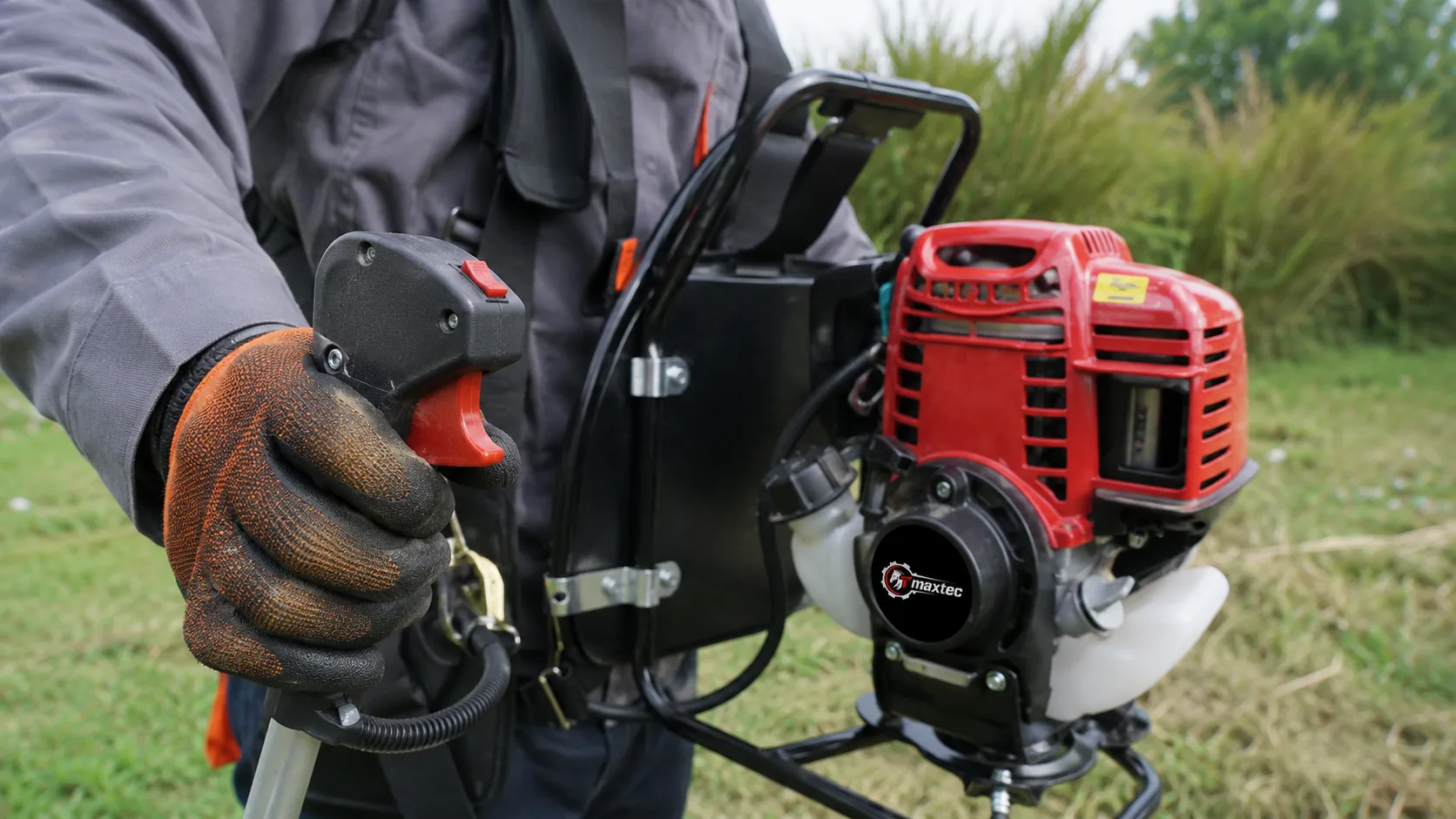
Backpack Brush Cutter Control Troubleshooting
Backpack Brush Cutter Throttle Trigger Hard to Press: Causes and Checks
A backpack brush cutter throttle trigger that is hard to press usually has a mechanical restriction somewhere between the control handle and the engine. Common causes include a sharply bent cable, a cable trapped against the backpack frame, damage inside the outer sheath, contamination around the trigger pivot, or binding at the carburetor linkage.
This guide covers a trigger that feels stiff, catches during movement, returns slowly, or requires excessive finger pressure. It does not cover a trigger that moves normally while the cutting blade continues spinning at idle. That separate symptom may involve idle speed, clutch engagement, or an incomplete throttle return.
| Quick answer: |
Test the throttle with the engine stopped and the spark-plug cap removed. Compare the trigger feel while the backpack frame and cutting shaft are placed in different operating positions. If resistance changes as the shaft moves, inspect cable routing and frame contact first. If resistance stays the same, separate the handle, cable, and carburetor linkage to locate the restriction. Importers and dealers should not use idle adjustment to hide a sticking control; the trigger must move freely and return fully before the machine is started. |
1. Confirm the Exact Throttle Trigger Symptom
Stop the engine, remove the spark-plug cap, and place the cutting attachment where it cannot move unexpectedly. Press and release the throttle trigger several times without starting the machine.
A normal trigger should move smoothly through its working range and return without being pulled back manually. The way a stiff trigger behaves provides useful clues:
| Observed trigger feel | Likely inspection area | First action |
| Heavy from the beginning | Trigger pivot, safety lockout, or crushed cable sheath | Inspect the handle before adjusting the cable |
| Easy at first, then catches | Sharp cable bend, damaged liner, or misaligned cable end | Follow the cable route and locate the repeatable catch point |
| Scraping or clicking sensation | Cracked trigger, displaced spring, dirt, or internal interference | Clean and inspect the control housing |
| Returns slowly or remains partly open | Cable friction, weak or displaced return spring, linkage binding | Do not operate the machine until full return is restored |
| Resistance changes as the shaft moves | Cable routing around the frame, straps, or flexible shaft | Reposition the cable and check its available movement |
Do not begin by spraying lubricant into every opening. A control housing may contain plastic parts, stop-switch wiring, and cable liners that are not compatible with an unknown solvent or heavy grease. Locate the source of resistance before applying any product.
2. Check Whether Backpack Position Changes the Trigger Feel
A backpack brush cutter uses a longer and more mobile control route than a conventional straight-shaft model. The engine remains on the operator’s back while the throttle trigger moves with the handheld shaft. The cable must accommodate turning, lowering, and raising the cutting head without pulling on the engine-side throttle lever.
- Place the complete machine on stable ground and test the trigger.
- Stand the backpack frame in its normal operating position and test it again.
- Gently move the shaft left, right, upward, and downward without starting the engine.
- Watch the cable near the frame, shoulder straps, flexible drive shaft, retaining clips, control handle, and engine mounting points.
- Stop at the position where the trigger becomes harder and identify what is pulling, compressing, or bending the cable.
A cable tie that is too tight can compress the outer sheath. A route that appears acceptable while the machine is stationary may become restrictive when the operator turns the shaft. The cable should be supported, but it should not be stretched tight or forced through a narrow bend.
3. Separate Handle, Cable, and Carburetor-Linkage Problems
The control system should be inspected in sections. Replacing a carburetor will not correct a trigger pivot that rubs against the housing, and replacing a handle will not solve a cable that has been crushed against the backpack frame.
Control handle inspection
|
Throttle cable inspection
|
Where the design allows, disconnect the cable from the control handle. If the trigger remains stiff with the cable removed, the restriction is inside the handle assembly. If the handle moves normally, test the disconnected inner cable by hand.
A cable that remains rough after both ends are disconnected is likely damaged internally. Lubrication should only be considered when the cable construction and recommended lubricant are known. Some liners are intended to remain clean, while thick grease can collect dust and increase resistance.
Next, move the carburetor throttle lever through its normal range and release it. The lever should return under spring force. If the cable moves freely but the lever is difficult to operate, inspect for dirt, bent components, incorrect assembly, or interference from an engine cover.
Changing its shape may prevent the engine from returning to idle or stop the engine from reaching full throttle. If stiffness appears only after the cable is reconnected, check the cable-end position, adjustment bracket, and connection angle.
4. Do Not Use Carburetor Adjustment to Hide a Sticking Trigger
A hard throttle trigger is primarily a movement problem. Turning the idle screw or altering the carburetor setting does not remove friction from the trigger, cable, or linkage.
If the cable holds the carburetor lever slightly open, reducing the idle setting may temporarily make the engine appear slower. The engine speed can rise again when the shaft changes position and pulls the cable. Correct the mechanical restriction first. Carburetor or idle adjustment should only be considered after every control component moves freely and returns completely.
Cable free play should also be set only after the stiffness has been removed. Too little free play may hold the throttle partly open, while excessive free play can delay acceleration or prevent the engine from reaching its intended operating speed. The exact adjustment depends on the installed handle and engine configuration.
5. When the Brush Cutter Must Not Be Used
A throttle trigger that does not return reliably creates a control risk. The machine may remain at an elevated engine speed when the operator approaches a fence, tree, stone, vehicle, or another worker.
Stop the engine immediately when:
|
After repair, reinstall all covers, clips, cable supports, and control components before reconnecting the spark-plug cap. Start the engine outdoors on stable ground with the cutting attachment clear of people, vegetation, and loose objects. Operate and release the trigger slowly several times before performing any cutting test.
6. Model Reference for Dealers and Service Teams
|
Backpack brush cutter reference TM-BG435 GX35-Model Backpack Brush CutterThe TM-BG435 is listed with a 35.8cc air-cooled 4-stroke engine, a rated output of 1.1 kW at 6,500 rpm, and an idling speed of 3,000 ±200 rpm. These specifications help identify the intended machine configuration, but they should not be used to compensate for a throttle cable that cannot move or return correctly. Dealers should confirm the final control handle, cable, and replacement-part configuration in the quotation or proforma invoice. |
|
For recurring local service, useful model-compatible parts may include the throttle cable, control housing, trigger spring, and cable adjuster. Compatibility should be confirmed by the selected engine and control configuration rather than by engine displacement alone.
7. Importer and Dealer Throttle-Control Checklist
Throttle stiffness can be introduced during factory assembly, local assembly, repacking, transport, or dealer preparation. A control test should therefore be completed before delivery, not left for the end user to discover in the field.
| Before shipment or delivery | After assembly or repair |
|
|
For repeat orders, importers should also confirm that the throttle-control configuration has not changed between production batches. A different handle, cable length, cable-end fitting, or adjustment bracket can affect both assembly and spare-parts compatibility.
8. Frequently Asked Questions
Why does my backpack brush cutter throttle get harder when I turn the shaft?
The cable is likely being stretched, compressed, or forced through a tighter bend as the shaft moves. Check where it passes around the backpack frame, shoulder straps, flexible drive shaft, retaining clips, and engine mounting points.
Can I lubricate a stiff backpack brush cutter throttle cable?
Only use lubrication when the cable design and suitable lubricant are known. Some cables have liners that should remain clean. Heavy grease or an unsuitable solvent may collect dirt, damage materials, or increase resistance.
Should a damaged throttle cable be repaired or replaced?
Replace a cable with frayed wire, a crushed or split sheath, separated end fittings, internal rust, or persistent rough movement. Twisting damaged strands together can allow the cable to break or jam during operation.
Can carburetor adjustment fix a hard throttle trigger?
No. Carburetor adjustment does not remove friction from the trigger, cable, or linkage. Mechanical movement must be corrected before idle speed or carburetor settings are considered.
What throttle parts should a backpack brush cutter dealer stock?
Depending on the confirmed model configuration, useful service parts may include the throttle cable, control housing, trigger, trigger spring, and cable adjuster. Compatibility should be checked against the engine and handle assembly used in the order.
Is it safe to use a brush cutter if the throttle returns slowly?
No. The machine should not be used until the trigger and engine-side lever return immediately and consistently. A delayed return can leave the engine operating faster than the operator intends.
Confirm the Complete Backpack Brush Cutter ConfigurationFor wholesale orders, check the throttle handle, cable routing, compatible replacement cable, engine configuration, and repeat-order consistency before shipment. A correctly routed control system can reduce assembly complaints and simplify dealer maintenance. |
|