
2-Stroke Brush Cutter Smoking Excessively: What to Check
A 2-stroke brush cutter smoking excessively may have too much oil in the fuel mix, restricted airflow, choke misuse, old fuel or exhaust deposits.
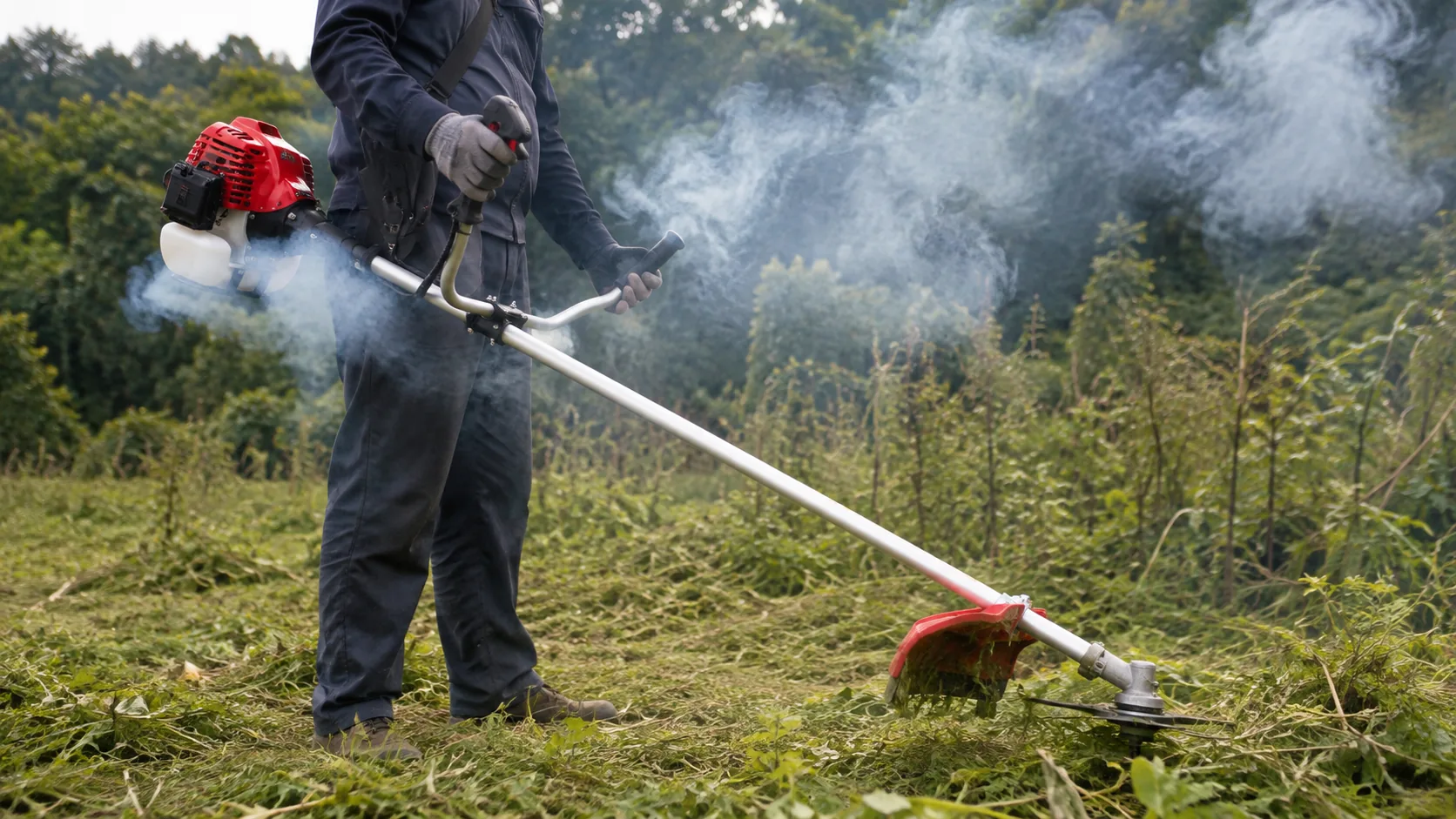
2-Stroke Brush Cutter Smoking Excessively: Fuel Mix, Airflow and Combustion Checks
If your 2-stroke brush cutter is smoking excessively after the engine has started and warmed up, verify the fuel-and-oil mixture before changing carburetor settings. Too much two-stroke oil, restricted airflow, a choke that has not fully returned to its running position, or incomplete combustion can all increase visible exhaust smoke.
A brief cloud during cold starting is different from thick smoke that continues at idle and normal working speed. This troubleshooting guide focuses specifically on persistent exhaust smoke from a 2-stroke brush cutter. It does not cover 4-stroke engine smoke, an engine that only runs with the choke engaged, unusually high fuel consumption, backfiring, or power loss under cutting load.
1. Separate Normal Start-Up Smoke From a Continuous Smoking Problem
Do not diagnose a brush cutter from the first few seconds after a cold start. Extra fuel entering the cylinder during repeated starting attempts can temporarily increase visible exhaust. The more useful observation is what happens once the engine is running steadily.
| Observed Smoke | What It Suggests | First Action |
| Brief smoke after starting, then clears | May be related to cold starting or temporary excess fuel | Continue observing after warm-up |
| Visible smoke at idle but less at normal working speed | Low-speed combustion and prolonged idling may be contributing | Check fuel ratio, choke and plug condition |
| Thick smoke at idle and working speed | Fuel mixture, airflow or combustion requires inspection | Start with fuel mix and air supply |
Persistent smoke deserves more attention when it appears together with rough running, weak throttle response, oily residue near the muffler, or repeated spark-plug fouling. Carry out observations outdoors or in a well-ventilated work area, and stop the engine before touching the fuel system, air filter, spark plug or muffler.
2. Confirm the 2-Stroke Fuel Mix Before Adjusting Anything
On a 2-stroke brush cutter, lubricating oil is mixed directly with gasoline. An inaccurate ratio therefore changes both lubrication and combustion conditions.
For example, the TM-CG520TB 52cc brush cutter uses a TB52 two-stroke air-cooled engine with a listed 51.7cc displacement, 1.8kW rated output at 6500rpm, a 1200ml fuel tank, and a specified 1:30 mixed-fuel ratio.
Do not copy the ratio from another machine.
A brush cutter specified for 1:30 should not automatically be operated at 40:1 or 50:1 simply because another engine uses that mixture. If the existing fuel was prepared by estimation rather than accurate measurement, drain it into an approved container and prepare a fresh batch according to the confirmed specification.
Adding extra oil “for more protection” can increase visible exhaust smoke and deposits. Reducing the specified oil proportion can reduce lubrication. For troubleshooting purposes, the important step is to return the fuel mixture to the engine manufacturer's confirmed requirement before changing carburetor settings.
3. Check the Choke and Air Filter Before Moving Into the Fuel System
The choke enriches the mixture for starting. If it stays partly closed after the engine is capable of normal operation, airflow remains restricted and the engine may continue running excessively rich.
Choke Inspection
|
Air Filter Inspection
|
A restricted air filter can produce a similar combustion condition to a partly closed choke because less air reaches the carburetor. Clean or replace the element according to its material and the machine's maintenance instructions.
Operating environment matters. Brush cutters used for dry farm clearing can collect dust and plant debris much faster than machines trimming short garden grass, so air-filter inspection should reflect actual field conditions instead of relying only on operating hours.
4. Use Engine Speed and Spark-Plug Condition as Diagnostic Evidence
How the smoke changes with engine speed can help narrow the cause. The TM-CG520TB specification lists an idle speed of 3000 ±200rpm, but this figure should be treated as a reference specification rather than a reason to immediately adjust the carburetor.
If smoking is strongest after prolonged idling and becomes noticeably lighter during normal operation, low-speed combustion may be contributing. If thick smoke continues during ordinary working speed, focus again on the fuel mixture, choke position, filter condition, fuel quality and spark plug.
- Wet with fuel: combustion may not be clearing the supplied mixture effectively.
- Oily residue: review the fuel-to-oil ratio and operating conditions.
- Heavy carbon: check for rich operation, repeated choke use, restricted airflow or excessive idling.
- Physical damage: replace or service the plug according to the engine specification.
A dark plug by itself does not prove that the carburetor is defective. The deposit may have developed because of incorrect fuel, excessive choke use or reduced airflow. Correct those external causes first, then inspect the plug again after normal operation.
5. Inspect the Muffler Before Considering Carburetor Adjustment
Because two-stroke oil passes through the combustion process with the fuel, poor combustion or an oil-heavy mixture can contribute to oily and carbon deposits in the exhaust system over time.
If fresh correctly mixed fuel, the choke position, air filter and spark plug have already been checked but the engine still produces persistent smoke, inspect the muffler outlet for abnormal deposit accumulation. Allow the exhaust system to cool completely before touching it.
Avoid pushing screwdrivers, drills or other metal objects deep into the exhaust port. If significant exhaust disassembly or internal carbon removal is required, follow the correct service procedure for the engine so loosened debris does not enter the cylinder.
Why carburetor adjustment comes later
Before changing fuel-metering settings, confirm that:
- the fuel is mixed at the required ratio;
- the fuel is reasonably fresh;
- the choke is fully released;
- the air filter is not restricted;
- the spark plug is serviceable;
- the exhaust outlet is not obviously obstructed.
If those checks are satisfactory and the engine still produces heavy smoke together with unstable running, poor acceleration or recurring plug fouling, then the carburetor and fuel-metering system may require further inspection. Random screw adjustment can make the original problem harder to identify because the previous setting is lost.
6. TM-CG520TB Reference for Dealers Handling 52cc Brush Cutters
| TM-CG520TB 52cc Gasoline Brush Cutter | |
| Engine | TB52, 2-stroke air-cooled |
| Displacement | 51.7cc |
| Rated Output | 1.8kW / 6500rpm |
| Idle Speed | 3000 ±200rpm |
| Fuel Tank | 1200ml |
| Specified Fuel Mix | 1:30 |
This model is particularly relevant to an excessive-smoke diagnosis because its published 1:30 fuel-mix requirement gives dealers and service staff a specific starting point. Users who automatically prepare fuel according to another brand's 40:1 or 50:1 instructions may be operating outside the confirmed specification for this machine.
| Check TM-CG520TB Specifications |
7. Importer and Dealer Checklist for Excessive-Smoke Complaints
Many smoking complaints can be screened without dismantling the engine. For distributors, the same checks are useful when preparing manuals, spare-parts support and dealer training for a bulk order.
| No. | Dealer / Importer Check | Why It Matters |
| 1 | Confirm the exact 2-stroke fuel-mix ratio for the selected engine. | Prevents users from copying a ratio from another model. |
| 2 | Check that mixing instructions in the manual match the actual configuration. | Avoids conflicting handover information. |
| 3 | Confirm the air-filter type used on the production specification. | Supports correct cleaning and replacement guidance. |
| 4 | Confirm the spark-plug specification before preparing service stock. | Helps dealers respond to repeated plug fouling correctly. |
| 5 | Verify choke operation during pre-delivery inspection. | A linkage problem can imitate an overly rich carburetor setting. |
| 6 | Check commonly serviced filter, plug and fuel-system parts. | Supports faster local after-sales response. |
| 7 | Keep fuel-mix information consistent on manuals and dealer instructions. | Reduces avoidable operating errors after delivery. |
| 8 | Confirm final engine configuration in the quotation or proforma invoice. | Reference specifications should match the order being supplied. |
For wholesale orders, this is more useful than treating every smoking complaint as an internal engine defect. A customer using the wrong fuel ratio, leaving the choke partly engaged or working with a heavily restricted filter can create symptoms before the machine actually needs carburetor or engine repair.
8. When Persistent Smoke Needs Further Inspection
If freshly prepared fuel at the correct ratio does not reduce the smoke, and the choke, air filter, spark plug and exhaust path have already been checked, stop treating the problem as a simple mixing error.
Persistent heavy smoke accompanied by abnormal mechanical noise, severe power loss, overheating, repeated spark-plug contamination or difficult starting deserves further inspection before the brush cutter returns to continuous field work. At that point, carburetor fuel metering or deeper engine condition may need to be assessed according to the actual engine configuration.
For 2-stroke brush cutter troubleshooting, starting with what enters the engine—fuel, oil and air—usually provides a clearer diagnostic path than changing internal settings first.
Frequently Asked Questions
Why is my 2-stroke brush cutter smoking excessively?
Start with the fuel-to-oil ratio, choke position and air filter. Too much oil in the mixed fuel, insufficient airflow or a choke that remains partly closed can increase visible exhaust smoke. Persistent smoke after these checks may require spark-plug, exhaust and carburetor inspection.
Can too much 2-stroke oil make a brush cutter smoke?
Yes. More oil than the specified proportion can increase smoke and contribute to deposits. Use the ratio specified for the actual engine rather than adding extra oil as a precaution.
What fuel mixture does the TM-CG520TB use?
The TM-CG520TB product specification lists a 1:30 mixed-fuel ratio for its TB52 two-stroke air-cooled engine. The ratio should be measured accurately rather than estimated.
Can a dirty air filter cause brush cutter exhaust smoke?
A heavily restricted filter reduces incoming air and can contribute to an overly rich combustion condition. Check for dust, grass debris, oil contamination, damaged filter material and poor sealing.
Should I adjust the carburetor if my brush cutter is smoking?
Not as the first step. Verify fuel mixture, fuel condition, choke position, air-filter condition, spark plug and exhaust outlet first. Carburetor inspection becomes more relevant when these external causes have already been excluded.
Is some smoke normal when a 2-stroke brush cutter starts?
A small amount of temporary smoke can appear during cold starting, particularly after repeated starting attempts. The more important symptom is thick smoke that remains after the engine has warmed and continues during normal operation.
Comparing 52cc Brush Cutter Configurations?For distributors evaluating a 2-stroke brush cutter, confirm the engine configuration, specified fuel ratio and commonly serviced parts before finalizing a wholesale order. For the TM-CG520TB, the listed 1:30 mixture should also be reflected consistently in dealer and end-user instructions. |
|