
Gas Chainsaw Won’t Start After Sitting: What to Check First
If a gas chainsaw won’t start after sitting, check stale fuel, flooding, filters and spark before adjusting the carburetor or replacing parts.
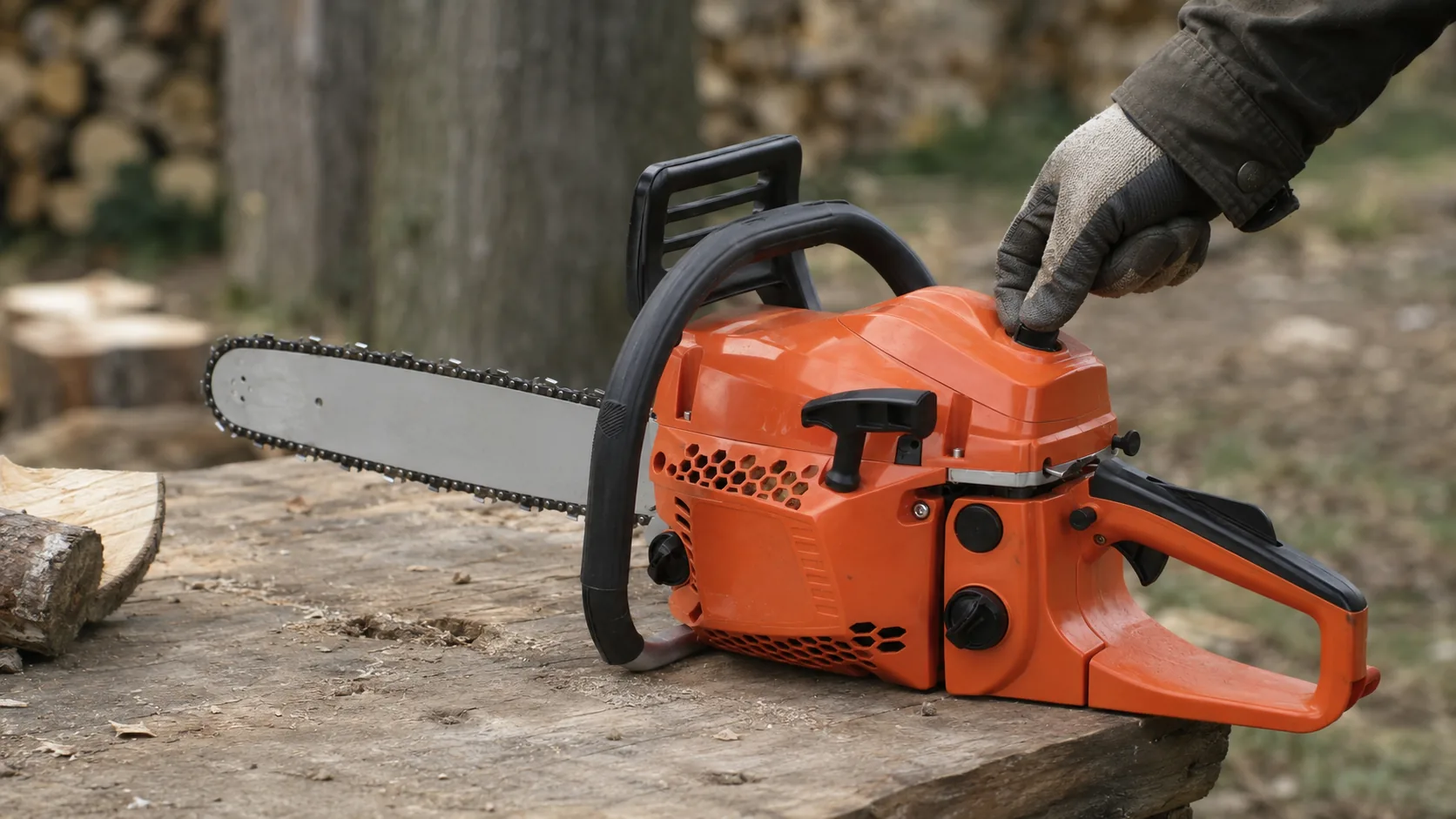
Gas Chainsaw Won’t Start After Sitting: Post-Storage Troubleshooting Guide
If your gas chainsaw won’t start after sitting for several weeks or months, begin with the fuel rather than the carburetor adjustment screws. Stored fuel, repeated starting attempts with too much choke, a wet or fouled spark plug, and restricted fuel flow are more useful first checks than immediately assuming that the carburetor or engine has failed.
This guide is specifically for a chainsaw that worked before storage but becomes difficult or impossible to start when returned to service. It does not cover a saw that starts normally and dies when the throttle is released, stalls only when the chain enters wood, runs only with the choke engaged, or refuses to restart when hot.
START HERE
Quick answer: replace questionable stored fuel first, then use the correct starting sequence without repeatedly pulling with full choke. If the engine still does not fire, inspect the spark plug to determine whether fuel is reaching the cylinder, then check the air filter, fuel filter and accessible fuel lines. Carburetor inspection belongs later in the sequence. For importers and dealers, fuel instructions, spark-plug specification, fuel filter and carburetor service parts should be confirmed against the exact engine configuration before machines enter a seasonal market.
1. Define the No-Start Symptom Before Disassembling the Saw
A post-storage no-start problem has a narrower diagnostic path than many other chainsaw complaints. The machine previously operated, then remained unused, and now fails to start or requires unusually many starting attempts.
| Observed Condition | Keep in This Diagnostic Path? | Priority |
| Worked before storage, now will not fire | Yes | Fuel condition and starting procedure |
| Starts but dies when throttle is released | No | Idle-related diagnosis |
| Runs only with choke on | No | Fuel-delivery or mixture diagnosis |
| Starter rope suddenly feels abnormally hard | Separate carefully | Mechanical resistance or flooding check |
Keeping these symptoms separate helps prevent unnecessary carburetor adjustment and avoids mixing several unrelated faults into one repair process.
2. Replace Old Fuel Before Changing Engine Settings
The first practical question is how long the fuel has remained in the tank or storage container. Fuel condition can deteriorate during storage, and questionable fuel can contribute to difficult starting and deposits in the fuel system.
Post-storage fuel check
- Drain questionable stored fuel into an approved container.
- Inspect the fuel tank for visible contamination.
- Prepare fresh fuel according to the actual engine specification.
- Do not dilute a large quantity of old fuel by simply adding fresh fuel on top of it.
Do not guess the required fuel specification from another chainsaw. The TM-CS5807 gasoline chainsaw, for example, is listed with a standard 58cc displacement, 2.4kW rated output, a 550ml fuel tank and a separate 260ml oil tank. The product page also lists 45cc, 52cc and 62cc engine options.
The published product information does not state one fixed fuel-mixing ratio. That ratio therefore should not be inferred from the 58cc displacement or copied from another model. Dealers should confirm the correct fuel requirement for the engine configuration actually being supplied.
3. Stop Repeated Full-Choke Pulling and Read the Spark Plug
A chainsaw that does not start immediately can become harder to start if the operator repeatedly pulls the starter with the choke fully closed. Full choke enriches the mixture for cold starting, but repeated attempts can introduce more fuel than the engine can ignite.
Possible Flooding Signs
|
Spark-Plug Evidence
|
If flooding is suspected, follow the flooded-engine starting procedure specified for the actual chainsaw. Continuing the same full-choke sequence normally adds more fuel rather than correcting the cause.
Do not replace the spark plug solely because another plug has the same thread. Heat range, reach and other specifications must match the engine. The TM-CS5807 product data does not publish one fixed spark-plug model, so spare-parts packages should be confirmed against the selected 45cc, 52cc, 58cc or 62cc configuration.
4. Check Airflow and Fuel Delivery Before Opening the Carburetor
A saw stored in a farm shed, workshop or warehouse can still contain fine sawdust and oily debris left from its previous use. Inspecting those external service points is faster and less disruptive than immediately opening the carburetor.
| 01 | Air filter: look for packed fine sawdust, oily contamination, damaged material and dirt around the sealing area. |
| 02 | Fuel filter: inspect for visible contamination or restriction. |
| 03 | Fuel hose: check accessible sections for cracking, hardening, loose connections or leakage. |
| 04 | Fuel tank: look for debris or contamination that could interfere with fuel supply. |
If fresh fuel is present but the spark plug remains dry after the correct starting procedure, restricted delivery from the tank toward the carburetor becomes more plausible. Do not pull aggressively on small fuel hoses inside the tank, because fittings and flexible lines can be damaged during inspection.
Avoid running the engine without the air filter simply to see whether the saw will start. In a dusty forestry or farm environment, that can allow abrasive debris into the intake.
5. Keep Engine Fuel and Chain Oil as Separate Systems
Gasoline chainsaws normally use separate systems for engine fuel and guide-bar lubrication. Confusing the two during post-storage preparation can send troubleshooting in the wrong direction.
| TM-CS5807 Reservoir | Published Capacity | Diagnostic Role |
| Fuel tank | 550ml | Directly related to engine starting and combustion |
| Chain-oil tank | 260ml | Used for guide-bar and chain lubrication |
A low chain-oil level does not explain why an otherwise healthy engine refuses to fire, although the machine should not be returned to cutting work without proper chain lubrication. Engine no-start diagnosis belongs primarily to the fuel, air and ignition side; chain-oiling faults require a separate inspection path.
6. Consider Carburetor Service Only After the External Checks
If the chainsaw still refuses to start after fresh fuel, correct starting procedure, spark-plug inspection, air-filter inspection and fuel-delivery checks, storage-related contamination inside the carburetor becomes a more reasonable possibility.
However, “check the carburetor” should not automatically mean “turn the mixture screws.” Several different internal conditions can produce a no-start complaint.
| Possible Carburetor Condition | Why Random Adjustment Is Not the Same Repair |
| Contaminated internal passage | Requires inspection or cleaning rather than blind screw adjustment. |
| Damaged diaphragm or metering component | A component condition must be corrected before tuning can be meaningful. |
| Restricted fuel inlet | Changing mixture settings does not remove the restriction. |
| Incorrect carburetor adjustment | Adjustment becomes relevant only after other causes are separated. |
If internal service is required, carburetor and repair-kit compatibility should be confirmed against the actual engine rather than purchased only by the general description “58cc chainsaw.” This matters particularly when one product family is offered with several displacement options.
7. Stop Pulling if the Starter Rope Becomes Abnormally Hard
A chainsaw that will not start is not the same as a chainsaw whose engine cannot be pulled through normally. If the starter rope suddenly becomes extremely hard, stops abruptly or the engine no longer rotates normally, do not solve the symptom by pulling harder.
Stop-use checks
- Confirm that the starting procedure and chain-brake handling are correct.
- Look for an obvious starter-mechanism problem.
- Consider whether excessive fuel may have entered the cylinder.
- Stop if the engine shows signs of abnormal internal mechanical resistance.
Repeatedly forcing the starter can damage the rope, pulley or starter assembly without correcting the cause. This symptom deserves to be separated from an ordinary post-storage fuel problem.
8. TM-CS5807 Reference and Dealer Preparation Checklist
TM-CS5807 Gasoline ChainsawStandard displacement: 58cc Rated output: 2.4kW Fuel tank: 550ml Oil tank: 260ml Listed idle speed: 3300±200rpm Other listed engine options: 45cc, 52cc and 62cc |
The product page also shows multiple engine and guide-bar options. Ignition, fuel-system, carburetor and other service parts should therefore be matched to the machine actually supplied.
|
For seasonal farm and forestry markets, the useful dealer preparation is not simply stocking a generic “chainsaw service kit.” The parts and instructions need to correspond to the confirmed engine configuration.
| Before Ordering / Shipment | Dealer After-Sales Preparation |
|
|
For a gasoline chainsaw that worked before storage, the most efficient order remains straightforward: verify the controls, replace old fuel, avoid excessive full-choke pulling, read the spark plug, inspect airflow and fuel delivery, and only then move toward carburetor or deeper engine work.
Frequently Asked Questions
1. Why won’t my gas chainsaw start after sitting for several months?
Begin with stored fuel and the starting procedure. Old or contaminated fuel, repeated full-choke attempts, a wet or fouled spark plug, a dirty air filter and restricted fuel delivery are useful first checks before carburetor adjustment.
2. Should I adjust the carburetor when a chainsaw will not start after storage?
Not as the first repair. Replace questionable fuel, confirm the starting sequence, inspect the spark plug and air filter, and check accessible fuel-delivery components first. Internal carburetor contamination can be considered later if those checks do not resolve the problem.
3. What does a wet spark plug mean on a chainsaw that will not start?
A wet plug indicates that fuel is reaching the cylinder but is not being burned correctly. Repeated choke use or flooding is one possible reason. Follow the proper flooded-engine procedure for the actual machine rather than continuing to pull with full choke.
4. What if the spark plug stays dry after repeated correct starting attempts?
A dry plug makes fuel delivery more important to investigate. Check the fuel filter, accessible fuel hoses, tank contamination and the path toward the carburetor before assuming an ignition problem.
5. Does the TM-CS5807 use the same service parts for every engine option?
The available product information lists a standard 58cc version together with 45cc, 52cc and 62cc engine options, but it does not establish that all versions use identical spark plugs, carburetors or fuel-system service parts. Dealers should confirm parts against the actual engine configuration.
6. Why is my chainsaw starter rope suddenly very hard to pull?
Treat this separately from an ordinary no-start condition. Check the starting procedure, starter mechanism and the possibility of excessive fuel in the cylinder, and stop pulling if the engine shows abnormal mechanical resistance.
Need to Confirm a Chainsaw Configuration for Wholesale Supply?For distributors comparing the TM-CS5807, confirm the selected displacement, guide-bar option, fuel instructions and compatible service parts before shipment. Clear configuration records make post-storage starting complaints easier for dealers to diagnose when seasonal machines return to use. |
|