
Gasoline Multi Tool or Separate Garden Tools: Which to Choose?
Compare a gasoline multi tool with separate garden machines by workload, attachment changes, engine sharing, maintenance needs and dealer support.
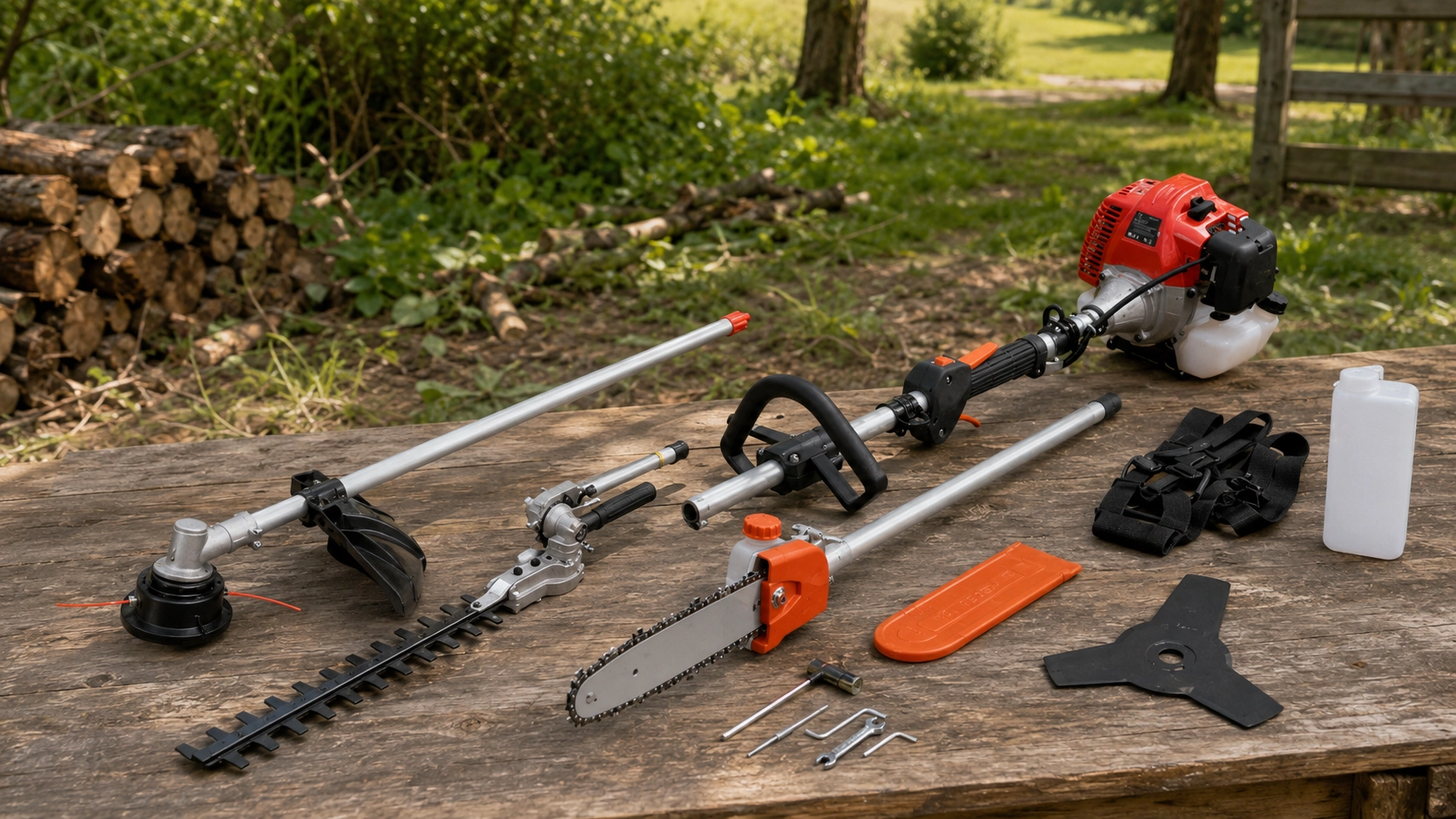
Gasoline Multi Tool vs Separate Garden Tools: What Importers Should Compare
A gasoline multi tool vs separate garden tools comparison should start with workload, not attachment count. A multifunction machine is useful when one operator moves between grass cutting, hedge trimming and branch pruning without using any one attachment continuously. Dedicated machines become more practical when one job occupies most of the working day.
For importers and dealers, the purchasing issue is therefore not whether four functions sound better than one. The real questions are how often attachments will be changed, whether several operators need to work at the same time, how the shared engine affects downtime, and which spare parts must remain attachment-specific.
| QUICK ANSWER |
Quick answer: Choose a gasoline multi tool when one operator performs several maintenance jobs in sequence and attachment use is intermittent. Choose separate garden tools when brush cutting, hedge trimming or pole sawing is continuous, when attachment changes would repeatedly stop work, or when several operators need to work simultaneously. For wholesale orders, compare the shared engine, attachment package, coupling system and spare-parts structure rather than judging the machine only by the number of included functions. |
First Decide How the Customer's Workload Is Divided
A multi tool shares one gasoline power unit across several working attachments. A dedicated brush cutter, hedge trimmer or pole saw gives each function its own complete machine.
That difference matters most when the customer's working day is mapped out. Mixed property maintenance usually favors a shared power unit. Long, specialized work usually favors dedicated equipment.
| Work Pattern | More Practical Choice | Reason |
| Grass cutting, hedge work and occasional pruning in the same day | Gasoline multi tool | One engine can be used across several intermittent tasks. |
| Several hours of continuous grass or weed clearing | Dedicated brush cutter | Unused hedge and pole-saw attachments provide little operational benefit. |
| Daily specialized hedge trimming | Dedicated hedge trimmer | The workflow does not depend on changing working heads. |
| Two operators must cut grass and prune at the same time | Separate machines | One shared power unit cannot operate two attachments simultaneously. |
For distributors, this workload distinction is more useful than advertising a machine simply as “4-in-1” or “multifunction.”
Attachment Changes Should Fit the Normal Workflow
A multifunction system works best when jobs are completed in blocks. An operator might clear grass first, install the hedge-trimmer attachment later and use the pole saw only when pruning work begins.
Changing attachments occasionally is very different from changing them every few minutes. Every change requires work to stop, the engine to be shut down and the next attachment to be fitted correctly. The coupling area should also be kept reasonably clean so dirt or debris does not interfere with the connection.
| Good Workflow for a Multi Tool
Complete grass work in one area, change the attachment once, perform hedge maintenance, then switch later for pruning. |
Poor Workflow for a Multi Tool
Alternate repeatedly between grass, hedge and pruning tasks where each attachment is only used for a few minutes before another change is required. |
This is a purchasing decision rather than a troubleshooting issue. The question is whether the user's normal working pattern suits a shared attachment system before the equipment is ordered.
One Engine Reduces Duplication but Concentrates Downtime
Using one engine for several attachments reduces the number of gasoline power units that require routine servicing. Fuel preparation, air-filter inspection, spark-plug service, carburetor-related work and recoil starter maintenance can all be centered around one engine.
For the TM-MT430, the reference configuration uses a 42.7cc 1E40F-5 two-stroke engine rated at 1.40kW, together with a diaphragm carburetor, 1:30 mixed-fuel ratio and 1200ml fuel tank.
Fewer engines can simplify routine maintenance and engine-parts stocking, but the shared power unit becomes a common dependency. If that engine is unavailable for service, the brush cutter, hedge trimmer and pole-saw attachments that depend on it are also unavailable.
This risk matters much more to a professional crew with scheduled jobs than to a property owner performing occasional maintenance.
Do Not Treat One Multi Tool as One Spare-Parts List
A multifunction machine reduces the number of engines, but each working attachment still introduces its own service parts and wear points.
| Attachment | Typical Service Areas | Dealer Planning |
| Brush cutter | Cutting head, blade mounting area, gearbox | Keep attachment-specific cutting and drive parts identified. |
| Hedge trimmer | Reciprocating blades, transmission mechanism | Do not mix blade-system parts with brush-cutter service stock. |
| Pole saw | Guide bar, saw chain, chain tension, lubrication | Stock saw-related wear parts separately from engine components. |
| Shared power unit | Fuel, air filter, spark plug, starter and engine service | Organize common engine parts around the confirmed engine specification. |
For after-sales departments, it is more accurate to view a gasoline multi tool as one engine system plus several separate working systems.
Check the Hardest Regular Job, Not the Easiest Attachment
A buyer should not choose a multifunction machine simply because the package contains more attachments. The shared power unit should be evaluated against the most demanding task that will be performed regularly.
The TM-MT430's listed 42.7cc displacement and 1.40kW rated output help place the machine within a product range, but those numbers should not be converted into unsupported claims about branch diameter, hedge capacity or cutting productivity.
- Identify the most frequent attachment. A buyer using the brush cutter 80% of the time has a different requirement from one using all attachments evenly.
- Identify the highest regular cutting load. Occasional pruning should not define the same purchase decision as prolonged dense vegetation clearing.
- Confirm the attachment supplied for that work. Final performance depends on the selected working head and operating condition.
- Then decide whether a shared engine remains practical. If the hardest task becomes continuous specialized work, a dedicated machine may be easier to manage.
Transport, Storage and Crew Size Can Change the Decision
A multi tool can be attractive where vehicle space or storage space is limited. Several attachments can be easier to organize than several complete gasoline-powered machines, especially for mobile maintenance teams and farms handling different seasonal jobs.
That advantage should not be confused with simultaneous productivity. One power unit cannot run the brush cutter and pole saw at the same time. If two employees must perform different jobs together, separate complete machines are required.
| 1 OperatorMixed jobs can favor one multi tool. | Several OperatorsSeparate power units may be required. | Limited Vehicle SpaceShared engine plus attachments can reduce duplication. |
Storage still needs to protect saw chains, hedge-trimmer blades, cutting heads and drive connections from damage. Reducing the number of engines does not remove normal storage and fuel-handling requirements.
TM-MT430 Product Match for Mixed Maintenance Work
TM-MT430 Multifunctional Brush CutterModel: TM-MT430 Engine: 1E40F-5, 42.7cc, two-stroke Rated output: 1.40kW Fuel specification: 1:30 mixed fuel Fuel tank: 1200ml Listed functions: brush cutter, hedge trimmer, pole saw and grass trimming. |
Best purchasing fit:
|
For wholesale orders, the final attachment package should still be confirmed in the quotation or proforma invoice. A dealer describing the product as a three-function, four-function or customized set should make sure the cartons, manuals and spare-parts references match the actual configuration supplied.
Importer and Dealer Checklist Before Ordering
Before adding a gasoline multi tool to a wholesale range, check both the customer's operating pattern and the after-sales consequences.
| Before Ordering | Dealer / After-Sales Setup |
|
|
FAQ About Gasoline Multi Tools vs Separate Garden Tools
Is a gasoline multi tool better than buying separate garden tools?
Not in every workload. A multi tool is more practical when one operator performs several intermittent jobs. Separate machines are usually easier when one task is continuous or several operators need to work at the same time.
Does a multi tool reduce maintenance?
It reduces engine duplication because several attachments share one power unit. However, brush-cutter, hedge-trimmer and pole-saw attachments still have their own wear parts and maintenance requirements.
What happens if the shared engine needs repair?
All attachments depending on that engine become temporarily unavailable. This is one reason professional crews with continuous schedules may prefer separate machines for their most important tasks.
Can two workers use different attachments from one multifunction set?
Not with one shared power unit. If one worker needs to brush cut while another uses the pole saw, two complete engine units are required.
What functions are listed for the TM-MT430?
The TM-MT430 product reference lists brush cutter, hedge trimmer, pole saw and grass trimming functions. The final combination supplied in a wholesale order should still be confirmed according to the quotation or proforma invoice.
Who is a gasoline multi tool most suitable for?
It is most relevant to farms, orchards, property-maintenance teams, garden services and other users where one operator carries out several different maintenance jobs without using one attachment continuously all day.
| Compare the Work Pattern Before Choosing the Tool Format
A gasoline multi tool vs separate garden tools decision should match the customer's real workload. If several attachments are used intermittently by one operator, the TM-MT430 can reduce engine duplication. If specialized work is continuous or several operators need equipment at the same time, separate machines may create the simpler operating setup. |
|