
What Does 8 L/min Mean on a 30L Power Sprayer?
Understand what an 8 L/min power sprayer flow rate means for a 30L tank, nozzle selection, spray time, field operation and model comparison.
What Does an 8 L/min Power Sprayer Flow Rate Mean for a 30L Tank?
An 8 L/min power sprayer flow rate does not mean a 30L tank will always be emptied in exactly 3.75 minutes. The flow figure describes the listed output capacity of the spraying system, while the liquid actually leaving the nozzle depends on nozzle design, pressure, trigger use, hose condition and the confirmed machine configuration.
For agricultural importers, the useful comparison is therefore not simply “30L tank plus 8L/min.” Tank capacity, practical nozzle discharge, crop application, operator movement and engine configuration all affect how the sprayer will be used in the field.
Quick answer:
| 1 | 8L/min describes the listed output capacity of the spraying system, not guaranteed nozzle discharge during every spraying job. |
| 2 | 30L ÷ 8L/min = 3.75 minutes is only a theoretical continuous-discharge calculation. |
| 3 | Importers should confirm the nozzle, pressure requirements, engine option, pump configuration and intended crop application before using flow rate to position a sprayer. |
What Does the 8 L/min Specification Actually Tell You?
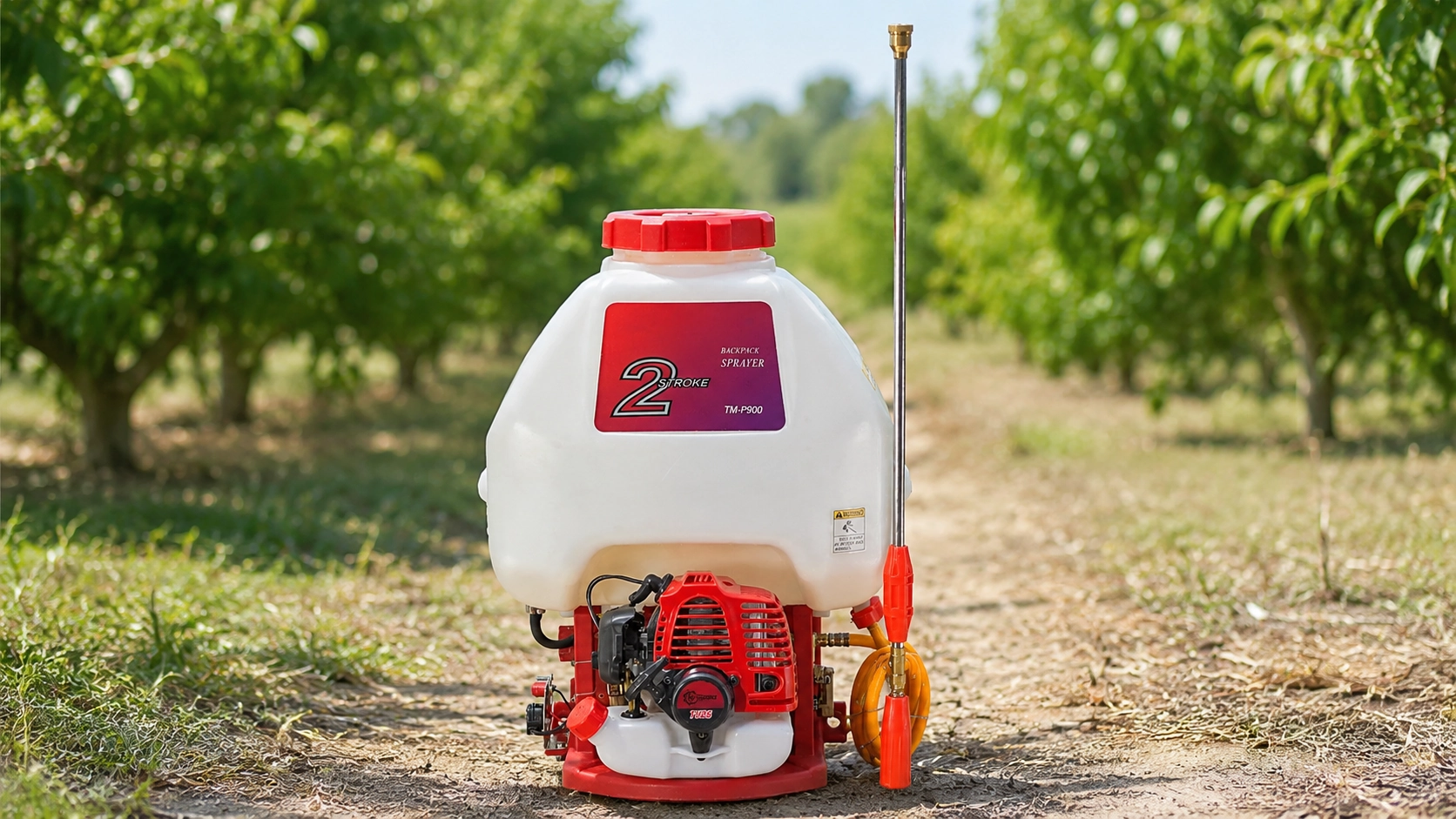
The TM-P900 30L power sprayer is listed with a 30L tank, 8L/min output, 25.6cc displacement and 0.81kW engine power in its reference configuration.
The standard engine shown is TU26, while 1E34F, 139F, GX35 and GX25 are listed as optional engine choices. The 8L/min figure helps a buyer understand the capacity of the spraying system to move liquid, but it should not automatically be treated as the amount of chemical leaving a particular nozzle every minute.
| Factor | How It Can Affect Practical Discharge |
| Nozzle opening and design | The nozzle creates a restriction and may use only part of the available system flow. |
| Operating pressure | Pressure changes how liquid is delivered through the selected nozzle. |
| Trigger use | Intermittent spraying reduces average liquid consumption over the complete work period. |
| Lance, gun and hose | The supplied spray arrangement and restrictions in the system can influence practical delivery. |
| Engine and pump configuration | The final ordered configuration should be confirmed before dealers publish performance information. |
The key distinction for distributors is between listed machine output and actual application rate at the crop. They are related, but they are not the same specification.
Why 30L ÷ 8L/min Does Not Give Guaranteed Tank Runtime
The calculation is mathematically useful because it shows the relationship between tank volume and listed output. It assumes, however, that all 30 liters are discharged continuously at exactly 8L/min.
Agricultural spraying normally does not follow that pattern. Operators may release the trigger while turning at the end of a row, walking between treatment areas, repositioning the hose or moving from one plant to another. A nozzle can also discharge less than the maximum flow available from the spraying system.
The same 30L tank can therefore remain in use considerably longer than the theoretical 3.75 minutes. Importers should not advertise the calculated value as guaranteed field runtime.
Higher Flow Is Not Automatically Better for Every Crop
A larger L/min number does not automatically mean an agricultural sprayer will finish every job faster. The useful flow depends on the amount of liquid the application actually requires.
High liquid output may suit jobs that require substantial spray volume. In another application, the same discharge could shorten tank duration and increase refill frequency without improving treatment quality. For controlled foliage coverage, nozzle selection and pressure may matter more than maximum pump output.
| Buying Question | Why It Matters |
| What crop or vegetation is being treated? | Closely spaced crops, larger foliage and orchard applications can require different spray patterns. |
| What nozzle will be supplied? | Nozzle opening and pattern influence practical liquid consumption. |
| Is controlled coverage or high volume required? | The correct choice is not always the configuration with the greatest discharge. |
| What refill pattern is practical? | Higher consumption can increase the number of stops required for refilling and chemical preparation. |
A better purchasing question is: can the spraying system provide the flow and pressure required by the selected nozzle and application?
Nozzle and Pressure Separate Pump Capacity From Crop Application
The nozzle is one of the most important components between the pump and the crop. It restricts the system and shapes the liquid into the required spray pattern. Depending on the nozzle opening, it may use only part of the flow that the spraying system is capable of supplying.
| Flow Rate
Describes how much liquid moves through the spraying system over a period of time. |
Pressure
Affects how liquid is delivered through the selected nozzle and contributes to the resulting spray condition. |
Two machines can therefore behave differently even when their flow figures appear similar. Nozzle design, adjustment, hose condition and operating pressure can all affect the actual spray pattern.
Replacing a nozzle with a larger opening simply to increase discharge is not automatically beneficial. Excessive liquid can shorten tank duration and may result in unnecessary chemical use or runoff.
When pesticides or other agricultural chemicals are used, operators should follow the chemical manufacturer's handling and application instructions and use appropriate protective equipment. If a required pressure specification is not stated for a particular machine configuration, it should be confirmed before dealers make application claims.
A 30L Tank Is Also a Field-Handling Decision
Tank capacity affects more than refill frequency. The TM-P900 is listed at 11kg net weight before spraying liquid is added.
Thirty liters of water alone has a mass of roughly 30kg. Agricultural mixtures can differ in composition, so the exact filled weight should not automatically be assumed to be identical for every liquid.
- how often the operator needs to refill;
- how much liquid weight is carried after filling;
- handling on uneven or sloping agricultural land;
- whether operators prefer full or partial tank fills;
- how long high-volume spraying continues before the machine becomes lighter.
A distributor serving relatively flat fields may evaluate a 30L machine differently from one serving users who walk long distances on steep or uneven land. Tank capacity should therefore be matched to both spraying demand and operator handling conditions.
TM-P900 Power Sprayer: Where the Specification Fits
TM-P900 30L Power SprayerTank capacity: 30L Listed output: 8L/min Reference displacement: 25.6cc Engine power: 0.81kW Standard engine shown: TU26 Optional engines listed: 1E34F, 139F, GX35, GX25 Net weight: 11kg |
Purchasing relevance:
|
The listed 8L/min output is most useful as a system-capacity reference. It should not be turned into unsupported claims about hectares per hour, number of trees per tank or guaranteed spraying time without the additional application information required for those calculations.
Importer Procurement Check Before Ordering a Power Sprayer
Where several engine options and spraying configurations are available, the dealer specification should follow the actual ordered machine rather than relying only on the model name.
| No. | Procurement Check | Why It Matters |
| 01 | Confirm the selected engine model. | TM-P900 lists TU26 with several optional engine choices. |
| 02 | Verify the final pump and spraying-system configuration. | Flow information should correspond to the actual machine ordered. |
| 03 | Confirm the supplied nozzle, lance or spray gun. | The working attachment directly affects practical spray delivery. |
| 04 | Confirm pressure requirements for the intended application. | Do not create dealer claims where the required specification has not been confirmed. |
| 05 | Review the crops and spraying pattern in the target market. | Application conditions determine whether available flow is useful. |
| 06 | Evaluate 30L tank handling in the local terrain. | Refill convenience must be balanced against filled carrying weight. |
| 07 | Prepare spare parts for the confirmed engine and pump. | Parts planning should not rely only on the TM-P900 model name. |
| 08 | Match dealer literature to the quotation or proforma invoice. | This reduces configuration errors in catalogs and after-sales records. |
| 09 | Avoid promising tank runtime from 30 ÷ 8 alone. | Actual consumption changes with nozzle, pressure and trigger use. |
FAQ About 8 L/min Power Sprayer Flow Rate
How long will a 30L tank last at 8L/min?
The theoretical continuous-discharge calculation is 3.75 minutes. Actual tank duration can be longer because nozzle flow, pressure, trigger use and interruptions during field work change average liquid consumption.
Does an 8L/min sprayer always discharge 8 liters through the nozzle every minute?
No. The listed output describes spraying-system capacity. Actual nozzle discharge depends on the nozzle, operating pressure, lance or gun configuration, hose condition and system adjustment.
Is a higher power sprayer flow rate always better?
No. Higher flow is useful only when the application requires that liquid volume. For some crops, controlled coverage and the correct nozzle pattern can be more important than maximum output.
Can I calculate hectares sprayed from the 8L/min specification?
Not from flow rate alone. Field coverage also depends on application rate, nozzle discharge, crop spacing, walking speed, spray width, trigger use and field layout.
What engine options are listed for the TM-P900?
The reference product information shows TU26 as the standard engine and lists 1E34F, 139F, GX35 and GX25 as optional engine choices. Buyers should confirm the selected version for the actual wholesale order.
What should an importer confirm before ordering a 30L power sprayer?
Confirm the engine, pump and spray configuration, nozzle or gun supplied, pressure requirements where applicable, target crop use, spare-parts package and dealer documentation. The ordered configuration should be matched to the quotation or proforma invoice.
| Match Flow Rate to the Actual Spraying Job
The practical value of an 8 L/min power sprayer flow rate is understanding the capacity available to the spraying system—not predicting a fixed tank runtime. For TM-P900 wholesale orders, confirm the 30L tank, selected engine, nozzle or spray accessories and spare-parts requirements together before preparing dealer specifications. |
|