
What Does a 28mm Brush Cutter Shaft Mean for Parts Fit?
A 28mm brush cutter shaft affects gearbox, handle and attachment fit. See what buyers should confirm before replacing parts or ordering stock.
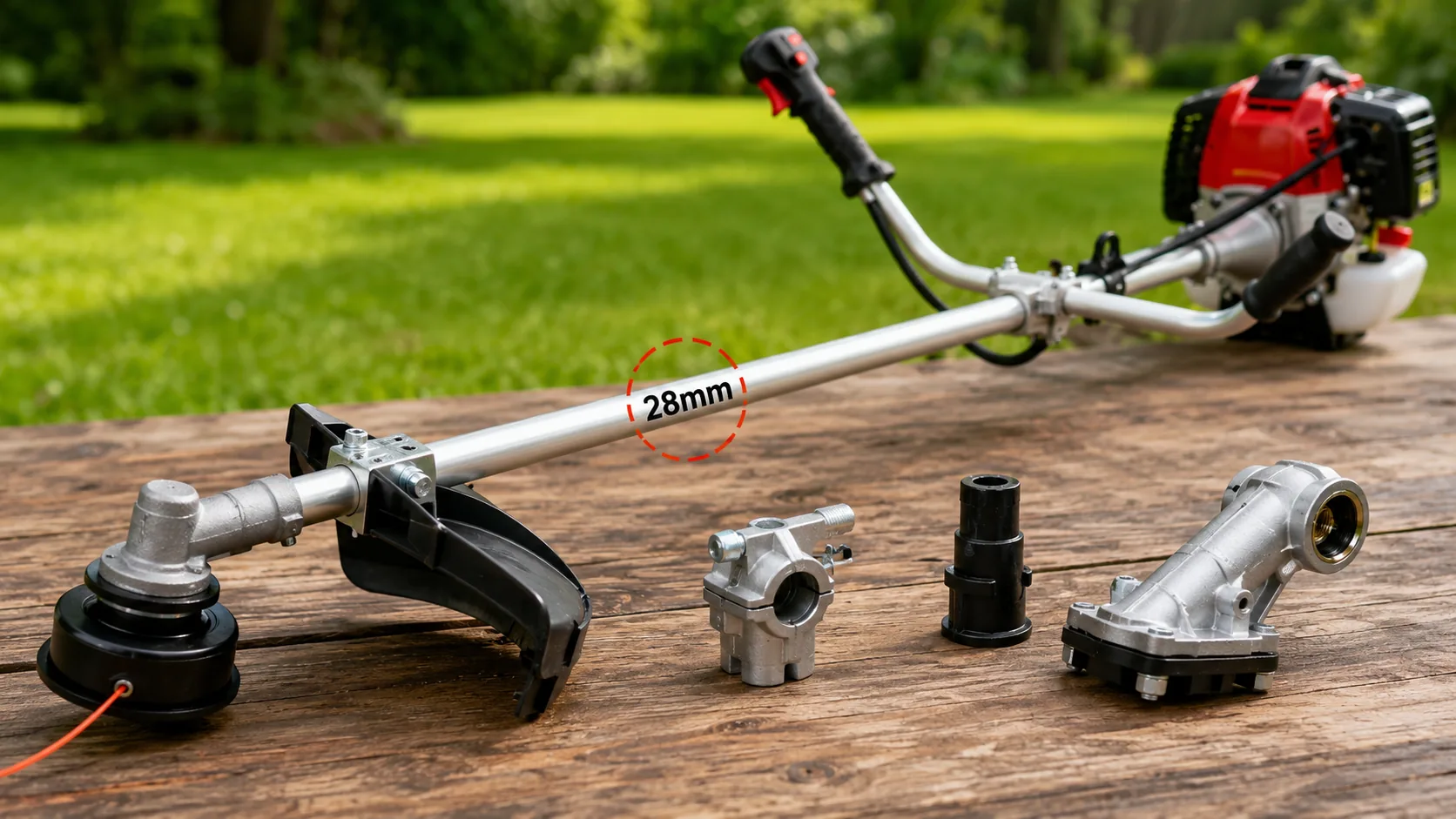
28mm Brush Cutter Shaft Compatibility: What Importers Should Check Before Ordering Parts
A 28mm brush cutter shaft is an important compatibility dimension, but it does not mean every gearbox, drive shaft, handle clamp or attachment marked “28mm” will fit the machine. Before ordering replacement parts, the outer tube diameter should be checked together with the internal drive connection, mounting method and the dimensions of the component being replaced.
This distinction becomes especially important for distributors handling several brush cutter platforms. Two machines can both be described as 52cc brush cutters and still use different shaft assemblies, gearbox inputs or cutting-side connections. Treating displacement or tube diameter as a complete spare-parts standard can lead to stock that physically mounts but does not transmit drive correctly.
Quick answer: A 28mm brush cutter shaft specification normally identifies the outer diameter of the main shaft tube. It does not confirm the internal drive shaft, gearbox input, cutting-head thread, coupling system or attachment compatibility. Before buying spare parts, first confirm the tube diameter, then compare the drive connection shape and dimensions, engagement depth, retaining arrangement and output-side connection. Importers carrying several 43cc or 52cc platforms should keep model-specific shaft and gearbox records instead of stocking generic “28mm” or “52cc” transmission parts.
What Does a 28mm Brush Cutter Shaft Diameter Actually Confirm?
On a brush cutter specification sheet, shaft diameter generally refers to the diameter of the main outer tube running between the engine assembly and the cutting gearbox.
The TM-CG520 52cc gasoline brush cutter, for example, lists a 28mm shaft diameter. Its reference specification also lists a 1E44F-5 two-stroke air-cooled engine, 51.7cc displacement and rated output of 1.8kW at 7500rpm.
The 28mm figure is useful when identifying components that physically clamp around, mount onto or slide over the tube. It should not automatically be treated as the diameter or specification of the internal drive shaft.
| Component | Does 28mm help? | What else must be checked? |
| Gearbox housing | Yes | Input drive shape, engagement depth, retaining method and output connection |
| Handle clamp | Yes | Clamp construction, bolt layout, handlebar size and control routing |
| Internal drive shaft | No | Overall length, end profile, tooth form and both engagement ends |
| Working attachment | Only partly | Coupling, drive interface, locking system and transmission design |
Why a 28mm Gearbox Can Still Be the Wrong Replacement
The gearbox normally clamps onto the lower end of the outer shaft tube. Its housing therefore needs an inlet diameter compatible with that tube. For a 28mm machine, this is the first dimensional check, not the final one.
Inside the tube, the engine transfers rotation through an internal drive shaft into the gearbox. The gearbox input must match that shaft correctly. A gearbox can clamp securely onto a 28mm tube and still be unusable if its internal connection is different.
If the tube fits but the drive connection does not, tightening the gearbox will not correct the mismatch. The machine may have no drive to the cutting head, incomplete shaft engagement or an incorrectly assembled transmission. For spare-parts purchasing, the gearbox should be matched to the complete shaft system.
Do Not Use “52cc” or “CG520” as a Complete Spare-Parts Standard
Descriptions such as “52cc brush cutter gearbox,” “52cc brush cutter shaft” and “CG520 spare parts” are common search terms. They help narrow down a product family, but they are not precise compatibility specifications.
A 51.7cc engine describes the engine platform. It does not automatically define the shaft tube, internal transmission or cutting-head interface. This is a common stocking risk for wholesalers buying visually similar machines from several factories.
| 51.7cc / 52cc engine | Does not define shaft tube diameter, gearbox input, gearbox output or handle mounting. |
| 28mm outer tube | Does not define the internal shaft profile, blade mounting dimensions or nylon-head thread. |
| “CG520” market name | Should not be assumed to mean every factory uses the same shaft or transmission system. |
For dealer after-sales support, stock should be identified by the confirmed machine model and component specification rather than by displacement alone. This becomes increasingly important once several 43cc, 52cc or similarly styled machines are stored in the same warehouse.
What Should Be Measured on the Internal Drive Shaft?
The internal drive shaft carries engine rotation through the outer shaft tube. A 28mm outer tube specification does not provide enough information to identify this component.
When replacing only the internal shaft, compare the original part with the proposed replacement. The dimensions that determine actual engagement should be recorded rather than inferred from the shaft tube.
| Inspection point | Why it matters |
| Overall shaft length | Determines whether both engine-side and gearbox-side connections can engage correctly. |
| Cross-sectional shape at each end | Different drive profiles cannot be corrected by matching the outer tube. |
| End dimensions or tooth form | The receiving engine and gearbox interfaces must match. |
| Engagement-section length | Insufficient engagement can prevent correct power transfer. |
| Engine and gearbox ends | Both ends must be checked; matching only one side is incomplete. |
For some aftermarket programs, ordering a complete matched shaft-and-gearbox assembly can reduce identification errors compared with combining individually sourced transmission parts. Whether this is appropriate depends on the machine design and the spare-parts program being supplied.
Will Any 28mm Attachment or Handle Clamp Fit?
Not necessarily. Attachments advertised as 26mm or 28mm often make tube diameter appear to be the main compatibility rule. In practice, an attachment must also receive mechanical drive from the machine and remain correctly locked during operation.
A dimension match may be enough to inspect
|
A dimension match is not enough to confirm
|
There is also an important structural difference between a standard brush cutter shaft and a detachable multi-function system. The TM-CG520 specification confirms a 28mm shaft diameter, but the supplied product page does not state that the shaft is a detachable multi-tool coupling system.
Buyers should therefore not assume that hedge trimmer, pole saw, cultivator or other interchangeable attachments can be installed merely because they are advertised for a 28mm tube. Attachment compatibility must be confirmed according to the actual shaft assembly.
Handle assemblies require similar care. A 28mm clamp must fit the tube, but the complete handle replacement may also depend on the clamp construction, bolt arrangement, handlebar diameter, anti-rotation features, throttle cable routing, control-handle installation and any rubber or isolation components used in the confirmed configuration.
TM-CG520 Reference: Why the Specifications Must Be Read Separately
TM-CG520 52cc Gasoline Brush CutterModel: TM-CG520 Reference engine: 1E44F-5 two-stroke air-cooled Displacement: 51.7cc Rated output: 1.8kW at 7500rpm Shaft diameter: 28mm This model is useful as a reference for importers evaluating a 28mm shaft brush cutter, but the engine displacement, engine output and shaft diameter should be treated as separate specifications. Spare gearbox, drive-shaft and attachment compatibility should be confirmed against the selected machine configuration. |
|
Importer and Dealer Checklist for 28mm Brush Cutter Spare Parts
For bulk orders, build the spare-parts record around the exact machine configuration instead of requesting generic “28mm brush cutter parts.” The objective is to make repeat orders and workshop identification possible even after similar models are added to the range.
| 01 | Record the confirmed outer shaft tube diameter rather than relying on the market name of the machine. |
| 02 | Identify the internal drive shaft length, end profile and engagement dimensions. |
| 03 | Match each replacement gearbox to the shaft system, not only to a 28mm mounting bore. |
| 04 | Confirm the cutting-side output connection before stocking blades, blade hardware or nylon heads. |
| 05 | Check whether optional working attachments are actually supported by the shaft and coupling system. |
| 06 | Keep handle clamps with the matching bolts and hardware when multiple versions are difficult to identify visually. |
| 07 | Use model-specific warehouse labels instead of broad categories such as “52cc gearbox.” |
| 08 | Keep dimensions and part references as the primary identification method; use photographs as additional support. |
| 09 | Record the confirmed shaft assembly and matching transmission parts together with the final quotation or proforma invoice for repeat-order consistency. |
Questions to Confirm Before Finalizing a Bulk Quotation
If interchangeability with existing dealer inventory matters, compatibility should be included in the technical confirmation before the machines arrive. This is more effective than trying to identify gearbox and shaft versions after the first service claims appear.
| 1 | Is 28mm the confirmed outer shaft tube diameter? |
| 2 | What internal drive shaft is supplied with this configuration? |
| 3 | Which replacement gearbox matches that shaft? |
| 4 | Are the gearbox and drive shaft available as separate service parts? |
| 5 | Which cutting-head connection is supplied? |
| 6 | Are optional attachments confirmed for this exact shaft and coupling system? |
These questions are particularly useful when an importer already sells another brush cutter and wants to share spare-parts stock between models. A shared 28mm shaft diameter is a useful starting point, but it is not evidence that the gearbox, internal shaft or working attachments are interchangeable.
28mm Brush Cutter Shaft Compatibility FAQ
Is a 28mm brush cutter gearbox universal?
No. The 28mm dimension may confirm the gearbox housing can mount to the outer tube, but the gearbox input profile, engagement depth, retaining method and cutting-side output must also match the machine.
Does a 52cc brush cutter always use a 28mm shaft?
No. Engine displacement and shaft diameter are separate specifications. Similar 52cc machines can use different shaft tubes, internal drive shafts and gearbox systems depending on the model and confirmed configuration.
Can I install a 28mm hedge trimmer or pole saw attachment on a normal brush cutter?
Not from the tube diameter alone. The attachment must match the coupling, internal drive connection, locking arrangement and transmission system. A standard brush cutter shaft should not be assumed to have a detachable multi-tool interface.
What should I measure before buying a brush cutter drive shaft?
Record the overall shaft length, the cross-sectional shape at each end, end dimensions, tooth form where applicable, engagement-section length and both the engine-side and gearbox-side connections.
Is the TM-CG520 shaft diameter 28mm?
Yes. The reference specification for the TM-CG520 lists a 28mm shaft diameter together with a 1E44F-5 two-stroke air-cooled engine, 51.7cc displacement and rated output of 1.8kW at 7500rpm. These specifications should still be treated separately when selecting spare parts.
How should distributors label 28mm brush cutter spare parts?
Use the confirmed machine model together with the component specification or part reference. Avoid relying only on labels such as “28mm,” “52cc” or “CG520,” especially when several factories or configurations are represented in the same spare-parts inventory.
Confirm the Shaft System Before Building Your Spare-Parts PackageFor the TM-CG520 or another 28mm brush cutter shaft model prepared for wholesale distribution, confirm the outer tube, internal drive shaft, gearbox and cutting-side connection according to the selected configuration. Recording these details at quotation stage makes later spare-parts purchasing and repeat-order matching more precise. |
|