
Brush Cutter Supplier for Wholesale and OEM Orders
Source gasoline brush cutters for wholesale and OEM orders. Compare engine sizes, shafts, attachments, spare parts and configurations with Teamaxpower.
Wholesale • Distribution • Private Label
Brush Cutter Supplier for Wholesale and OEM Orders
Importers and distributors looking for a brush cutter supplier need more than an attractive machine and a low unit price. A workable supply program must cover suitable engine sizes, shaft and handle configurations, cutting attachments, service parts, packaging requirements and repeat-order documentation for the destination market.
TEAMAX supplies gasoline brush cutters for distributors, agricultural equipment dealers, wholesalers and private-label buyers. The available selection includes compact machines for lighter maintenance, widely requested 43cc and 52cc configurations, and higher-displacement models for markets requiring more demanding cutting applications.
Quick answer: Evaluate a brush cutter supplier by its ability to define and reproduce complete configurations—not only by the number of models or the quoted engine displacement. Confirm the engine identity, shaft and handle construction, cutting package, standard accessories, OEM scope, spare-parts references and inspection requirements before comparing prices. A smaller range of clearly differentiated models is normally easier for a distributor to sell, service and reorder than a catalog filled with similar machines.
What Should a Brush Cutter Supplier Offer Commercial Buyers?
A supplier relationship should support the complete purchasing cycle—from initial model selection and sample approval to bulk inspection and repeat orders. The machine is only one part of that process. Importers also need controlled specifications and enough technical information to support local sales and after-sales service.
Commercial buyers should be able to confirm the following points before approving a quotation:
| Power Unit | Machine Configuration | Commercial Control |
|
|
|
These details prevent machines with similar product names from being treated as identical. Two 52cc brush cutters, for example, may use different handles, shaft assemblies, cutting heads, guards, harnesses and packing arrangements. Those differences affect price, operation, freight planning and replacement-parts demand.
Brush Cutter Models for Different Market Positions
One machine rarely covers an importer’s complete customer base. Dealers may serve homeowners, farms, landscaping contractors and professional vegetation-clearing users at the same time. Each model in the range should therefore have a defined commercial purpose.
| Model Position | Typical Requirement | Selection Priority | Commercial Risk |
| Compact / light-use | Routine grass trimming and lighter maintenance | Balance, working weight, cutting package and service needs | Choosing by low price without checking usability |
| 43cc general-purpose | Common farm, garden and dealer applications | Actual displacement, engine identity, shaft and handle | Assuming the commercial model name is the specification |
| 52cc wholesale core | Thicker grass, weeds and demanding field conditions | Defined handle, shaft, harness and attachment package | Stocking several cosmetically different but overlapping models |
| Higher displacement | Heavier vegetation and longer working periods | Harness, vibration, shaft, gearbox and load testing | Treating displacement as proof of universal cutting capacity |
Compact Brush Cutters for Lighter Maintenance
Lower-displacement machines can suit customers who prioritize easier handling, routine trimming and lighter property maintenance. They may also create an accessible entry price for agricultural equipment dealers.
Displacement alone is not enough for selection. Compare working weight, handle position, machine balance, shaft construction, cutting attachment, harness configuration and local service requirements. A lightweight machine still needs the correct cutting system and a practical spare-parts plan.
43cc Brush Cutters for General Dealer Demand
The 43cc category is commonly considered by buyers seeking a balance between familiar construction, manageable handling and general farm or garden use. Different machines in this category may use different engine specifications, handle designs, shaft systems and accessory packages.
Product names and technical values should be checked separately. A model marketed in a 43cc category may have a technical displacement that is not exactly 43cc. Record the engine model, actual displacement, rated output, shaft, handle and cutting accessories in the final quotation.
52cc Brush Cutters for Wholesale Ranges
The 52cc segment is often relevant to agricultural dealers whose customers work in thicker grass, weeds and more demanding field conditions. Each 52cc model added to a distributor’s range should have a distinct purpose, such as a different shaft system, handle configuration, harness, cutting package, price level or customer group.
Selecting multiple models that differ only in color or cover styling can divide sales volume and make parts planning unnecessarily complicated.
Higher-Displacement Brush Cutters
Higher-displacement models may fit markets where customers expect machines for heavier vegetation or longer working periods. Pay particular attention to working weight, vibration, harness support, shaft strength, gearbox configuration, cutting-tool compatibility and heat-cycle behavior. Final performance still depends on the complete machine, attachment, vegetation and operator technique.
Build a Focused Wholesale Product Range
The most effective dealer range is not necessarily the one containing the most products. Too many similar machines can confuse customers, divide order quantities and increase the number of replacement components dealers must carry.
Use one question before adding a model:
Does this machine reach a new customer group, application or price position—or does it merely duplicate a model already in the range?
A practical range may contain an entry-level machine, a core general-purpose model and a higher-demand option. This structure gives every product a defined role and allows the importer and brush cutter supplier to organize accessories and service parts more efficiently.
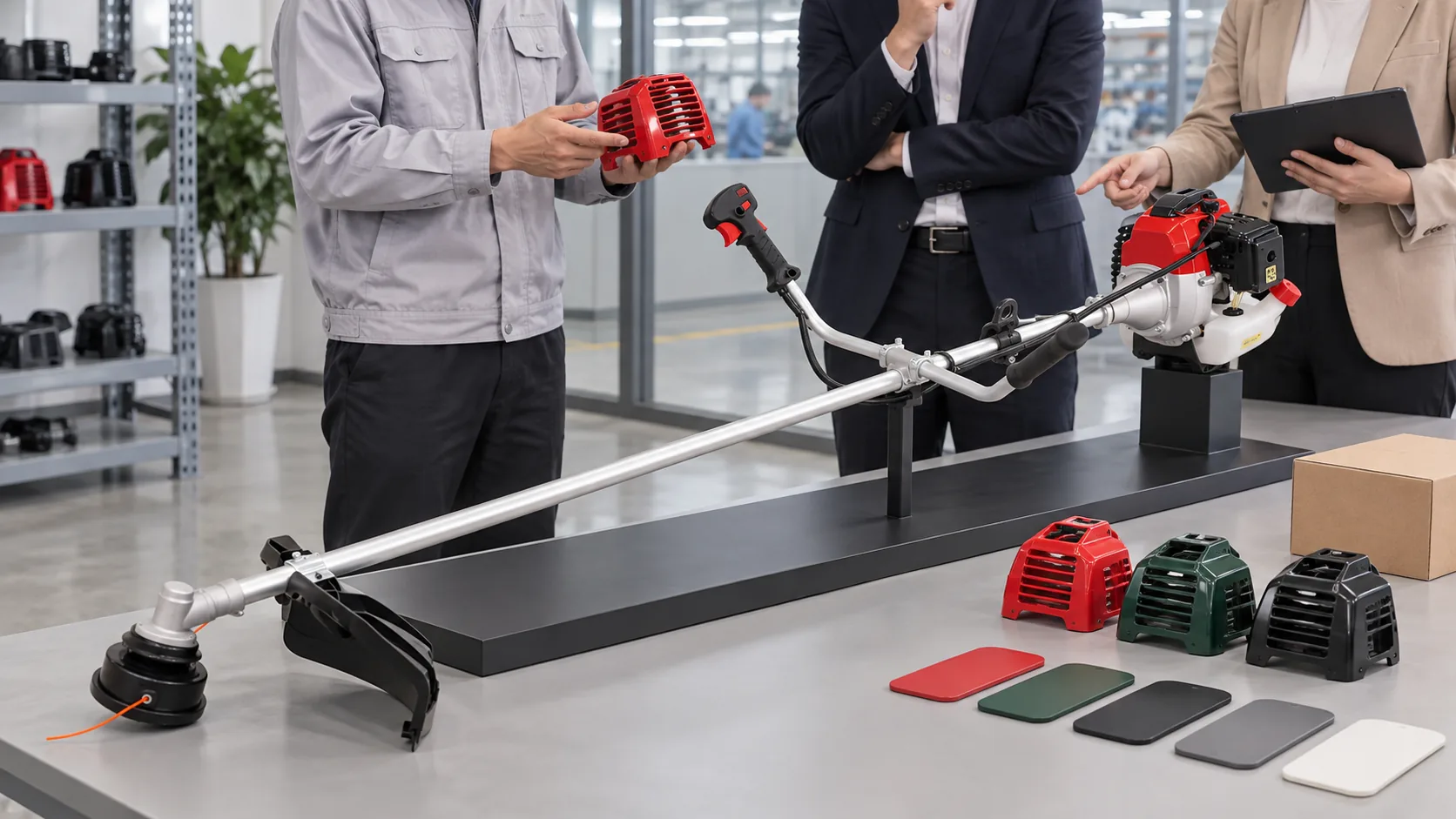
A different color or engine cover is not always enough to justify another stock-keeping unit. Commercial separation should come from a meaningful configuration, user group or price distinction.
Models for Wholesale and Dealer SelectionReview compact, 43cc, 52cc and higher-displacement gasoline brush cutters, then shortlist models according to application, configuration, price position and after-sales requirements. |
|
OEM Branding Must Follow the Approved Configuration
Private-label supply requires more than adding a buyer’s logo. Branding and technical approval need to remain connected because a logo can be printed correctly while the machine label, carton, manual and quotation contain inconsistent specifications.
Brand and appearance
|
Documents and packaging
|
The engine code, displacement, fuel requirement and model reference should remain consistent across the machine label, operating instructions, carton and commercial documents. Final editable artwork should be submitted only after the physical configuration has been approved.
If the machine specification changes after printing begins, the buyer may receive packaging or manuals prepared for a different version. A controlled approval sequence reduces that risk.
Spare Parts and After-Sales Planning
A brush cutter supplier should identify service parts according to the actual machine and component specification. Descriptions such as “43cc spare parts” or “52cc spare parts” may be too broad because machines with similar displacement can use different carburetors, recoil starters, clutches, shafts, gear cases and mounting dimensions.
| Parts Group | Examples | Planning Focus |
| Routine wear items | Blades, nylon heads, trimmer line, air filters, spark plugs and fuel filters | Regular local consumption |
| Damage-prone operating parts | Guards, handles, throttle controls, harnesses, starters and shaft-related parts | Field damage and dealer repairs |
| Model-specific repair parts | Carburetors, clutches, gearboxes, drive shafts, engine components and specific fasteners | Exact model and component matching |
Recommended quantities depend on the order volume, local repair habits, expected workload and whether several models use verified common components. Parts should not be described as interchangeable until dimensions and part references have been checked.
Clear identification helps distributors support the first shipment and manage later orders without guessing which component belongs to which version.
Prepare a Comparable RFQ and Approve the Sample
A request asking only for “your best 52cc brush cutter price” leaves too many variables open. Different suppliers may quote different shafts, handles, blades, nylon heads, harnesses and packaging. Those prices cannot be compared accurately.
|
|
If the model has not been selected, describe the local customer, vegetation and working conditions instead of choosing by engine displacement alone. TEAMAX can then discuss relevant configurations from its gasoline brush cutter range.
Use the Sample as the Production Reference
A sample should establish the configuration for the bulk order. Approval should cover more than appearance or basic starting. Depending on the selected model, the inspection can include cold starting, warm operation, hot restarting, idle stability, throttle response, clutch engagement, cutting-head behavior, shaft and handle assembly, guard installation, harness fit, vibration, visible fuel leakage, labels, accessories and carton protection.
Where practical, test the sample under a controlled cutting load representing the intended market. Record the fuel and oil, confirmed mixing ratio, attachment, vegetation, test duration, operating conditions and post-test observations.
After approval, retain a written specification or approved-sample record. Use it when preparing the proforma invoice, approving artwork, inspecting production and placing repeat orders.
Wholesale Brush Cutter Order Checklist
The following checks connect commercial approval with production consistency. Adjust the details to the selected model and destination market.
| Before Ordering | Before Shipment |
|
|
Randomly selected production units should be compared with the confirmed specification—not with memory or a generic catalog description. A substitute component should not automatically be considered equivalent simply because it can be installed on the machine.
This control is particularly important for repeat orders, where a broad request for “the same model” may not identify every component used in the earlier shipment.
Frequently Asked Questions
How do I choose a brush cutter supplier for wholesale orders?
Compare the supplier’s model range, specification clarity, sample process, configuration control, spare-parts identification, OEM support and ability to reproduce the approved machine in later orders. Compare unit prices only after the quoted configurations and accessories are equivalent.
Does TEAMAX supply different brush cutter engine sizes?
The TEAMAX category includes compact models, widely requested 43cc and 52cc configurations, and higher-displacement options. Confirm the exact engine model, displacement and technical specification for every shortlisted machine.
Can importers request OEM branding?
OEM requirements such as product color, logo, labels, manuals and carton artwork can be discussed according to the selected model and order. Record the final scope in the quotation or proforma invoice before artwork and production approval.
What information is needed for a brush cutter quotation?
Send the destination market, expected quantity, preferred models or applications, handle and shaft requirements, cutting attachments, accessories, branding, packaging, spare-parts needs and preferred trade term.
Should wholesale buyers order spare parts with the machines?
Dealers should plan routine wear items and model-specific service parts according to the order size and local repair habits. Verify compatibility against the exact machine configuration rather than relying on displacement alone.
Can one brush cutter model serve every market segment?
Usually not. Homeowners, farms, landscaping teams and heavier-use customers may require different displacement, weight, handle, shaft and cutting configurations. A focused but differentiated model range is generally easier to sell and support.
|
DISCUSS YOUR SUPPLY REQUIREMENTS Shortlist Brush Cutters for Your MarketReview the TEAMAX gasoline brush cutter selection, then send your target market, preferred engine range, estimated quantity, required configuration, OEM scope and spare-parts needs for quotation discussion. |
|