
How Should Dealers Check a Chainsaw Chain Brake at Handover?
A chainsaw chain brake check should verify guard movement, brake engagement, release and the correct test procedure before dealers hand over a petrol saw.
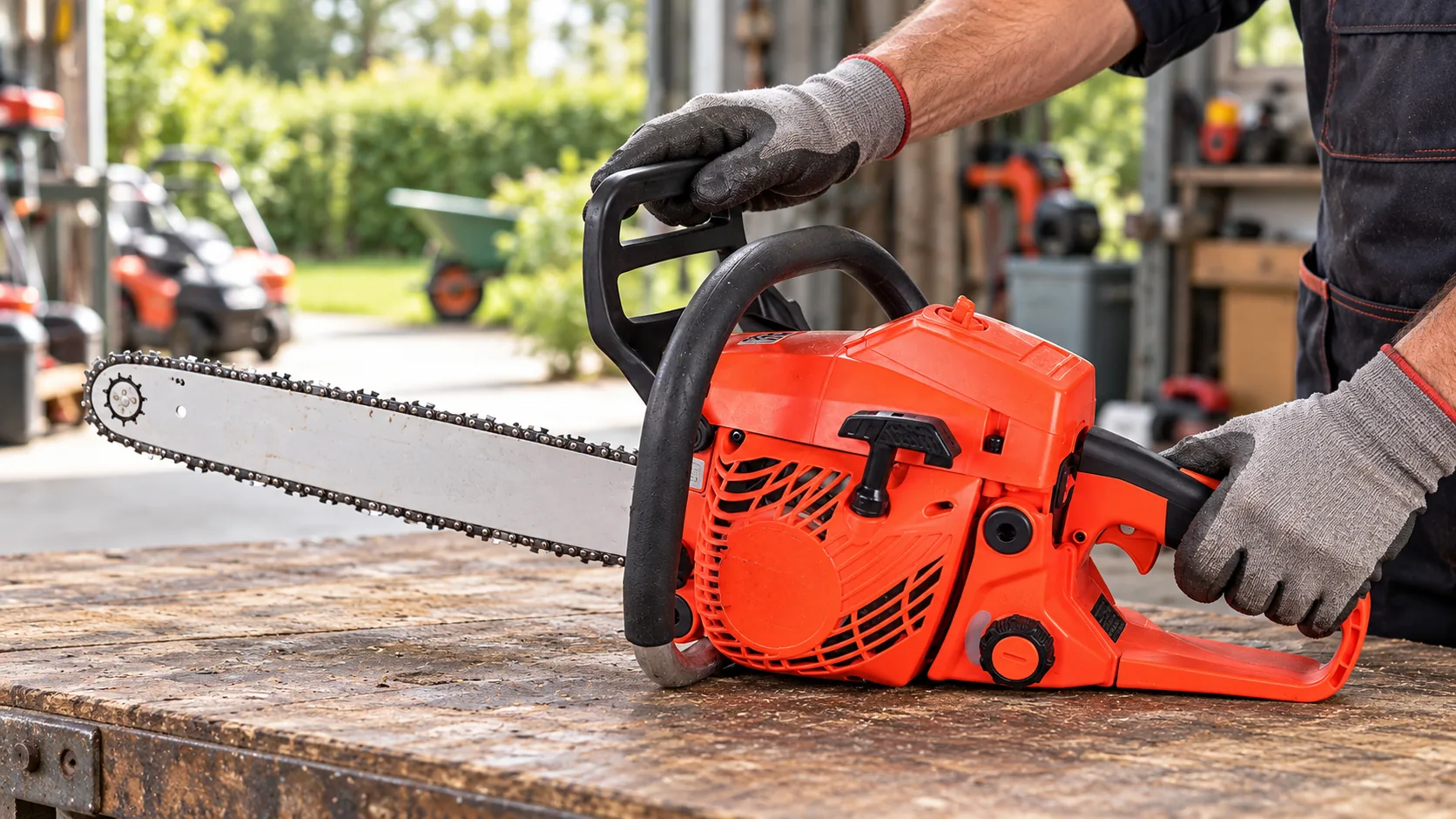
How Should Dealers Check a Chainsaw Chain Brake at Handover?
A chainsaw chain brake check must establish that the control operates correctly and that the brake performs its intended function using the procedure specified for the actual saw. A moving hand guard or an audible click alone does not prove braking performance.
At dealer handover, the result must belong to the individual machine being delivered. The inspection should also teach the customer how to operate the fitted system and make clear when a doubtful result means the saw must remain out of service. This is a pre-delivery brake inspection; it does not diagnose a chain that moves at idle or refuses to turn during cutting.
Quick answer: Obtain the brake instructions for the supplied chainsaw configuration before testing. Inspect the hand guard with the engine stopped, distinguish brake holding from a binding cutting system, and have a trained person perform any prescribed running test. Confirm manual and inertia activation separately where required; do not assume an inertia function from the guard’s appearance. Neither engine output nor idle speed defines brake acceptance. If engagement, stopping or release is doubtful, keep the saw out of service until a qualified technician resolves the issue and completes the required recheck. Demonstrate the controls and record the result for the customer’s actual machine.
1. Obtain the Brake Procedure for the Supplied Configuration
Start with the operating instructions for the machine being delivered. Identify the brake control, its engagement and release positions, the inspection method and any specified service limits. Confirm whether the supplied system includes inertia activation; the appearance of the front hand guard does not establish this.
A manual from another chainsaw can explain general principles, but its test speed, handling sequence or inspection dimensions must not become the acceptance standard for this model. If the correct procedure is unavailable, request it before attempting a powered brake test or handing over the saw.
MODEL REFERENCE FOR DEALER PREPARATION
TM-CS4000 Gasoline Chainsaw
The TM-CS4000 lists a 40.2cc engine and 1.6kW rated output, with 11.5-inch, 16-inch and 18-inch guide-bar options. Its published idle reference is 3300 ±200rpm. These details help identify the selected machine and cutting set; they do not specify the brake mechanism, activation method or acceptable stopping time.
For importers considering this model for a dealer programme, the procurement priority is to obtain the applicable brake instructions alongside the selected configuration. Confirm product specifications and supplied safety components in the quotation or proforma invoice.
| Review TM-CS4000 Specifications |
2. Inspect Guard Movement With the Engine Stopped and Cool
Inspect the guard and its attachment points for cracks, deformation, loose mounting parts and contact with nearby components. Transport damage or incorrect assembly may restrict the clearance around the control.
Operate the guard only as described in the manual. It should reach the specified positions without forcing. A guard that catches halfway, moves inconsistently or will not remain in position needs investigation before any engine-running test.
Do not apply lubricant indiscriminately to improve a stiff control, or tighten an unfamiliar fastener until movement changes. Cleaning methods, permitted lubrication points and any procedure for removing a brake-related cover must come from the applicable instructions. A pre-delivery inspection should not become an improvised repair of a safety mechanism.
3. Distinguish Brake Holding From Cutting-System Resistance
A chain that cannot be moved does not automatically prove that the brake holds correctly. Excessive chain tension, incorrect assembly or a binding guide bar can also prevent movement. Use the manufacturer’s engine-off procedure to distinguish the brake-engaged and brake-released conditions.
Before any permitted manual chain check, prevent accidental starting as instructed, wear protective gloves and keep hands clear of cutting edges. Never touch or attempt to move the chain while the engine is running. If the released cutting system binds, correct that separate problem before assessing the brake.
| Observation | What it establishes | Handover decision |
| Guard moves or makes a click | Control movement only; braking performance remains unverified | Continue the specified chainsaw chain brake check |
| Cutting system binds with the brake released | Resistance may come from assembly, tension or the guide bar | Resolve the binding before evaluating the brake |
| Chain moves at normal idle | A separate idle or drive-system concern requiring investigation | Do not use the engaged brake to conceal the symptom |
| Stopping, engagement or release is doubtful | The prescribed brake inspection has not established an acceptable result | Keep the saw out of service pending repair and recheck |
Record the bar and chain actually fitted to the customer’s TM-CS4000. The listed bar options are configuration references, not proof that every bar and chain combination is interchangeable. A result from a demonstration saw must not be copied onto the delivery record for a differently assembled unit.
4. Keep the Running Test Within the Approved Method
Any engine-running functional test should be performed by a trained person in a clear area, wearing the required protective equipment. Follow the applicable manual’s position, grip, activation method and engine condition. Do not improvise a kickback event to demonstrate activation.
Where separate manual and inertia activation checks are required, record them separately. Passing one does not verify the other. The Husqvarna start-up inspection guidance provides general context, but the supplied model’s instructions must define its acceptance procedure.
Release the throttle immediately as directed during the test. Holding high engine speed against an engaged brake can damage the clutch and brake system. A prescribed brief test is different from repeatedly revving a saw with its chain locked; consult the STIHL chainsaw safety manual for general safety context.
The TM-CS4000’s 3300 ±200rpm idle reference is neither a brake-test speed nor a stopping-time specification. If the chain does not stop as required, the guard engages inconsistently or release leaves abnormal resistance, stop testing. Repeated attempts do not make an uncertain result acceptable. A qualified technician must resolve the problem and complete the required recheck.
5. Demonstrate the Controls Without Promising Complete Protection
After the inspection passes, show the customer the engagement and release positions on the actual machine. Identify the manual section covering checks before use. Let the customer identify the control with the engine stopped before any supervised operating demonstration.
Explain that the chain brake and engine stop control have different functions: engaging the brake does not switch off the engine. A working brake does not eliminate kickback risk or replace correct handling, protective equipment and suitable cutting technique. The STIHL chain-braking systems overview provides background on these functions.
If inertia activation is fitted, describe only its confirmed function. Do not present it as a guarantee that every kickback will activate the brake.
6. Complete an Individual Dealer Handover Record
The record should identify the machine, fitted cutting set, applicable manual and inspector. Separate visual condition, control movement, engine-off checks, the prescribed functional test and the customer demonstration.
Write unresolved observations precisely. “Guard does not reach the release position” is more useful than “brake problem.” Retain the failed observation and subsequent recheck when repair is needed, rather than changing the original inspection to a pass.
Importer / Dealer Checklist
- Identify the individual saw by its available model and machine identification.
- Record the actual guide bar and chain fitted for delivery.
- Identify the applicable operating instructions and brake inspection criteria.
- Confirm the supplied activation functions, including whether inertia activation is fitted.
- Record guard condition, mounting condition and movement to the specified positions.
- Complete the approved engine-off checks and resolve released-system binding.
- Record each required functional check separately, with the inspector’s name and inspection date.
- Document doubtful or failed results, corrective work and the required recheck.
- Confirm that the customer has been shown brake engagement, release and the separate engine stop control.
- Make the final handover decision only after the applicable checks are complete and unresolved faults are cleared.
7. Chainsaw Chain Brake Check: Dealer Questions
Does a clicking hand guard mean the brake has passed?
No. Movement or a click does not establish braking performance. Complete the inspection specified for the actual saw.
Can the TM-CS4000 idle speed be used as the brake-test speed?
No. The published 3300 ±200rpm value is an idle reference. It does not define a running brake-test condition or an acceptable stopping time.
Does manual activation also verify an inertia brake?
Not by itself. First confirm whether inertia activation is fitted. Where the applicable instructions require separate checks, complete and record each one.
What if the chain remains difficult to move after brake release?
Stop the assessment and investigate the resistance using the approved engine-off procedure. Incorrect assembly, excessive tension or guide-bar binding can interfere with the brake check.
Can a dealer use another chainsaw’s test instructions?
They may help explain general principles, but they must not supply the acceptance standard for this machine. Obtain the applicable procedure before a powered test or handover.
Can the saw be handed over while an uncertain result is investigated?
No. Keep it out of service until a qualified technician resolves the concern and completes the required recheck.
Prepare the Brake Instructions Alongside the Dealer Order
For a TM-CS4000 dealer programme, request the applicable brake operating instructions and inspection criteria alongside the selected cutting configuration. A repeatable chainsaw chain brake check depends on the correct method, an individual machine record and a clear customer demonstration.
| Ask About the Supplied Configuration |