
Private Label Chainsaw Artwork: What Should Buyers Check?
Approve private label chainsaw artwork by checking model identity, technical claims and cutting-set variants before machine labels and cartons are printed.
PRIVATE LABEL PROCUREMENT · PRINT APPROVAL
Private Label Chainsaw Artwork: What Importers Should Approve Before Printing
Private label chainsaw artwork should be approved against a confirmed production specification and a defined cutting-set configuration. Logo placement is only one part of the decision. Each label and carton must identify the ordered machine, use supported technical claims and belong to the artwork version authorized for printing.
The risk increases when one powerhead has several guide-bar options or an importer replaces the factory model name with a retail code. A visually correct proof can still describe the wrong machine or leave dealers unable to distinguish packaged variants.
Quick answer: Approve the machine identity, technical wording and packed cutting-set variant before releasing private label chainsaw artwork. Keep the supplier model and branded sales model linked in writing, and confirm displacement separately from the model code. Where several guide bars are available, define how each finished carton identifies the version inside. Review an actual-size proof, assign one traceable printing release and compare production labels and cartons with that release before shipment. Product-page specifications provide a reference; the supplier’s written confirmation must establish the configuration for the private label order.
1. Link the Retail Model to the Factory Production Reference
Before reviewing colors or layout, create a written cross-reference between the supplier’s model and the importer’s sales model. State which reference appears on the machine label, carton, manual and spare-parts records. Purchasing and service teams need to recognize the same machine even when customers see only the private label name.
The TM-CS5800 illustrates why the model name and technical specification need separate fields. Its published displacement is 55cc, although its model code contains “5800.” That number should not become a 58cc claim unless the actual ordered engine has been confirmed accordingly.
A changed logo does not define a new mechanical specification. Equally, an unchanged retail model name does not establish that the engine or cutting set remains the same. The cross-reference must identify the approved production configuration.
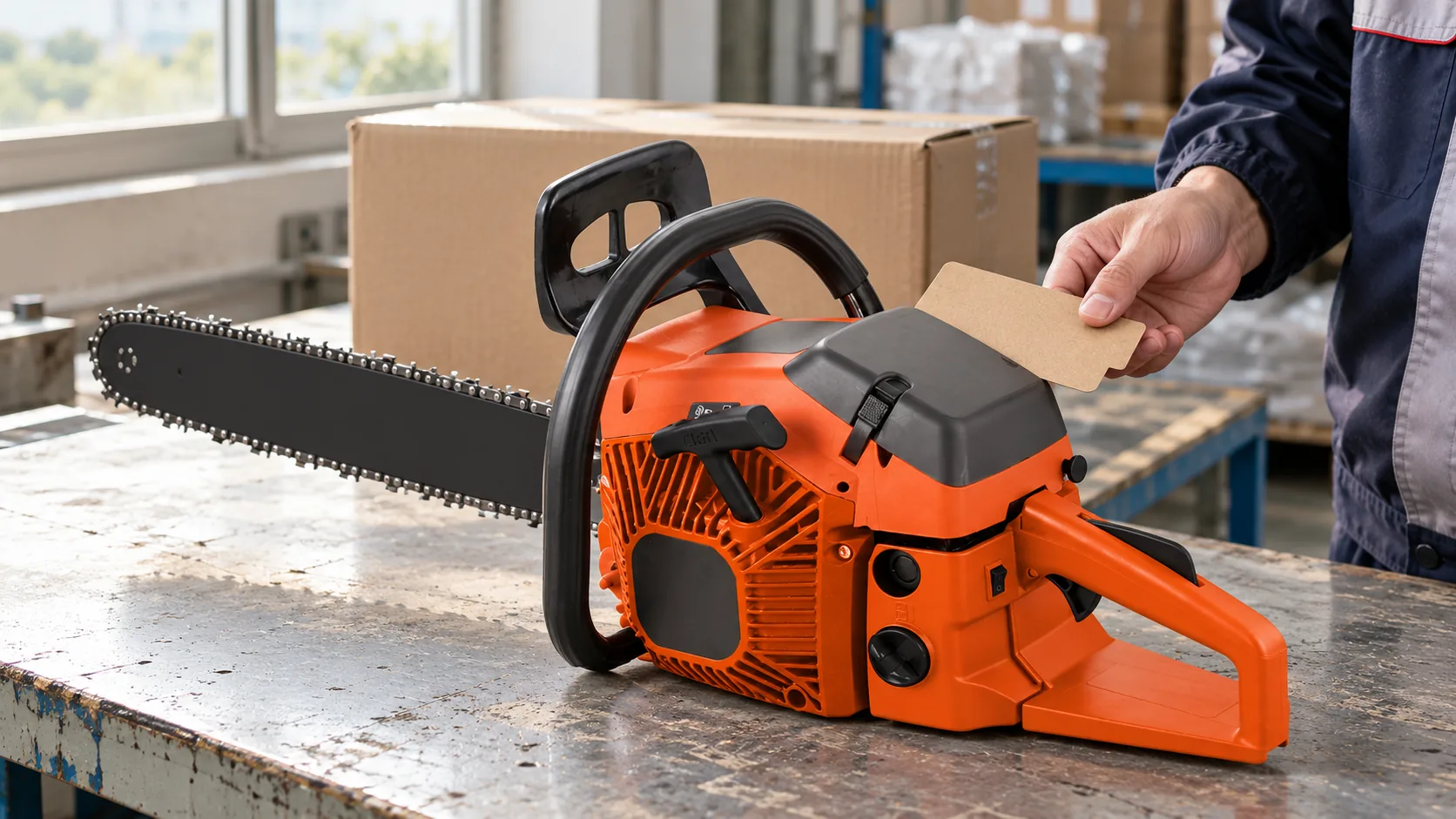
TM-CS5800 Gasoline Chainsaw
A relevant model for importers reviewing private label identification across alternative cutting sets. The supplied reference lists 55cc displacement, 2.4kW at 7500rpm and 20-inch or 22-inch guide-bar options.
Use these details to prepare the text approval sheet, then obtain written confirmation of the engine and cutting set included in the order.
| Check Specifications |
2. Approve Technical Wording Before the Layout Is Locked
Confirm quantities, units and descriptions before preparing final design files. If the order retains the published 2.4kW at 7500rpm rating, keep the power value and associated engine speed together wherever that rating appears. Engine rpm must not be presented as chain speed.
A text approval sheet helps expose old figures left on secondary panels. Record the field, approved wording and every location where it appears. The following items need separate decisions:
| Artwork field | Approval basis | Error to prevent |
| Model identity | Written factory-to-retail model cross-reference | A branded name disconnected from production and parts records |
| Displacement | Factory-confirmed ordered engine; published reference: 55cc | Inferring 58cc from “5800” |
| Rated output | 2.4kW at 7500rpm, if retained in the approved specification | Separating the rating from its engine speed or mislabeling rpm |
| Guide-bar variant | Selected 20-inch or 22-inch configuration | Listing available options without identifying the packed version |
Translations and unit conversions also require review. Do not add horsepower, cutting diameter or productivity claims to fill unused carton space. Resolve missing specifications with the supplier instead of borrowing a plausible figure from another model.
The released technical text should match the confirmed quotation or proforma invoice. Product-page values remain reference information until the private label order specification is agreed in writing.
3. Make the Packed Cutting Set Identifiable Without Opening the Carton
The TM-CS5800 lists 20-inch and 22-inch guide-bar options. Even where the branded powerhead is shared, the packing team and dealer need an unambiguous way to distinguish the ordered versions. Agree on separate carton artwork or a controlled variant-label system before printing.
| Separate carton versions
Each printed version identifies its intended cutting set. Approval must cover every ordered carton version, and packing must match the machine to the correct carton. |
Controlled variant labels
Shared artwork requires a defined label or marking process that identifies the actual contents. Agree on the wording, location and packing check. |
“20/22 inch” may describe available options, but it does not identify which one is inside. Without an additional marking method, receiving staff may have to open cartons to separate stock.
Review the product photograph too. A general promotional image may show a different guide bar or accessories. Request order-specific images where the pictured configuration could mislead the buyer, and show accessories only when included or clearly marked as optional. Artwork and the packing list must describe the same retail unit.
4. Inspect Actual-Size Prints on the Intended Surfaces
Request a physical proof or representative print at the intended size. Check small text, numbers against backgrounds, resized images and information near carton folds or joins. An enlarged screen proof can make these problems difficult to notice.
For the machine label, verify its dimensions and proposed position against the actual housing. If adhesive labels are used, obtain confirmation of the label construction and suitability for the mounting location and operating environment. A carton sticker should not automatically be specified for the machine.
Keep marking review distinct from design approval. Responsible parties need to review product warnings and destination-specific markings. Branding must not obscure existing safety information, and certification marks require evidence that they apply to the supplied configuration. A marketing proof does not establish that approval.
5. Release One Traceable Private Label Chainsaw Artwork Version
Assign a version reference and record the approver, approval date and covered order. “Use the latest file” is insufficient when several revised PDFs or images have circulated. The printing release should identify the machine label, carton and any included branded material.
List revisions explicitly. A displacement correction may affect several panels even when the model name is unchanged. Keep the approved text sheet with the final files, and ensure a revised carton does not leave an older machine label authorized for production.
If obsolete printed stock exists, agree on its disposition before production continues. Reuse must follow an approved decision; it should not depend on whether packing staff consider the old artwork close enough.
6. Use This Importer Checklist at Release and Shipment
Separate permission to print from verification of the printed result. The first stage establishes the approved files; the second checks whether production followed them.
Before releasing files
- Record the supplier model, private label model and approved mechanical configuration.
- Confirm displacement independently of the model code.
- Approve technical wording, units, translations and all artwork locations.
- Define how each packed guide-bar variant will be identified.
- Match photographs and illustrated accessories to the agreed retail contents.
- Approve actual-size label and carton proofs, including label position and construction.
- Record the status of warning and destination-marking reviews.
- Identify the authorized file versions, covered order and treatment of obsolete print stock.
Before shipment and repeat ordering
- Compare production labels and cartons with the released artwork, including figures, images and variant markings.
- Inspect examples from every ordered package variant in a mixed shipment.
- Retain a printed sample or clear photographs with the order record and document discrepancies.
- Reconfirm the mechanical configuration and artwork applicability before reusing files for a repeat order.
One photographed carton cannot represent every variant in a mixed shipment. The inspection record needs to connect each sampled machine with its branded identity and marked cutting set.
7. Questions About Private Label Chainsaw Artwork Approval
Can TM-CS5800 artwork state 58cc because the model contains “5800”?
No. The supplied product reference lists 55cc. Use the factory-confirmed displacement for the ordered engine; a model code is not evidence of cylinder displacement.
Is “20/22 inch” enough to identify the packaged chainsaw?
It describes options, but does not identify the supplied option. Use separate carton versions or an agreed variant-marking system that corresponds to the contents.
Should the retail model name replace the factory reference in all records?
Keep a written cross-reference even if customer-facing materials use only the retail model. Production, purchasing and spare-parts records need a way to identify the original configuration.
Does approving a PDF authorize every branded item for printing?
Only if the release clearly identifies the covered items and file versions. A carton approval should not be treated as approval of an unspecified machine label or manual.
Can the same artwork be reused for a repeat order?
Yes, after confirming that the mechanical specification, cutting set, approved wording and applicable markings still match. The same retail model name alone does not establish that the previous files remain suitable.
Prepare the Order Details Before Print Approval
For a TM-CS5800 private label enquiry, provide the intended brand, retail model name, selected guide-bar configuration, destination market and proposed artwork. Request confirmation of the technical text and factory-model cross-reference before releasing private label chainsaw artwork for printing.
| Ask About Available Configurations |