
Short-Shaft or Long-Shaft Outboard Motor for Small Boats?
Compare short-shaft and long-shaft outboard motors, measure boat transom height correctly, and reduce compatibility problems when ordering for resale.
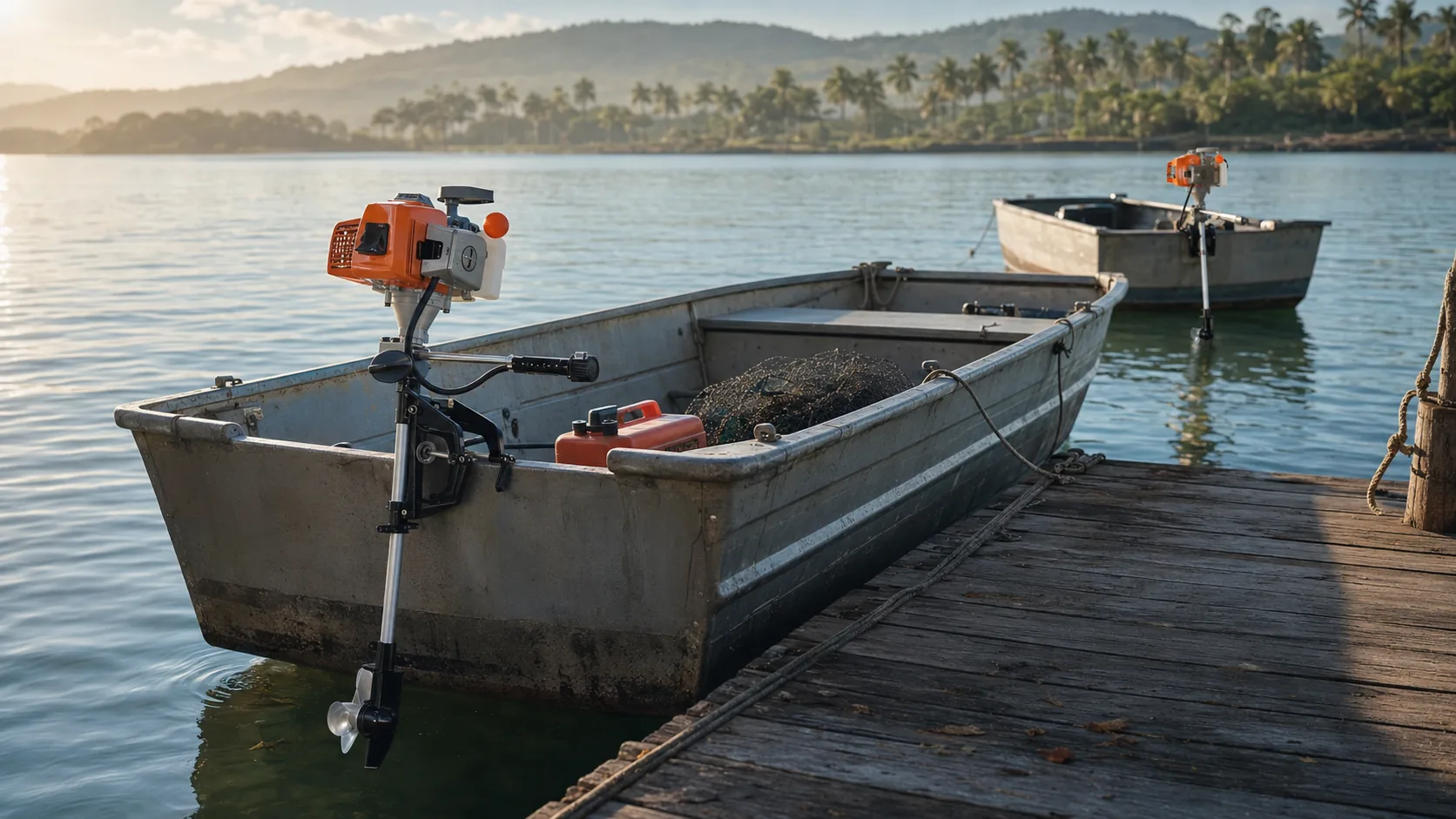
|
Small-Boat Motor Selection
The correct outboard motor shaft length depends primarily on the boat’s transom height. Selecting the wrong configuration can cause ventilation, excessive drag, poor handling and avoidable customer complaints—even when the engine itself operates normally. |
|
Quick Answer
|
Measure vertically from the top center of the transom mounting area to the bottom of the hull. A low transom generally requires a short-shaft configuration, while a taller transom requires a long shaft. Always compare the boat measurement with the supplier’s dimensional drawing before ordering. |
What Outboard Motor Shaft Length Actually Means
Outboard shaft length describes the approximate vertical distance from the motor’s mounting bracket to the anti-ventilation plate above the propeller. This dimension determines how deeply the lower unit and propeller sit after installation.
The advertised length is normally a size category, not a measurement of every visible part. Because suppliers may use slightly different reference points, importers should request an actual dimensional drawing rather than relying only on the terms “short” and “long.”
|
Configuration A
Short Shaft
Intended for boats with a relatively low motor-mounting position. |
Configuration B
Long Shaft
Designed for a taller transom that places the motor higher above the hull bottom. |
Configuration C
Extra-Long Shaft
Used for specialized boats or unusually tall transom installations. |
Measure the Boat Transom Before Selecting a Motor
The transom is the rear section of the boat where the outboard motor is mounted. Measure vertically from the top center of the mounting area down to the bottom of the hull.
Do not follow the angled face of the transom. That measurement will be longer and may lead to the wrong selection. Keels, reinforced center sections and unusual stern shapes must also be considered when identifying the actual bottom reference point.
| Dealer measurement | Why it matters | Common buying risk |
|---|---|---|
| Vertical transom height | Determines the basic shaft category | Propeller sits too high or too deep |
| Transom thickness | Must fit the mounting-clamp range | Correct shaft but incompatible bracket |
| Stern hull shape | Affects water flow around the propeller | Ventilation or unstable thrust |
| Normal boat load | Changes how deeply the stern sits | Motor works empty but performs poorly when loaded |
| Structural condition | Confirms whether the transom can support the motor | Damage, movement or unsafe mounting |
What Happens When the Shaft Is Too Short?
A short shaft fitted to a high transom can leave the propeller too close to the water surface. Instead of receiving a steady flow of water, the propeller may draw air and lose grip.
| Engine revs but acceleration is weak The symptom can be mistaken for insufficient engine power or propeller damage. | Thrust disappears during turns Water moves away from the propeller area and the blades draw air. |
| Performance changes with loading The problem may be more obvious when a fishing boat is lightly loaded and the stern sits higher. | Cooling pickup may lose submersion An incorrect mounting depth may interfere with reliable cooling-water intake. |
Installing a larger engine does not correct a lower unit positioned too high. The mounting geometry must be corrected first.
What Happens When the Shaft Is Too Long?
An unnecessarily long shaft places more of the lower unit below the hull. Although the propeller remains submerged, the excessive depth may increase underwater resistance and expose the lower unit to shallow obstacles.
| Possible results |
|
A long-shaft motor is not automatically a more powerful or more capable version. It is an installation configuration for a different transom height.
Why Local Boat Construction Changes the Stocking Decision
Many marine dealers serve markets where boats are locally built instead of manufactured to a single standardized design. Two boats with similar overall length may have different transom heights, hull bottoms and mounting structures.
Wooden boats may also be repaired or modified over time. Reinforcement plates, raised transoms and replacement stern sections can all change the required shaft configuration. Dealers should survey several common boat types before deciding the short-shaft and long-shaft order ratio.
| Local boat type | What dealers should record | Potential variation |
|---|---|---|
| Wooden fishing boat | Repairs, reinforcement and transom height | Large differences between local builders |
| Fiberglass boat | Stern shape and intended motor range | Model-specific mounting geometry |
| Aluminum utility boat | Transom rating, thickness and load use | Light hull with varying cargo loads |
| Inflatable or portable boat | Rigid-transom dimensions and motor weight limit | Restricted mounting and control clearance |
|
Light Marine Applications
TM-OE144F Gasoline Outboard Engine
Importers can discuss this model for small fishing boats and light marine work, with the final shaft and mounting configuration confirmed according to the target boat. |
|
Correct Shaft Length Does Not Guarantee Correct Engine Selection
Shaft length answers the mounting-depth question, but it does not confirm whether the motor is suitable for the boat’s weight, hull or intended work.
Boat and load
|
Operating requirement
|
A motor suitable for a lightly loaded personal fishing boat may not suit a commercial boat carrying nets, fuel, equipment and several passengers. Buyers should request actual output, engine weight, reduction configuration, propeller specification and recommended application.
|
Compare
OE630
|
TM-OE630 Outboard Engine
This configuration should be matched to transom dimensions, working load and local water conditions rather than selected only from its engine size or model name.
|
Check the Mounting Range and Control Clearance
A motor may have the correct shaft length but still be difficult to install if the transom is unusually thick, heavily reinforced or narrow around the control area.
|
|
On narrow boats, the tiller handle may contact the boat side or stored cargo. On boats with a deep stern, the operator may struggle to reach the controls. These installation details often affect customer satisfaction more than minor differences in engine appearance.
Saltwater and Freshwater Markets Need Different Preparation
| Market | Main maintenance concern | Importer preparation |
|---|---|---|
| Saltwater | Corrosion on fasteners, anodes, coatings and lower-unit components | Confirm corrosion-prone parts and provide clear freshwater-flushing instructions |
| Freshwater | Mud, weeds and sand restricting the cooling inlet or propeller shaft | Prepare routine cleaning guidance and cooling-system service parts |
Spare Parts Marine Dealers Should Order
A dealer should not import outboard motors without planning for routine maintenance and installation parts. The exact package depends on the selected engine and production configuration.
| Routine service | Spark plugs, fuel filters, fuel hoses and recoil starter components |
| Propulsion | Propellers, propeller hardware, shafts, seals and gearbox components |
| Cooling system | Water-pump and cooling-system service components for the exact model |
| Mounting and control | Clamps, fasteners, throttle parts and control components |
Compatibility should be confirmed by model and production version. Similar-looking motors do not necessarily use interchangeable propellers, drive parts or gearbox components.
An additional configuration for importers planning a range for fishing, small-boat operation and local marine transport. Request the corresponding parts list for the exact version included in the order.
| View Product Details |
A Safer Inventory Plan for Importers
Avoid setting the order ratio from one sample boat. Collect measurements from local boat builders, repair workshops, fishing communities and current outboard owners. Classify the results by transom height, boat type and normal working load.
| 1 | Survey: Measure several popular boat types in the destination market. |
| 2 | Classify: Group boats by transom height, hull design and normal load. |
| 3 | Select: Build the shaft-length mix around measured demand rather than general estimates. |
| 4 | Verify: Ask each customer for measurements and rear and side photographs before recommending a motor. |
Importer and Dealer Order Checklist
|
Boat and market review
|
Supplier and order review
|
Before paying a deposit, confirm where the manufacturer measures shaft length. Ask whether the mounting bracket, drive shaft, lower unit, propeller or packaging changes between short-shaft and long-shaft versions.
A smaller product range with the correct installation configurations, compatible spare parts and clear application guidance may be easier to sell and support than a large range selected only by engine displacement.
Frequently Asked Questions
How do I know whether a boat needs a short-shaft or long-shaft outboard?
Measure vertically from the top center of the transom mounting area to the hull bottom. Compare that measurement with the motor supplier’s shaft-length diagram and recommended transom range.
What happens if an outboard motor shaft is too short?
The propeller may draw air, lose thrust during turns and provide unstable acceleration. The cooling-water pickup may also fail to remain sufficiently submerged.
Is a long-shaft outboard better than a short-shaft model?
No. The two versions suit different transom heights. An unnecessarily long shaft can increase drag, spray, fuel use and the risk of striking underwater objects.
Can the same outboard motor fit every small fishing boat?
Not necessarily. Locally built boats may have different transom heights, mounting thicknesses, loads and stern shapes even when their overall lengths are similar.
What should importers confirm before buying outboard motors in bulk?
Confirm shaft dimensions, mounting range, motor weight, output, propeller specification, starting system, local water conditions, packaging identification and spare-parts compatibility.
Should marine dealers stock both shaft configurations?
Only when local boat measurements support the demand. Survey boat builders and users first, then set the inventory ratio according to actual transom configurations in the market.
Teamax Power can discuss gasoline outboard motor configurations, shaft requirements and spare-parts planning with importers and marine equipment dealers.
| Get Wholesale Information | Compare Models |
Measuring local transoms before ordering allows importers to build inventory around real installations. It also reduces returns, installation disputes and complaints that an otherwise functional outboard motor cannot provide stable propulsion.