
Cordless Brush Cutter Returns: What Dealers Should Check
Prevent cordless brush cutter returns by checking battery compatibility, cutting limits, ergonomics, spare parts, packaging, and after-sales support.
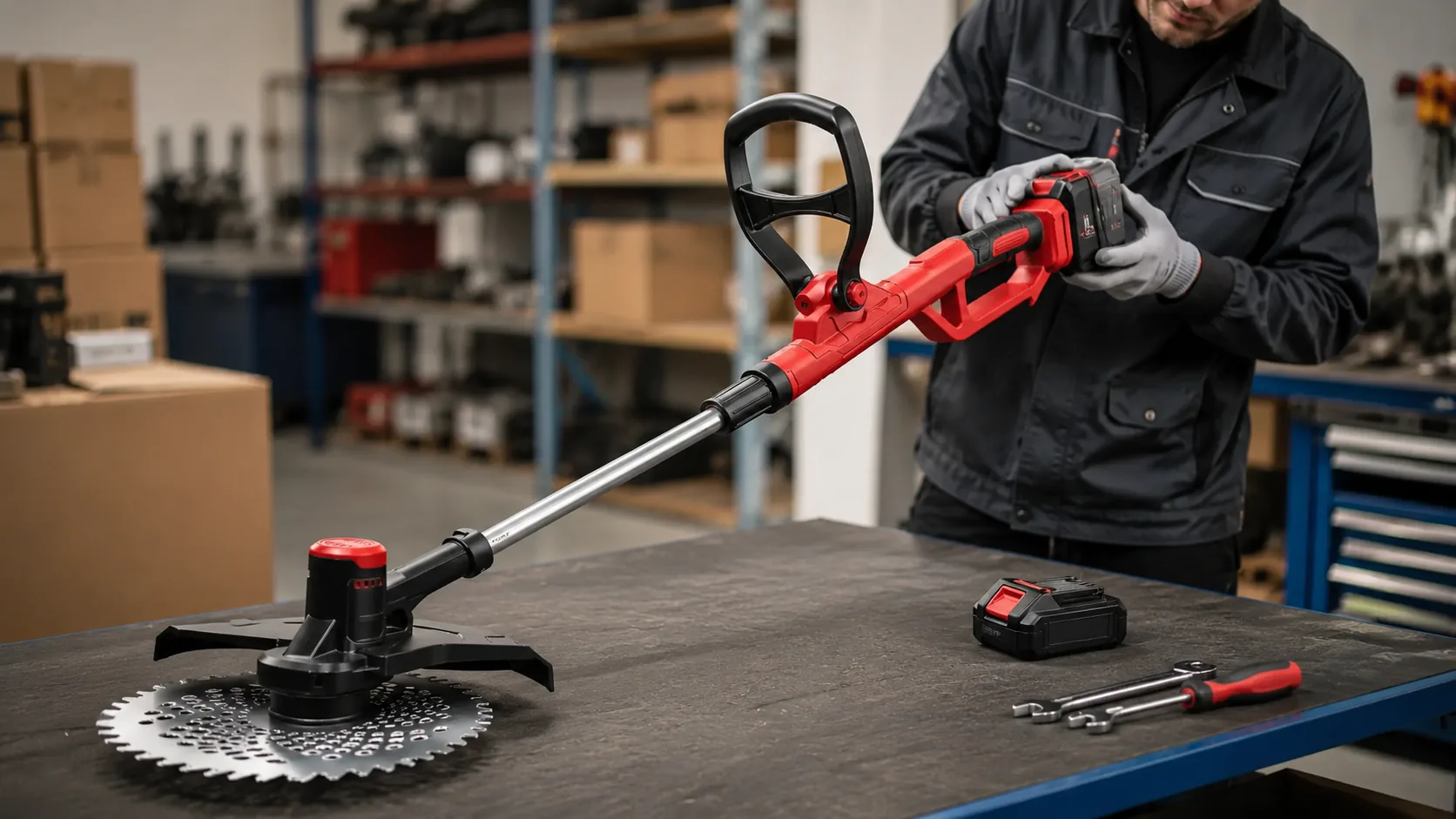
Dealer Return Prevention Guide
A practical procurement guide for matching cordless brush cutters with local vegetation, battery expectations, cutting attachments, user ergonomics, spare parts, and retail positioning.
Cordless brush cutter returns are often caused by a mismatch between the machine, battery system, cutting task, and buyer expectations—not simply by a defective tool. A machine may start normally and cut light grass correctly, yet still be returned when the customer expected gasoline-level runtime or heavy-brush performance.
Dealers, importers, wholesalers, and garden machinery retailers can reduce complaints by evaluating the complete product configuration before ordering. This includes the battery and charger package, approved cutting attachments, telescopic range, local vegetation, replacement parts, packaging information, and the way sales staff describe the product.
Most cordless brush cutter returns can be reduced by defining the correct application before sale. Confirm what the machine is designed to cut, clearly state whether the battery and charger are included, test the sample in local vegetation, and stock replacement batteries, chargers, cutting heads, and wear parts.
Why Cordless Brush Cutters Get Returned Even When They Work
Many retail customers compare a cordless brush cutter directly with a gasoline model. They may expect the same cutting force in mature weeds, the same continuous working time, and the same ability to clear large farm or roadside areas.
However, many compact cordless models are designed for lawn edges, garden paths, light weeds, residential maintenance, and short repeated jobs. When a customer purchases a light-duty cordless trimmer for dense vegetation, the machine may be working within its design limits while still failing to meet the buyer’s expectations.
A compact cordless grass trimmer is commonly suitable for:
| Residential Maintenance Lawn edging, garden paths, small yards, and routine trimming around walls, fences, and trees. | Convenience-Focused Users Older users and homeowners who value easy starting, lighter handling, and no fuel mixing or storage. |
| Commercial Touch-Up Work Landscaping around buildings, pathways, parking areas, and locations where noise and fuel handling are concerns. | Short Repeated Jobs Maintenance tasks completed in several short sessions rather than continuous all-day vegetation clearing. |
It may be a poor fit for mature brush, thick tropical roadside vegetation, large agricultural areas, or full-day work without spare batteries. Clear application positioning is therefore one of the most effective ways to prevent returns.
Is the Battery Configuration Clear to Retail Customers?
Battery misunderstandings are a frequent source of dissatisfaction. Before approving a quotation, importers should confirm whether the package includes a battery, charger, both items, multiple batteries, or the bare tool only.
The voltage printed on a battery is not enough to confirm compatibility with another product or brand. The connector shape, battery management electronics, charger design, current output, cell configuration, and communication system may be different even when the voltage label appears similar.
Battery and Charger Details to Confirm
- Battery voltage and exact battery platform
- Available battery capacity options
- Number of batteries included with each machine
- Charger plug type and destination-country input voltage
- Normal charging time under the supplied charger specification
- Expected runtime under different cutting conditions
- Replacement battery and charger availability
- Compatibility with future tools in the same battery series
Runtime should not be promoted as one fixed number without explaining the test conditions. Light lawn grass, repeated edging, dense weeds, blade use, high cutting-head resistance, and frequent stop-and-start operation place different loads on the battery.
Dealers should provide a realistic working range based on the selected battery capacity and intended application rather than promising an exact duration that may not be repeatable in the customer’s field.
Are Buyers Using the Correct Cutting Attachment?
Customers may use the term “brush cutter” for many different battery-powered cutting tools, but nylon line, plastic blades, and metal blades are intended for different vegetation and create different operating loads.
| Cutting Attachment | Recommended Application | Dealer Check | Common Risk |
|---|---|---|---|
| Nylon line | Lawn grass, edges, and vegetation near walls or trees | Confirm spool size, line diameter, and replacement availability | Incorrect line increases load or feeds poorly |
| Plastic blade | Light weeds and slightly stronger vegetation | Check blade type, mounting system, and carton quantity | Blades can break when used against hard surfaces |
| Metal blade | Only where approved for the specific machine | Confirm motor capability, guard, balance, and fastening parts | Unsupported use may overload the machine or create a safety issue |
Importers should confirm the approved cutting attachments and exact carton contents before printing packaging, catalogs, or online advertisements. A cutting head shown in a generic product listing should not automatically be assumed suitable for every model.
Basic wear parts should also be included in the purchasing plan. A functioning machine may still become a return when the customer cannot find the correct spool, line, blade, guard, retaining nut, or mounting hardware.
Which Cordless Brush Cutter Fits Your Market?
Model selection should consider more than rated power. Shaft length, working balance, storage size, user height, battery weight, handle position, and the typical vegetation in the destination market can all affect customer satisfaction.
TM-GT303Li Lithium Brush Cutter
Listed with an 800 W rated power, 10,000 rpm no-load speed, 21 V battery system, 200 mm maximum cutting width, and a telescopic length range of 100–140 cm. The shorter adjustment range may suit compact storage and general home-garden retail channels.
| View This Model |
TM-GT304Li Lithium Brush Cutter
Listed with an 800 W rated power, 10,000 rpm no-load speed, 21 V battery system, 200 mm maximum cutting width, and a telescopic length range of 100–140 cm. Importers should compare the complete package, handle design, supplied attachments, and battery option during sample approval.
| Check Specifications |
TM-GT307Li Lithium Brush Cutter
Listed with a 700 W rated power, 9,000 rpm no-load speed, 21 V battery system, 200 mm maximum cutting width, and a telescopic length range of 120–150 cm. The longer shaft range may be relevant for taller users or buyers who prioritize extended working length.
| Compare This Model |
| Model | Rated Power | No-Load Speed | Telescopic Range | Buying Focus |
|---|---|---|---|---|
| TM-GT303Li | 800 W | 10,000 rpm | 100–140 cm | Compact storage and general garden use |
| TM-GT304Li | 800 W | 10,000 rpm | 100–140 cm | Compare package, handle, and attachments |
| TM-GT307Li | 700 W | 9,000 rpm | 120–150 cm | Longer adjustment range and user reach |
These specifications should be evaluated together rather than individually. A higher no-load speed does not automatically mean better performance in every type of vegetation, and a longer shaft is not always more comfortable if the machine becomes front-heavy.
Samples should be tested by several users with different heights and experience levels. A purchasing manager who handles the machine for only a few minutes may not identify the balance, grip, and posture issues that appear during normal retail use.
Can the Product Handle Local Grass and Weeds?
Vegetation conditions vary significantly between markets. Soft lawn grass, dry seasonal weeds, wet tropical growth, and fibrous roadside vegetation do not place the same load on a cordless cutting system.
A showroom demonstration on short grass is not enough for sample approval. The product should be tested on vegetation that represents the actual destination market and the way local customers are likely to operate the machine.
Recommended Local Sample Test
- Light lawn trimming
- Edging near walls, paving, and fences
- Medium weeds at normal local cutting height
- Repeated stop-and-start operation
- Use with every intended cutting attachment
- Battery temperature after sustained work
- Vibration and balance at full shaft extension
- Ease of removing wrapped grass from the cutting head
The objective is not to force the machine through every possible material. The objective is to establish where it performs consistently and where the dealer should recommend a gasoline brush cutter or a heavier cordless platform instead.
Will the Charger and Plug Work in the Destination Country?
A wrong plug, unsuitable input voltage, unclear charging label, or missing replacement charger can create an immediate after-sales claim. These details should be confirmed before mass production rather than after the shipment arrives.
Importers should verify destination voltage, plug type, charger markings, label language, and separate charger availability. A small charger failure can become a complete machine return when the distributor cannot supply a replacement.
For companies supplying several countries, purchasing records should separate the machine model from the plug and charger configuration. This reduces the risk of shipping the correct cordless trimmer with the wrong charging system to a regional warehouse.
What Dealers Should Check During Sample Approval
A sample should be evaluated as a complete retail product, not only as a machine that starts and rotates. Assembly, packaging, labeling, charging, handling, and accessory identification all influence the customer experience.
| Inspection Area | Items to Check | Why It Matters |
|---|---|---|
| Assembly | Shaft locking, handle tightening, guard installation, cutting-head mounting | Unclear assembly creates immediate retail complaints |
| Controls | Trigger response, safety switch, speed behavior, stopping response | Retail users may interpret unfamiliar operation as a fault |
| Battery System | Battery insertion, removal, locking, charger indication, charging instructions | Loose fit or unclear charger signals increase warranty inquiries |
| Retail Package | Carton protection, labels, instructions, accessories, tools, packing list | Missing or poorly identified parts may be reported as shortages |
The purchasing team should assemble the sample using only the instructions and tools intended for the final customer. When experienced import staff cannot easily identify how a component fits, retail users may face the same difficulty.
Dealers can also prepare a short assembly video, battery installation guide, and basic troubleshooting video before the first shipment arrives. Local sales staff can then solve simple issues without immediately treating the machine as defective.
Spare Battery and Wear-Part Planning for Importers
The correct spare-part ratio depends on the sales channel. A retailer serving occasional home users may need fewer spare batteries than a distributor supplying landscaping crews, rental shops, or commercial maintenance teams.
However, importing machines without any replacement battery, charger, or cutting-head plan creates unnecessary risk. Importers should discuss separate quantities for the following components:
| Power System Batteries, chargers, battery connectors, and charging indicators. | Cutting System Cutting heads, nylon spools, plastic blades, approved metal blades, and guards. | Repair Parts Switches, fastening parts, retaining hardware, shaft locks, and model-specific fittings. |
The supplier should identify which parts are model-specific and which parts are shared across the series. Shared batteries or chargers can improve inventory efficiency, but technical compatibility must be confirmed rather than assumed from the voltage label.
How Dealers Should Describe Cordless Brush Cutters
Product descriptions should focus on suitable work rather than broad claims such as “cuts everything” or “fully replaces a petrol brush cutter.” Such claims may increase initial interest but can also create unrealistic expectations and higher return rates.
A more accurate sales message explains that the machine is intended for routine garden trimming, lawn edges, light weed control, and convenient maintenance where easy starting and reduced fuel handling are important.
Runtime information should always mention the main variables:
Battery capacity, vegetation density, cutting attachment, cutting-head condition, operator technique, shaft position, and frequency of stopping and restarting.
For online listings, show the full package clearly. Customers should be able to identify whether the battery and charger are included, which cutting heads are supplied, and what vegetation the model is designed to manage.
Importer and Dealer Procurement Checklist
- Quality: Test trigger response, shaft locking, vibration, balance, battery fit, and cutting-head operation.
- Battery package: Confirm capacity, quantity per machine, charger specification, plug type, and charging time.
- Accessories: Verify every cutting head, guard, tool, fastener, and attachment included in the carton.
- Packaging: Check carton protection, component separation, labeling, instructions, and regional language requirements.
- Market demand: Match the machine with local gardens, vegetation, customer budgets, and preferred working length.
- MOQ: Confirm separate minimum quantities for machines, batteries, chargers, and customized packaging.
- Supply stability: Ask whether the battery platform and key components will remain available for repeat orders.
- Spare parts: Prepare batteries, chargers, cutting heads, spools, blades, guards, switches, and fastening parts.
- Repair convenience: Confirm which components can be replaced locally and which require factory support.
- User habits: Consider whether customers expect continuous work, heavy weed cutting, or occasional garden maintenance.
- Repeat-order consistency: Confirm that future shipments can maintain the agreed battery, charger, accessories, labels, and packaging configuration.
Frequently Asked Questions
Why do customers return cordless brush cutters?
The most common reasons are unrealistic runtime expectations, using the machine in vegetation that is too heavy, misunderstanding the battery package, choosing the wrong cutting attachment, uncomfortable shaft length, or being unable to obtain replacement parts.
Can a cordless brush cutter replace a gasoline brush cutter?
It depends on the task. A cordless model can be practical for lawn edges, light weeds, residential gardens, and short maintenance work. Dense brush, large fields, and continuous daily cutting may require a heavier cordless platform, several batteries, or a gasoline model.
How should importers test a cordless brush cutter sample?
Test it in local grass and weeds using every intended attachment. Check runtime, battery temperature, vibration, balance, shaft locking, charger operation, battery removal, guard installation, and ease of clearing wrapped vegetation.
How many spare batteries should a dealer order?
The quantity should reflect the customer group. Home-garden retailers may need a lower ratio, while distributors serving landscapers or professional users should prepare more spare batteries and chargers. A replacement plan should be confirmed before the first shipment.
Are batteries with the same voltage interchangeable?
Not necessarily. Compatibility depends on the connector, battery management system, charger, current output, physical dimensions, and electronic protection. Importers should obtain technical confirmation before advertising cross-model compatibility.
Which spare parts should cordless brush cutter dealers stock?
Priority parts normally include batteries, chargers, cutting heads, nylon spools, approved blades, guards, switches, retaining hardware, fastening parts, and battery connectors. The supplier should clarify which items are shared and which are model-specific.
Final Procurement Check Before a Bulk Order
A cordless brush cutter order should not be approved based only on rated power, speed, appearance, or purchase price. The battery package, charger specification, cutting attachments, telescopic range, local vegetation, packaging, spare parts, and actual application limits should be reviewed together.
Lower return rates usually come from matching the machine with a clearly defined customer group. When dealers test samples locally, train sales staff, describe runtime honestly, and stock commonly requested parts, cordless brush cutters become easier to sell and support.
|
Compare Cordless Brush Cutter Models for Your Market Teamax Power can provide different cordless brush cutter configurations for garden retailers, importers, wholesalers, and regional dealers. Confirm the required battery package, working length, attachments, plug type, and spare-part plan before ordering. |
|||||
|