
Why Does a Gasoline Water Pump Run but Not Pump Water?
Learn why a gasoline water pump runs but does not pump water, how to restore suction, and what dealers should inspect before delivery or resale.
Troubleshooting and Procurement Guide
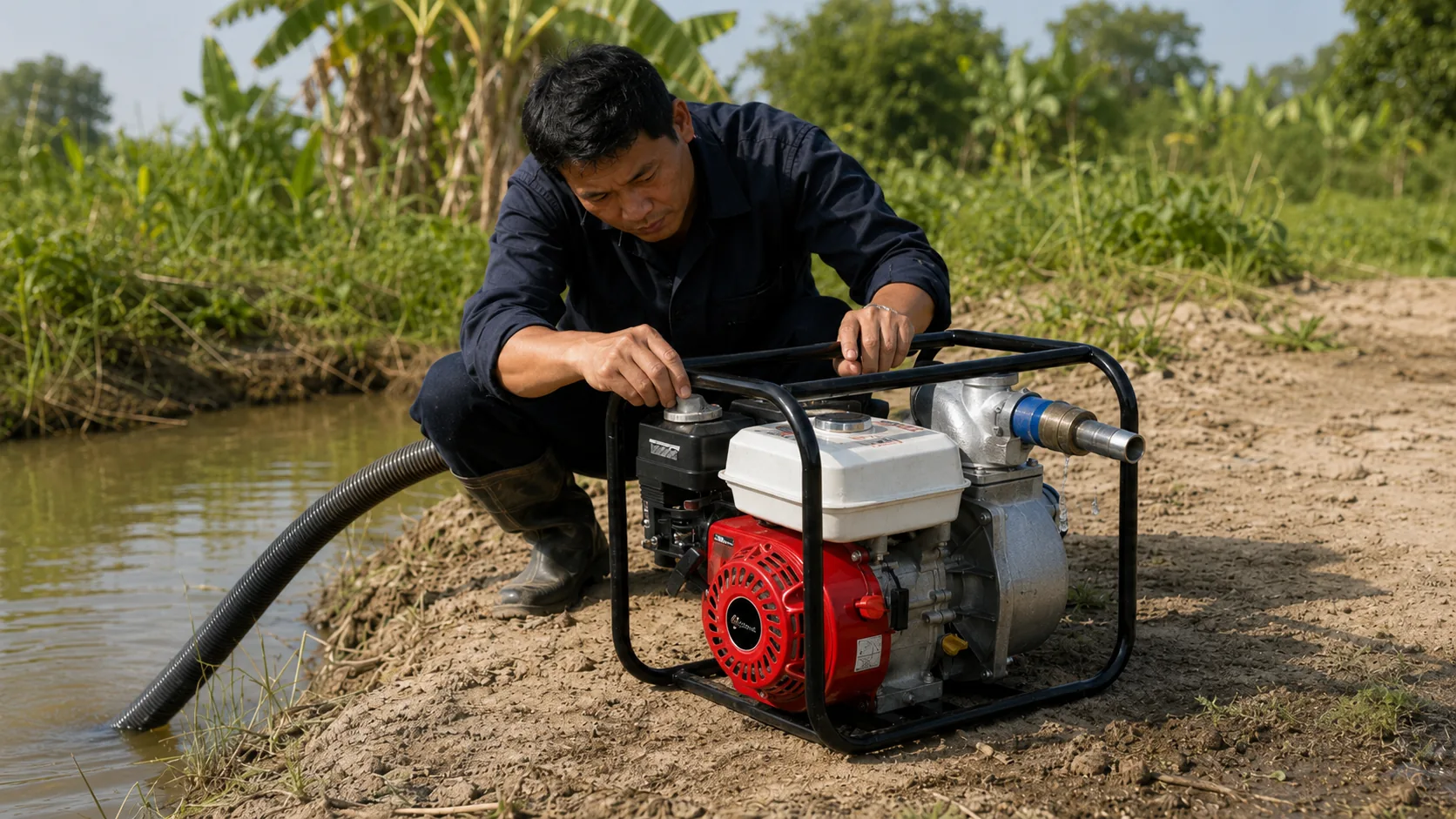
A gasoline water pump can run normally without moving water when the pump casing is not primed, air enters the suction line, the suction lift is excessive, or the inlet strainer is blocked. In most cases, the engine is not the first component that should be adjusted or disassembled. The correct troubleshooting sequence starts with the water path: pump casing, suction hose, connectors, strainer position, installation height, and discharge layout.
This symptom is especially common after initial installation, hose replacement, long storage, transport, or relocation to a deeper pond, canal, tank, or irrigation source. For importers, wholesalers, dealers, and repair shops, understanding the difference between an engine fault and a pump-system fault can prevent unnecessary product returns, incorrect carburetor adjustments, and avoidable spare-parts costs.
| Quick answer: | A gasoline water pump that runs but does not pump water usually has a priming or suction-side problem. Stop the engine, fill the pump casing completely with clean water, confirm that the inlet strainer is fully submerged, and inspect every suction-hose connection for air leakage. Use a reinforced suction hose rather than a soft discharge hose, and position the pump as close to the water source as practical. Importers and dealers can reduce complaints by supplying compatible couplings, gaskets, clamps, strainers, and clear priming instructions with each machine. |
01What This No-Flow Symptom Usually Means
The engine and pump body perform different jobs. The engine turns the impeller, but the pump casing and suction system must create enough vacuum to draw water through the inlet. An engine can start, idle, and accelerate normally while the hydraulic side of the machine remains unable to lift water.
A centrifugal water pump cannot begin pumping effectively when the casing contains only air. Even a pump described as self-priming normally requires the casing to be filled with water before starting. This initial water allows the impeller to develop suction and also helps protect the mechanical seal from overheating during startup.
When no water appears at the discharge hose, buyers should resist the temptation to immediately adjust the carburetor, replace the spark plug, or blame low engine power. The first inspection should determine whether water can reach the impeller through an airtight and correctly installed suction system.
|
A. Engine Runs Normally Focus first on priming, hose sealing, inlet depth, suction height, strainer blockage, hose collapse, and internal pump wear. A stable engine sound does not confirm that the pump system is correctly installed. |
B. Engine Loses Speed Check the water path first, then inspect throttle position, air filter, fuel condition, choke position, spark plug, governor movement, and whether the impeller is obstructed. |
02Gasoline Water Pump No-Flow Diagnostic Table
The following table helps dealers and technicians separate common installation faults from internal pump or engine problems. Start with checks that require no disassembly, then move to mechanical inspection only after priming and suction integrity have been confirmed.
| Observed Symptom | Possible Cause | Inspection Point | Recommended Action |
| Engine runs, but no water appears | Dry pump casing | Priming plug and casing water level | Stop the engine and fill the casing completely |
| Pump works briefly, then loses flow | Air leak or water draining back | Clamps, gaskets, foot valve, hose ends | Reseal connections and inspect the non-return valve |
| Flow decreases as engine speed rises | Suction hose collapse | Soft sections, bends, incorrect hose type | Install a reinforced suction hose of the correct diameter |
| Irregular flow with rattling noise | Cavitation or restricted inlet | Suction height, hose length, strainer blockage | Move the pump closer and remove inlet restrictions |
| Pump primes but output remains weak | Discharge resistance or internal wear | Outlet hose, delivery height, impeller, volute | Correct the installation before opening the pump body |
| Water leaks between pump and engine | Mechanical seal damage | Seal area and dry-running history | Replace the seal and inspect mating surfaces |
A useful workshop rule is to verify the complete installation with a known good suction hose and clean water source before authorizing major repairs. This avoids replacing pump bodies, carburetors, or engines when the actual fault is an inexpensive connector gasket or poorly selected hose.
03Priming, Air Leaks and Suction Hose Checks
Priming should be the first physical check. Turn off the engine, allow the machine to cool, remove the priming plug, and fill the pump casing completely with clean water. Reinstall the plug securely before restarting. Adding only a small amount of water may leave enough air inside the casing to prevent the impeller from developing the vacuum required to lift water.
If the pump works after priming but loses flow after shutdown, water may be draining back through the suction line. Inspect sealing washers, hose connectors, clamps, threaded adaptors, the non-return valve, and the foot valve where fitted. A functioning foot valve helps retain water in the suction hose and can shorten priming time during repeated operation.
Suction-side air leaks are not always visible. Because the inlet operates under vacuum, air may be pulled inward without water leaking outward. Fine cracks near hose ends, hardened gaskets, unevenly tightened clamps, punctures, and poorly fitted connectors can all prevent a gasoline water pump from drawing water.
Suction Assembly Inspection Order
- Confirm that the pump casing is completely filled with water.
- Check the gasket inside the pump inlet coupling.
- Tighten hose clamps evenly without damaging the hose.
- Inspect the hose ends for cracks, deformation, and poor seating.
- Check the full hose length for punctures and collapsed sections.
- Verify the connection between the suction hose and strainer.
- Test the foot valve or non-return valve where one is installed.
A lightweight discharge hose should not be used on the inlet side. It may flatten under vacuum even when it appears normal before startup. Dealers should specify a reinforced suction hose with a diameter matching the pump inlet, avoiding sharp bends, crushed sections, loose couplings, and unnecessary length.
04Installation Limits Buyers Often Ignore
Suction height has a major effect on priming time and pumping stability. The pump should be positioned as close to the water source as practical. A machine installed high above a pond, canal, river, tank, or drainage pit must create more vacuum before water reaches the impeller.
A published maximum suction figure should not be treated as the recommended working height for every installation. Actual field performance is influenced by hose length, air leakage, altitude, water temperature, hose diameter, bends, fittings, strainer restriction, and wear inside the pump. A shorter and straighter suction arrangement normally produces faster priming and more consistent output.
| Installation Factor | Common Risk | Field Symptom | Dealer Advice |
| Excessive suction height | Slow or failed priming | No water or unstable flow | Move the pump closer to the source |
| Strainer partly above water | Air enters the suction line | Pump repeatedly loses prime | Keep the strainer fully submerged |
| Strainer resting in mud | Blocked inlet and abrasive wear | Weak flow and pump noise | Use a basket or raised support |
| Long narrow discharge hose | High friction loss | Pump operates but output seems low | Match hose diameter to the outlet |
The inlet strainer must remain completely underwater during operation. A falling water level, shallow drainage pit, or whirlpool around the inlet can expose part of the strainer and introduce air. The strainer should not rest directly in mud or crop residue, and it should be protected from leaves, plastic, weeds, and other debris.
A rattling, grinding, or gravel-like sound may indicate cavitation. This can occur when the suction height is excessive, the hose is too long, the inlet diameter is restricted, the strainer is blocked, or air enters the suction line. Stop the pump and correct the installation rather than treating cavitation as a normal operating sound.
05Internal Pump Components and Engine Checks
If the pump is fully primed, the suction line is airtight, the hose does not collapse, and the installation height is reasonable, the next step is to inspect the internal water path. Mud, string, leaves, plastic, and small stones can enter when the strainer is missing, damaged, or incorrectly installed. These materials may obstruct the impeller or reduce the clearance required to generate suction.
Internal wear can cause increasingly long priming times, low discharge pressure, failure to hold prime, unusual pump noise, or water leakage between the pump and engine. A mechanical seal may be damaged by repeated dry running or abrasive water. Worn impeller and volute surfaces can also reduce vacuum and water output even when the engine reaches normal speed.
Engine checks should follow the water-system inspection. Confirm that the throttle is in the operating position, the choke is fully open after starting, the air filter is not heavily blocked, the fuel is fresh, the spark plug is serviceable, and the governor and throttle linkage move correctly. The engine may run at idle while producing insufficient speed for normal pump output.
Repair Priority
Do not adjust the carburetor before confirming priming, hose sealing, strainer condition, and suction height. Carburetor adjustment cannot correct air leakage, a collapsed hose, a blocked inlet, or a worn pump impeller. Internal inspection should only be performed after the engine is stopped, cooled, and protected against accidental starting.
06TM-WP80A Recommendation and Market Fit
For markets that require a larger water connection for farm irrigation, drainage, garden watering, and general water transfer, buyers can evaluate the TM-WP80A 3-inch gasoline water pump. The model is designed around a 3-inch or 80 mm water connection and uses a 212 cc gasoline engine.
| TM-WP80A Gasoline Water Pump | |
| Model | TM-WP80A |
| Water Connection | 3 inch / 80 mm |
| Engine Displacement | 212 cc |
| Maximum Lift | 26 m under applicable operating conditions |
| Maximum Suction | Up to 7 m under applicable operating conditions |
| Suitable Applications | Irrigation, drainage, garden watering, and general clean-water transfer |
The suction hose, couplings, gaskets, clamps, and strainer should match the 3-inch flow path. Reducing the inlet diameter can restrict water supply, extend priming time, and lower actual output. Dealers should sell the model together with a suitable reinforced suction assembly or clearly specify the required hose standard.
|
Recommended for 3-Inch Water Transfer Requirements Review the model specifications, connection size, intended applications, and installation requirements before planning a wholesale order. |
|
This type of pump can suit agricultural dealers, irrigation suppliers, drainage contractors, hardware stores, and professional users who need to transfer larger volumes of water. It is not intended to operate like a trash pump in water containing stones, heavy sand, or abrasive construction debris. Application positioning should be clear before resale.
07Importer and Dealer Checklist
A wholesale buyer should evaluate the gasoline water pump as a complete working system rather than only comparing engine displacement or pump-body size. The checklist below separates decisions that should be made before ordering from inspections that should be completed before shipment or resale.
|
Before Ordering
|
Before Shipment or Resale
|
A dealer pre-delivery inspection should include more than starting the engine for a few seconds. The machine should be connected to a suitable suction hose, properly primed, and tested with water. This confirms that the pump draws water, develops stable discharge flow, and does not leak from the casing, couplings, drain plug, or mechanical-seal area.
Dealers should also explain the term “self-priming.” Customers may incorrectly assume that the pump can begin working with a completely dry casing. A clear priming label, illustrated manual, or short delivery demonstration can prevent mechanical-seal damage and reduce avoidable warranty claims.
08Maintenance, Spare Parts and After-Sales Planning
The most useful spare parts for dealers are components that solve predictable wear and installation problems. Recommended stock may include mechanical seals, impellers, volute components where applicable, casing gaskets, priming-plug seals, drain-plug seals, recoil starter assemblies, air filters, spark plugs, carburetor service parts, hose gaskets, clamps, and inlet strainers.
After each use, the pump should be stopped, cooled, and drained according to the operating instructions. Water left inside the casing during long storage can contribute to corrosion, deposits, freezing damage in cold climates, or unpleasant contamination. Muddy or dirty water should be flushed from the casing before storage.
Repeated dry running should be treated as an operating error rather than normal use. Without water in the casing, friction and heat can damage the mechanical seal. Dealers can reduce after-sales complaints by including priming instructions on the machine, carton, manual, and sales invoice instead of relying only on verbal explanations.
Dealer service note: When a customer reports that a gasoline water pump runs but does not pump water, ask whether the casing was filled, how high the pump is above the water, whether the strainer is submerged, and what type of suction hose is installed. These four questions often identify the problem before the machine is returned to the workshop.
Frequently Asked Questions
1. Why does my gasoline water pump run but not pump water?
The most common causes are an unprimed pump casing, air leakage in the suction line, a collapsed or incorrectly sized suction hose, a partly exposed strainer, excessive suction height, or an inlet blockage. Check these items before adjusting the engine.
2. Does a self-priming water pump need water in the casing?
Yes. A self-priming centrifugal pump normally still requires the pump casing to be filled before initial startup. The water allows the impeller to create suction and helps protect the mechanical seal from dry-running damage.
3. How can dealers reduce water pump after-sales complaints?
Dealers should complete a real water-flow test before delivery, provide the correct suction hose and sealing components, explain the priming procedure, confirm the application limits, and stock common seals, gaskets, filters, starter parts, and strainers.
4. Can a discharge hose be used as a suction hose?
A soft discharge hose should not be used on the suction side because vacuum pressure may cause it to collapse. Use a reinforced suction hose with a diameter matching the pump inlet and avoid sharp bends or excessive length.
5. What should importers inspect before a bulk water pump order?
Importers should confirm connection sizes, engine and pump specifications, hose compatibility, intended water conditions, strainer and coupling supply, spare-parts availability, packaging strength, manuals, priming labels, flow-testing procedures, MOQ, lead time, and repeat-order consistency.
6. Is the TM-WP80A suitable for dirty water containing stones and heavy sand?
The TM-WP80A is presented for irrigation, drainage, garden watering, and general water transfer. A general-purpose clean-water pump should not be operated like a trash pump in water containing stones, heavy sand, or abrasive debris because these materials can accelerate impeller, volute, and seal wear.
When a gasoline water pump runs but does not pump water, the most effective troubleshooting order is priming, suction-side sealing, hose condition, strainer position, installation height, discharge resistance, internal pump condition, and finally engine performance. For importers and dealers, supplying the correct hose kit and teaching the priming procedure are two of the most practical ways to reduce no-flow complaints and unnecessary product returns.
|
Need a 3-Inch Gasoline Water Pump for Wholesale Supply? Review the TM-WP80A configuration and discuss hose compatibility, applications, spare parts, packaging, and bulk-order requirements before purchase. |
|