
Gas Brush Cutter Won’t Restart When Hot: Causes and Fixes
Learn why a gas brush cutter will not restart when hot, how to check fuel, spark, cooling, and compression, and what dealers should inspect.
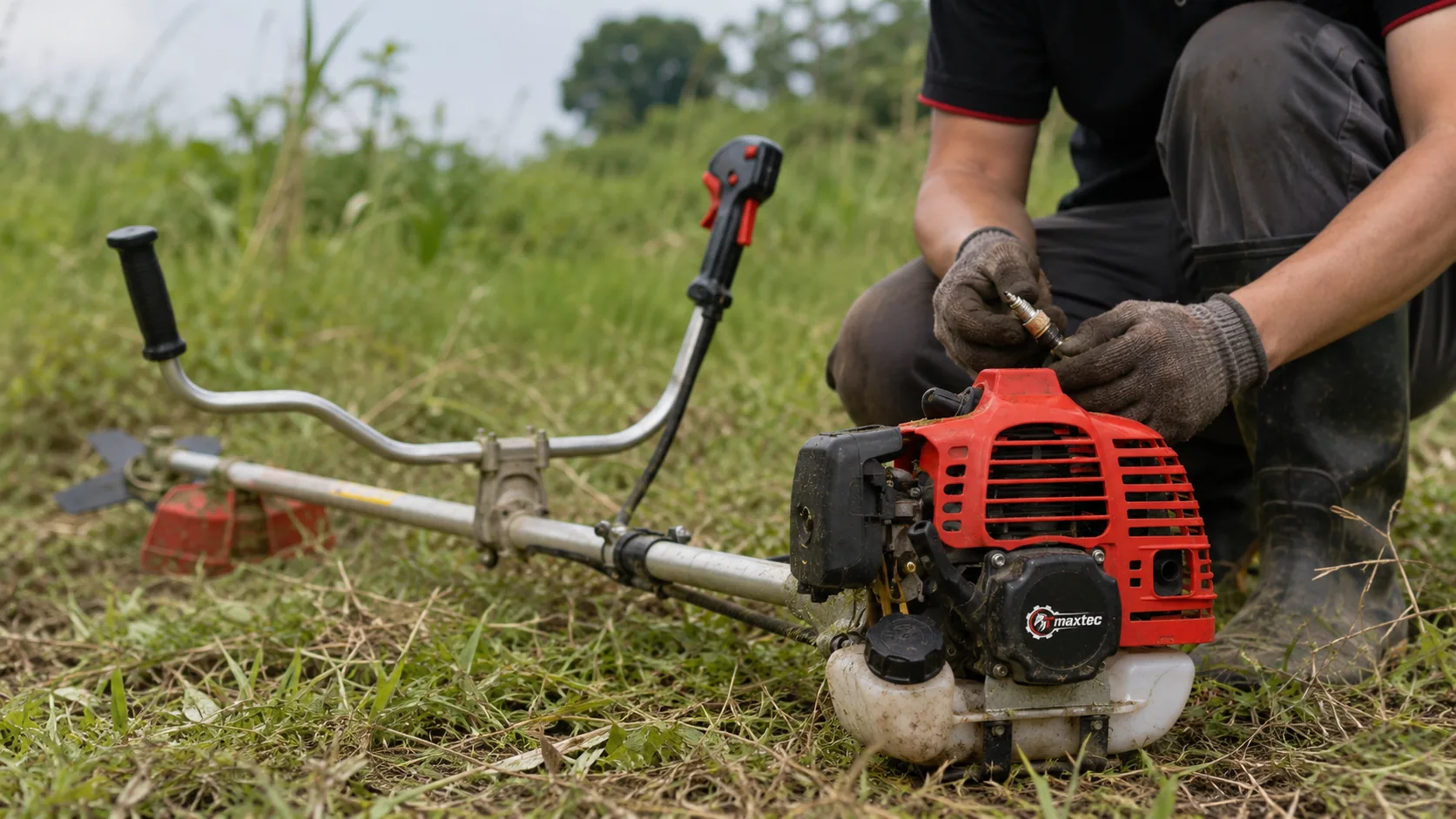
Field Service and Dealer Troubleshooting Guide
A gas brush cutter that starts normally when cold but refuses to restart after use usually has a warm-start procedure, flooding, fuel delivery, ignition, overheating, or compression problem. The symptom can be frustrating because the machine may appear completely normal again after it has cooled for twenty or thirty minutes.
For operators, the priority is to avoid repeated starting attempts that make the condition worse. For importers, distributors, repair shops, and agricultural machinery dealers, the priority is to separate user-operation errors from genuine component or assembly faults. A fixed diagnostic sequence reduces unnecessary carburetor replacement, ignition-coil replacement, warranty cost, and repeated customer complaints.
| Quick answer: | A gas brush cutter that will not restart when hot should first be tested with the choke fully open and without repeated priming. If it still does not start, inspect whether the spark plug is wet or dry. A wet plug usually points to flooding or weak ignition, while a dry plug suggests restricted fuel delivery. Dealers should then compare cold and hot spark, inspect the tank vent, fuel lines, air filter, cooling fins, carburetor, and actual fuel ratio. Compression testing should come later, after the easier external causes have been eliminated. |
What a Hot-Restart Failure Usually Means
The phrase “will not restart when hot” can describe several different failure patterns. Some machines run normally, are switched off by the operator, and then refuse to restart. Others gradually lose power, stop by themselves, and remain impossible to start until they cool. These two patterns should not automatically be treated as the same fault.
A machine that runs well but floods during the restart procedure may only need correct operator training. A machine that loses spark after reaching operating temperature may have an ignition coil, plug cap, stop-switch wire, or electrical grounding fault. A machine that loses power before stopping may have a blocked tank vent, restricted fuel filter, lean carburetor setting, dirty cooling system, or internal wear.
Dealers should ask whether the engine stopped by itself or was deliberately switched off. They should also ask how long the machine operated, what cutting attachment was installed, whether power dropped before shutdown, and how long the engine had to cool before restarting. These details often narrow the diagnosis before any parts are removed.
| Observed Symptom | Likely Area | First Inspection | Dealer Advice |
| Starts cold, runs normally, floods after shutdown | Warm-start procedure | Choke, primer use, wet plug | Provide clear warm-start instructions |
| No spark immediately after hot shutdown | Ignition system | Coil, plug cap, stop-switch wire | Compare cold and hot spark results |
| Loses power before stopping | Fuel flow or overheating | Tank vent, fuel filter, cooling fins | Do not replace the carburetor first |
| Restarts only after a long cooling period | Coil, fuel vapor, compression | Hot spark and compression comparison | Record cooling time during sample tests |
| Starter feels unusually easy when hot | Internal sealing | Piston, rings, cylinder, crank seals | Test compression before dismantling |
Correct Warm-Start Procedure and Flooding Checks
Many operators repeat the full cold-start procedure every time they restart a brush cutter. They close the choke, press the primer bulb several times, set the throttle, and repeatedly pull the starter. A warm engine normally needs much less fuel enrichment. Using full choke on a warm engine can quickly make the mixture too rich to ignite.
| 1 | Place the brush cutter on stable ground with the cutting attachment clear of people, vegetation, and loose objects. |
| 2 | Confirm that the stop switch is in the operating position and that the throttle control is not damaged or stuck. |
| 3 | Keep the choke open or in the normal running position. Do not repeatedly press the primer unless the fuel system has been emptied. |
| 4 | Use the correct high-idle or throttle-start position only when the model’s control design requires it. |
| 5 | Pull the starter firmly. Stop and diagnose the machine if several controlled attempts produce no sign of ignition. |
A strong gasoline smell, a wet spark plug, fuel around the air-filter area, or an engine that briefly fires and immediately stops can indicate flooding. More choke and more primer operation will not correct an engine that already contains excess fuel.
Allow the engine to cool enough for safe handling. Remove the spark plug and inspect the electrodes. A wet plug can be dried or replaced with the correct specified type. With the ignition disabled and the plug removed, the starter may be pulled several times to help clear excess fuel. Reinstall the plug and attempt a restart without full choke. Because throttle-control systems differ, dealers should provide instructions based on the actual model rather than using one generic sequence for every machine.
Spark Plug, Ignition Coil and Stop-Switch Diagnosis
A spark plug can operate well enough for a cold start but become unreliable after the engine reaches operating temperature. Heavy carbon deposits, an incorrect electrode gap, a cracked ceramic insulator, worn electrodes, a loose terminal, or a damaged plug cap can weaken ignition.
The plug condition also provides useful diagnostic information. A wet plug indicates that fuel is reaching the combustion chamber but is not being burned reliably. A completely dry plug after several starting pulls suggests that fuel may not be entering the cylinder. Dealers should replace plugs by the specified heat range, reach, resistance, and electrode design rather than selecting a replacement only by thread diameter.
Cold-to-Hot Spark Comparison
Check spark with a proper spark tester when the engine is cold. Operate the machine until the hot-start fault appears, stop it, and immediately test again. Spark that is present when cold but disappears when hot may indicate a heat-sensitive ignition coil, plug cap, grounding wire, or stop-switch circuit fault.
Before replacing the ignition coil, inspect the stop-switch wiring carefully. A wire with damaged insulation may touch the engine housing only when vibration, heat expansion, or handle movement changes its position. This grounds the ignition and can create an intermittent fault that is easily misdiagnosed as a defective carburetor.
Technicians should also inspect coil mounting screws and confirm the ignition-coil air gap according to the engine specification. The gap should not be guessed, and the flywheel should not be forced against the coil. When a fault appears only after heating, testing immediately is essential; waiting until the machine cools may hide the problem.
Fuel Tank Vent, Fuel Lines and Carburetor Checks
The fuel tank must admit air as gasoline leaves the tank. If the tank vent is blocked, negative pressure develops and gradually restricts fuel flow to the carburetor. The brush cutter may start and run correctly, lose power after several minutes, stop, and then restart after sitting long enough for the pressure to equalize.
Possible indicators include a primer bulb that does not refill normally, a dry spark plug, reduced power before shutdown, improved fuel flow after carefully loosening the cap, and a machine that restarts only after cooling. A loose-cap test should be brief and performed in a ventilated area away from flames, sparks, hot mufflers, and spilled fuel. The machine should not be operated continuously with the cap loose.
Fuel lines can also soften, crack, collapse, or leak after repeated exposure to heat and mixed fuel. Inspect the line inside and outside the tank, the fuel filter, primer connections, carburetor fittings, and the route of the hoses. A line positioned too close to a hot cylinder or muffler may behave differently after the engine warms.
Carburetor-related causes include a hardened metering diaphragm, sticking inlet needle, dirt in the internal passages, incorrect idle setting, damaged primer bulb, intake leakage, or unsuitable mixture-screw adjustment. Clean or replace the air filter and repair fuel or intake leaks before adjusting the carburetor. Turning mixture screws cannot correctly compensate for a blocked filter, damaged gasket, leaking crank seal, or restricted muffler.
Fuel Ratio, Cooling Airflow and Cutting Load
Two-stroke brush cutters depend on the specified gasoline-and-oil mixture for lubrication and temperature control. Too little two-stroke oil can reduce lubrication and accelerate piston, cylinder, bearing, and crankshaft wear. Excessive oil can increase smoke, plug fouling, exhaust deposits, and muffler restriction. Old fuel, water contamination, unsuitable oil, or fuel stored in an open container can also make hot starting unpredictable.
Fuel ratios are not universal. Operators must use the ratio listed for the actual brush cutter model. Repair shops should ask customers what gasoline, oil, ratio, and measuring method were used. An estimated mixture prepared directly in the fuel tank may differ significantly from the required ratio.
|
Recommended Model Reference TM-CG520TB Gasoline Brush Cutter |
Model specifications: 51.7cc two-stroke air-cooled engine, 1.8 kW rated output at 6,500 rpm, 28 mm shaft diameter, and a listed 1:30 mixed-fuel ratio. This model is relevant for dealers requiring a 52cc-class brush cutter for grass cutting, heavier weeds, agricultural maintenance, and markets where technicians are familiar with mixed-fuel engines. The listed fuel ratio applies to this model and should not be copied to unrelated engines.
|
Overheating may be caused by blocked cooling-air intake openings, debris packed around the cylinder fins, a clogged air filter, a restricted muffler or spark-arresting screen, a carburetor adjusted too lean, or continuous heavy operation. Cleaning only the outside cover is not enough if grass dust has accumulated underneath the engine housing.
The cutting system also affects engine temperature. A blunt blade, excessive nylon-line length, grass wrapped around the gear head, a cutting attachment that is too heavy, or operation at low speed under heavy load can increase engine stress. Stop the machine if it suddenly loses power, produces abnormal mechanical noise, or becomes unusually hot. Continued use may turn an airflow or fuel-setting problem into piston and cylinder damage.
When Compression and Internal Wear Should Be Tested
Internal wear can become more noticeable after the engine warms. A brush cutter may still start when cold because the choke provides a richer mixture, but hot restarting becomes difficult as sealing conditions change. Possible causes include worn piston rings, a scored piston or cylinder, leaking crankshaft seals, a loose cylinder, damaged intake gaskets, or carbon preventing the piston ring from moving freely.
Common warning signs include reduced starter resistance, declining cutting power, unstable idle, difficult cold and hot starting, repeated carburetor adjustments without lasting improvement, and abnormal mechanical noise. A machine with compression trouble may also require progressively more choke or throttle manipulation to start.
Compression should be measured with suitable equipment and compared with the service specification for the actual engine platform. One general compression number should not be applied to every brush cutter. Before dismantling the cylinder, confirm the starting procedure, fuel quality, plug condition, hot spark, tank vent, air filter, fuel lines, carburetor, muffler, and intake sealing.
Dealer Testing Before a Bulk Brush Cutter Order
Hot-restart performance should be included in sample approval and pre-shipment inspection, especially when a distributor expects the machines to be used in high-temperature regions, farms, roadside clearing, or continuous dealer demonstrations. A cold-start test alone cannot reveal every ignition, fuel-routing, or temperature-related fault.
Run several sample machines under a realistic cutting load rather than operating them without an attachment. After the engines reach normal operating temperature, switch them off and attempt controlled warm restarts. Repeat the procedure several times and record the number of pulls, choke position, primer use, idle stability, cooling time, and any difference between sample units.
Testing multiple units helps identify inconsistent carburetor settings, ignition-coil quality, fuel-line routing, stop-switch wiring, fuel-cap venting, and assembly variation. It also gives dealers accurate starting instructions to include in local manuals, training videos, and after-sales materials.
Importer and Dealer Procurement Checklist
Before Ordering
|
Before Shipment
|
Frequently Asked Questions
1. Why does my gas brush cutter start cold but not restart when hot?
The most common causes are an incorrect warm-start procedure, engine flooding, a spark plug or ignition coil that fails when heated, restricted tank venting, carburetor mixture problems, overheating, or reduced compression. Start by leaving the choke open, avoiding repeated priming, and checking whether the spark plug is wet or dry.
2. Should I use the choke when restarting a warm brush cutter?
A normal warm engine generally does not require full choke. Keep the choke in the open or running position unless the model instructions specify another sequence. Repeated use of full choke and the primer bulb can flood the engine.
3. How can I tell whether the brush cutter is flooded?
Common signs include a strong fuel smell, a wet spark plug, repeated pulling without ignition, fuel near the carburetor, or a brief start followed by immediate stopping. Stop adding fuel, clear the excess safely, and restart without full choke.
4. Can an ignition coil work when cold but fail when hot?
Yes. Heat can expose an internal coil fault or a problem in the plug cap, grounding wire, or stop-switch circuit. Compare spark when the engine is cold with spark immediately after the hot-start failure appears.
5. What spare parts should dealers stock for hot-start complaints?
Useful service stock includes specified spark plugs, plug caps, ignition coils, stop switches, primer bulbs, fuel lines, fuel filters, tank caps or vents, air filters, carburetor diaphragms, carburetor assemblies, intake gaskets, and starter components. Stock should be matched to the actual engine platform.
6. What should importers inspect before placing a bulk brush cutter order?
Importers should test cold and hot starting, engine performance under load, fuel-cap venting, fuel-line routing, carburetor consistency, ignition reliability, cooling airflow, cutting-attachment suitability, carton protection, manuals, spare-parts availability, and repeat-order consistency across multiple sample units.
Compare a 51.7cc Brush Cutter for Your MarketFor wholesale orders, review the TM-CG520TB specifications, fuel requirement, shaft configuration, application fit, spare-parts plan, and hot-restart inspection points before confirming the final model selection. |
|