
Brush Cutter Blade Cuts Poorly: Is the Blade Type Wrong?
Brush cutter blade cuts poorly? Check blade type, tooth count, diameter, installation, vegetation, and machine compatibility before replacing parts.
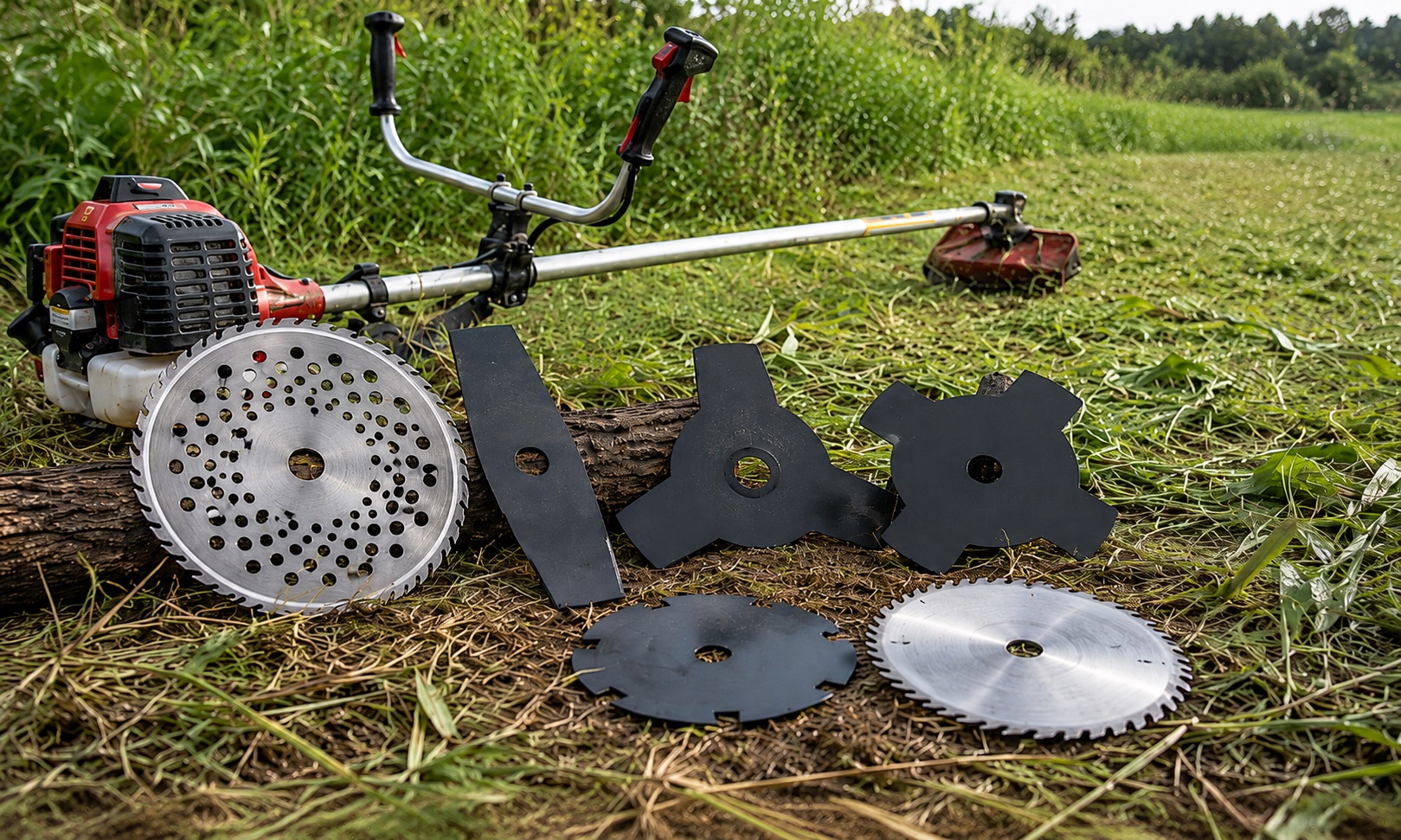
Blade Selection and Dealer Troubleshooting
Application matching, installation checks, tooth-count comparison and bulk-buying guidance for importers and dealers.
A brush cutter blade can look sharp and still cut poorly when its diameter, tooth count, cutting shape, or weight does not match the vegetation and machine. Grass, tangled weeds, reeds, thorny scrub, and small woody stems create very different loads. One blade should not be expected to handle every application equally well.
Before sharpening the blade, replacing the gearbox, or blaming the engine, identify what the customer is cutting. Importers and dealers should also confirm blade direction, center-hole size, guard arrangement, machine output, operating speed, handle type, harness, and mounting components. Poor blade selection can easily be mistaken for low engine power or a defective brush cutter.
| Quick answer: | A brush cutter blade usually cuts poorly because the blade type does not match the vegetation, the cutting edges are dull or uneven, the blade is mounted in the wrong direction, or the engine cannot maintain speed under load. Lower-tooth open blades are generally more suitable for grass and dense weeds, while higher-tooth circular-style blades may suit firmer, fibrous, or woody growth when the machine configuration permits them. Importers should reduce risk by confirming diameter, center hole, thickness, weight, maximum speed, balance, guard requirements, and field performance before ordering blades in bulk. |
01 Match the Blade to the Vegetation First
The first question is not whether the blade feels sharp. The first question is whether its cutting design matches the material. A blade intended for ordinary grass may push over woody stems, while a fine-tooth blade can collect soft wet grass or suffer unnecessary damage in rocky ground.
Open grass blades and brush knives are commonly selected for grass, thick weeds, tangled growth, and light scrub. Circular saw-style blades are closer to a sawing attachment and may be selected for firmer, fibrous, or woody vegetation when the exact blade and brush cutter combination is approved.
| SOFT GRASS | Buying focus: Efficient clearing, moderate blade weight, correct cutting width and reduced wrapping. |
| DENSE WEEDS | Buying focus: Open blade shape, strong cutting edges, balanced design and sufficient machine output. |
| LIGHT SCRUB | Buying focus: Controlled cutting, suitable blade thickness, correct guard and experienced operation. |
| WOODY GROWTH | Buying focus: Approved circular-style blade, suitable handle and harness, limit stop, protective equipment and machine compatibility. |
When customers say the brush cutter lacks power, the actual problem may be that the same blade is being used for roadside grass, wet weeds, reeds, thorny scrub, and woody stems. Dealers should ask what material is being cut before recommending a replacement blade.
02 2T, 3T, 4T and 8T Blade Comparison
Lower-tooth blades use a relatively open cutting profile. Tooth count affects cutting character, but it does not automatically determine quality. Blade diameter, steel, thickness, weight, edge shape, balance, machine speed, and operator technique are equally important.
| Blade Type | Typical Application | Common Poor-Cutting Cause | Dealer Buying Focus |
| 305mm 2T | Broad grass mowing and open vegetation clearing | Oversized for the machine, dull edges, excessive forward speed | Diameter, weight, center hole, guard and engine approval |
| 255mm 3T | Thick grass, dense weeds, tangled vegetation and light scrub | Uneven sharpening, bending, wrapping or low engine speed | Balance, edge symmetry, flatness and steel condition |
| 255mm 4T | Controlled cutting of weeds and tough grass | Mounted upside down, dull edges, wide sweep or flat vegetation | Blade shape, thickness, machine speed and intended vegetation |
| 255mm 8T | Dense grass and heavier grassy growth | Tangled material, wrapped vines, forcing too much vegetation at once | Tooth consistency, balance and local grass conditions |
The 305mm 2T brush cutter blade may suit applications where broad cutting width is useful. Because of its larger diameter, dealers should verify machine approval, blade weight, center hole, guard clearance, maximum operating speed and gearbox load before presenting it as an upgrade.
| View 305mm 2T Blade |
| 255mm 3T Blade
The 255mm 3T brush cutter blade can be positioned for customers clearing thick grass, dense weeds and light scrub. Every cutting edge should be maintained equally to preserve blade balance.
|
255mm 4T Blade
The 255mm 4T brush cutter blade offers more cutting edges while retaining an open profile. It may suit dealers needing a general grass and weed blade between basic mowing attachments and higher-tooth saw-style blades.
|
| 8T Dense Grass |
The 255mm 8T brush cutter blade provides more cutting points and may suit dense grassy growth. Long vines, plastic cord, wire and irrigation material should be removed regularly because wrapping behind the blade can make a sharp attachment appear ineffective.
|
03 When 40T and 80T Blades Are Appropriate
A 40-tooth or 80-tooth blade has a different cutting character from an open grass blade. The finer tooth pattern may be useful for firmer, fibrous, brush-like, or small woody material depending on the exact blade construction and approved machine configuration.
These blades should not automatically be marketed as universal attachments. Closely spaced teeth can collect soft wet grass, while rocky ground exposes more cutting points to stones and buried objects. The machine must also be suitable for a circular-style attachment.
|
FINE-TOOTH OPTION
255mm 40T Alloy BladeThe 255mm 40T alloy brush cutter blade may be considered for firmer, fibrous or brush-like vegetation. Dealers should ask whether the customer is cutting ordinary grass, brush or woody material before recommending it. Important checks: stone frequency, machine approval, guard type, bicycle handle, harness, limit stop and local sharpening capability.
|
PROFESSIONAL CLEARING
255mm 80T BladeThe 255mm 80T brush cutter blade may be relevant for professional users handling thick weeds, cattails, brush or small saplings, subject to the exact blade and machine specification. Important checks: approved guard, handle, harness, limit stop, operator control, protective equipment and maximum permitted speed.
|
Circular saw-style blades should only be used with an approved brush cutter, guard, handle, harness, limit stop and mounting system. An incompatible combination can increase blade thrust, component damage, thrown-object risk and loss of control.
04 Installation Problems That Make a Good Blade Cut Badly
A suitable brush cutter blade will still perform poorly if it is installed incorrectly. Depending on the machine, the mounting stack may include a drive disc, blade, support cup, flange, washer and locking nut. Every component must sit flat and in the correct order.
| Inspection Point | Possible Fault | Recommended Action |
| Cutting direction | Blade mounted upside down or facing the wrong direction | Follow the blade marking and machine manual |
| Center hole | Loose fit, wrong reducer or mismatch with drive disc | Confirm exact center-hole and flange dimensions |
| Mounting surface | Dirt, deformation or incorrect support component | Clean the stack and replace distorted parts |
| Locking nut | Incorrect tightening direction or insufficient torque | Use the correct shaft-locking procedure and manual |
| Guard clearance | Blade contacts the guard or limit stop | Install the approved guard and check full rotation |
| Output shaft | Abnormal resistance, wrapping or bent mounting parts | Remove material and inspect shaft and gearbox condition |
Some brush cutters use a left-hand thread on the blade-retaining nut. Dealers should not assume the tightening direction. Incorrect assembly can damage the nut, output shaft, flange or blade mounting surface.
Before inspection, stop the engine and disconnect the spark plug. After installation, rotate the blade manually to confirm that it sits flat, clears the guard and turns without abnormal resistance.
05 Blade Damage, Sharpening and Balance
A blade does not need to be completely blunt before cutting quality declines. Rounded edges increase resistance, reduce cutting speed and make the operator use wider or more aggressive sweeps.
|
|
Grass blades should be sharpened evenly across all cutting edges. Removing more material from one side can create imbalance, vibration and additional load on the gearbox bearings, shaft and handle assembly.
Bent or cracked blades should not be repaired by hammering, welding or bending them back into shape. After correct sharpening, test the machine at low speed and stop immediately if vibration increases.
Importers should include blade flatness and balance in quality inspection. A blade may meet the stated diameter and tooth count while still producing complaints because of inconsistent thickness, poor heat treatment, distorted mounting surfaces or inaccurate center holes.
06 Is the Brush Cutter Powerful Enough for the Blade?
A large-diameter, heavy or high-tooth blade increases load on the engine, clutch, shaft and gearbox. The machine may run normally without contact but lose speed as soon as the blade enters dense vegetation.
| Air and Fuel Check the air filter, gasoline quality, fuel mixture, fuel filter and carburetor response. | Ignition Inspect the spark plug, ignition stability and engine acceleration under load. | Transmission Confirm clutch engagement, drive-shaft condition and gearbox lubrication. | Cutting Load Remove grass, vines, wire and other material wrapped around the output shaft. |
If engine speed drops sharply, fitting a sharper or higher-tooth blade may not solve the problem. Dealers should test the selected machine-and-blade combination in actual vegetation, not only by running it above the ground in a warehouse.
Operators also affect performance. A sweep that is too wide or too fast can overload the cutting attachment. Dense vegetation should be cleared in controlled sections while maintaining effective engine speed.
07 Importer and Dealer Bulk-Order Checklist
Brush cutter blades should not be purchased only by diameter and tooth count. Two blades described as 255mm may differ significantly in center-hole diameter, thickness, material, weight, tooth shape, heat treatment and maximum permitted speed.
| Product and Quality Audit | Market and Shipment Audit |
|
|
Markets dominated by roadside grass may require more 2T, 3T, 4T or 8T open blades. Areas with thorny scrub, reeds, fibrous growth or small woody stems may require a controlled quantity of 40T or 80T circular-style blades. Multiple blade types are useful only when sales staff can explain their applications and compatibility limits.
08 Practical Troubleshooting Order
STEP 1 Identify whether the customer is cutting grass, weeds, reeds, scrub or woody stems.
STEP 2 Confirm that the blade type is suitable for that vegetation.
STEP 3 Check diameter, center hole, blade weight and machine approval.
STEP 4 Inspect cutting direction and the complete mounting stack.
STEP 5 Inspect for dull edges, missing teeth, cracks, bending and uneven sharpening.
STEP 6 Remove vegetation, wire and cord wrapped around the output shaft.
STEP 7 Check engine acceleration, clutch engagement, shaft and gearbox condition.
STEP 8 Test the blade in realistic vegetation at a controlled sweep speed.
STEP 9 Replace the blade only after confirming that machine and application are suitable.
FAQ Frequently Asked Questions
Why does a sharp brush cutter blade still cut poorly?
The blade may not match the vegetation, may be installed in the wrong direction, may be too large or heavy for the machine, or may be losing speed because of engine, clutch, shaft or gearbox problems.
Which blade is suitable for thick grass and heavy weeds?
Open 3T, 4T or 8T blades are commonly considered for thick grass and dense weeds. The final choice depends on the machine output, blade specification, grass density, wrapping risk and local operator habits.
Is an 80-tooth blade better than a 3-tooth blade?
Not for every application. A 3T blade is more open and can suit dense grass, weeds and light scrub. An 80T blade has a circular-style cutting character and may suit firmer or woody growth when the machine configuration permits it.
Can a larger blade damage a brush cutter?
An oversized or excessively heavy blade can increase load on the clutch, shaft, gearbox and engine. Dealers should confirm the permitted diameter, weight, guard, center hole and maximum operating speed before supplying a larger blade.
How can dealers reduce blade-related complaints?
Dealers should ask what vegetation the customer cuts, verify machine compatibility, explain installation direction, inspect mounting parts, and provide clear application labels. Field testing is more useful than relying only on tooth count.
What should importers inspect before buying brush cutter blades in bulk?
Inspect diameter, center hole, thickness, weight, steel specification, tooth design, maximum speed, balance, flatness, packaging protection, compatible flange and recommended guard arrangement.
| WHOLESALE BLADE SELECTION Choose Blade Inventory by Application, Not Tooth Count Alone
A brush cutter blade cuts properly only when the blade, vegetation, engine, guard, handle, harness and mounting system work as one compatible configuration. Compare open grass blades and circular-style blades according to your local market before confirming bulk quantities. |
|