
Do You Need a New Trimmer Head or Just Replacement Line?
Know when poor line feeding needs a full trimmer head, not another refill. Check eyelets, spool, cover, compatibility, and dealer stock planning.
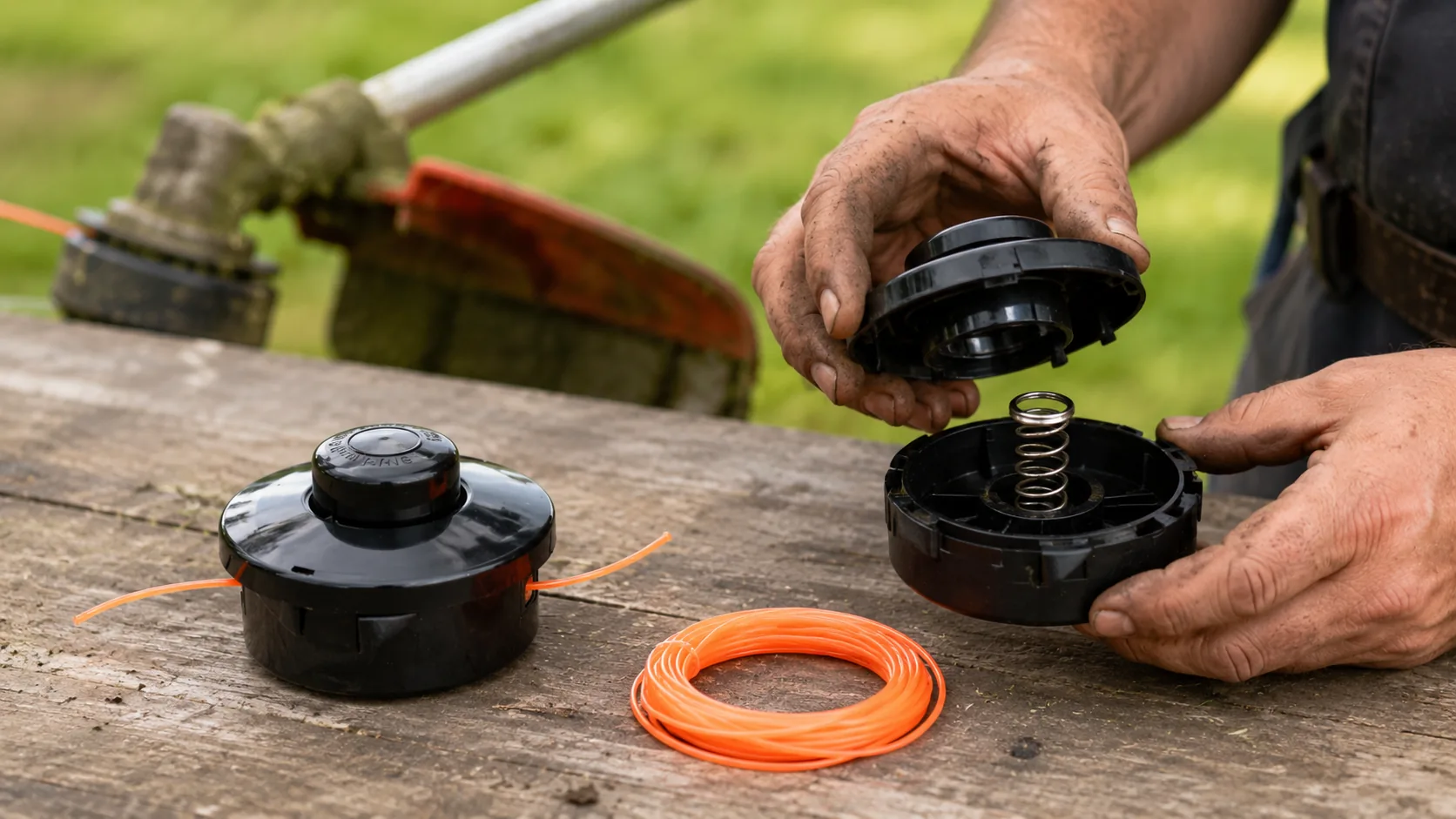
Dealer Spare Parts and Workshop Guide
Trimmer Line or Complete Trimmer Head Replacement: How to Choose the Correct Spare Part
Replace only the trimmer line when the existing head is structurally sound, rotates normally, closes securely, and feeds correctly after the spool has been reloaded. Replace the complete trimmer head when wear or damage affects the housing, cover locks, eyelets, spool, bump knob, internal feed mechanism, mounting point, or rotational balance.
For brush cutter dealers, landscaping workshops, agricultural machinery stores, and spare-parts importers, this distinction affects both repair cost and inventory planning. Supplying another coil cannot solve a cracked housing or worn feed mechanism. Replacing a healthy head every time the line runs out, however, increases the customer’s cost and creates unnecessary waste.
| 1 |
Quick answer: Refill a healthy head when the line is empty, tangled, incorrectly wound, unevenly loaded, or unsuitable for the permitted line diameter. |
| 2 |
Replace a serviceable internal component when the correct spool, cover, eyelet, spring, or bump knob is available separately and the remaining head is still safe. |
| 3 |
Replace the complete assembly when structural damage, excessive wear, poor locking, abnormal wobble, or inconsistent feeding makes the head unsafe or uneconomical to repair. |
When Fresh Trimmer Line Is the Correct Repair
An empty spool does not mean the trimmer head is damaged. Refill line is normally the correct purchase when the housing has no cracks, the cover remains securely locked, the spool sits correctly, and both line ends can move through the outlets without catching.
Before loading new line, remove the battery or stop the engine. Disconnect the spark plug where appropriate, wait for all rotating parts to stop, and clean grass, soil, and line fragments from the head. This makes it easier to separate a loading problem from actual component wear.
| Observed Condition | Likely Cause | Correct Action |
| No line remains in the head | Normal consumption | Load compatible replacement line |
| Line remains but will not advance | Line ends are too short or trapped | Remove, inspect, and rewind correctly |
| Line tangles inside the spool | Loose, uneven, or crossed winding | Reload evenly in the indicated direction |
| Cover is difficult to close after loading | Too much line has been installed | Reduce the loaded length |
| Line jams despite an undamaged head | Incorrect line diameter or profile | Confirm the range accepted by the head |
Reloading methods vary. Some heads require removal of the cover and spool, while easy-load designs allow line to pass through aligned eyelets before it is wound by turning an external knob. The winding direction, permitted diameter, maximum load, and line profile should be confirmed for the actual head rather than assumed from the brush cutter category.
|
Workshop refill supply 1402 Replacement Trimmer LineA loose coil is relevant for repair shops, landscaping teams, commercial grass-cutting crews, and dealers that refill compatible heads repeatedly. Confirm before quotation: line diameter, length, profile, material, compatible head range, quantity per coil, and carton packing. |
|
When the Complete Trimmer Head Should Be Replaced
New nylon line cannot correct structural damage. A complete replacement becomes the practical choice when the housing cannot remain closed, the rotating assembly is out of balance, the spool no longer engages correctly, or internal feeding parts cannot release and retain the line consistently.
A damaged head rotates at high speed and should not be returned to service with glue, wire, modified locking tabs, improvised fasteners, or an unconfirmed cover. The machine should remain stopped until the damaged assembly or correct service component has been replaced.
Replace the Head Immediately
|
Inspect Before Deciding
|
|
Complete assembly option 1302 Trimmer HeadRelevant when the customer needs a complete enclosed cutting-head assembly rather than another refill coil. |
Visible configuration: Enclosed head, two line exits, and installed nylon line. Use case: Cracked, excessively worn, poorly locking, or unreliable original head. Confirm: Mounting thread, adapter, rotation direction, permitted line size, guard clearance, and machine compatibility. |
|
Inspect the Eyelets, Spool, and Bump Mechanism Separately
A feeding complaint can begin at several different points. Workshops should inspect the line outlets, internal spool, cover, knob, spring, engagement teeth, and sliding surfaces before deciding that the nylon line itself is unsuitable.
Where the manufacturer supplies internal service parts, replacing one component may be economical. When several parts are worn together, a complete head normally reduces workshop time and lowers the risk of the customer returning with another related fault.
| Inspection Area | Wear Signs | Likely Customer Complaint | Repair Decision |
| Eyelets or outlets | Sharp edge, elongated opening, deep groove, missing guide | Line breaks repeatedly close to the head | Replace the guide if serviceable; otherwise replace the head |
| Spool channels | Cracks, heat distortion, rounded engagement points | One-sided feed, internal unwinding, repeated jamming | Replace the spool or complete assembly |
| Bump knob | Worn flat, cracked, stuck, or unable to engage | Line does not advance when the head is tapped | Clean first; replace the knob or head if wear remains |
| Return spring | Missing, compressed, corroded, or distorted | Knob remains pressed or feed action becomes irregular | Install the confirmed replacement spring |
| Cover and locks | Loose fit, worn tabs, cracking, movement after locking | Head opens, rattles, or releases the spool | Replace the cover only if the housing is undamaged and compatible |
Do Not Use Thicker Line to Compensate for a Worn Feed System
Thicker line cannot repair a worn bump knob, damaged engagement teeth, distorted spool, or sharp eyelet. It may create additional resistance, fail to pass through the outlets, overload the feed mechanism, or exceed the line range permitted for the head.
Confirm Mounting Compatibility Before Ordering a Complete Head
A replacement head can look similar to the original and still fail to fit the gearbox output. The importer or workshop should identify the mounting arrangement before placing an order or describing a part as suitable for a particular brush cutter.
A head described as universal may include several adapters, but this does not confirm compatibility with every straight-shaft or curved-shaft machine. Incorrect thread direction, adapter engagement, head diameter, or guard clearance can prevent secure installation or create an unsafe rotating assembly.
- 01. Record the mounting thread diameter and thread pitch.
- 02. Confirm whether the output uses a left-hand or right-hand thread.
- 03. Identify whether the machine requires a male fitting, female fitting, or separate adapter.
- 04. Check the output-shaft rotation direction.
- 05. Compare the head diameter with the guard and line-cutting blade position.
- 06. Confirm the accepted nylon-line diameter and loading capacity.
- 07. Test the installed head for secure engagement and normal rotation before cutting.
Stock Loose Coils, Retail Packs, and Complete Heads for Different Buyers
The same line material can serve different sales channels depending on presentation and order packing. Commercial users and repair workshops may prefer larger loose coils because they refill many heads. Hardware stores may need smaller retail packs that customers can identify, carry, display, and store more easily.
Complete heads serve a separate requirement. They are needed for structural damage, severe wear, lost components, or machines entering a workshop with an incompatible or unrepairable original head. Dealers that stock only one of these product levels leave common service needs unresolved.
Complete HeadsFor cracked housings, worn locking systems, unreliable feeding, missing parts, or compatibility-based replacement. |
Loose Refill CoilsFor workshops, contractors, landscaping teams, and frequent users with compatible serviceable heads. |
Retail Line PacksFor dealer shelves, hardware stores, garden-tool retailers, and end users buying smaller replacement quantities. |
|
Retail display option 1407 Packaged Trimmer LineThe product is presented in a round hanging case and can be compared for hardware-store display and end-user replacement sales. Confirm before ordering: line dimensions, profile, label design, branding, quantity per pack, hanging format, and outer-carton arrangement. |
|
Importer and Dealer Spare-Parts Checklist
Stock quantities should reflect the work performed in the destination market. Commercial landscaping crews may consume large volumes of line while replacing relatively few heads. Roadside clearing markets with stones, concrete edges, wire, rough handling, and limited maintenance may require a higher proportion of complete assemblies and structural service parts.
| 01 | Identify common machine mountings before choosing complete trimmer heads and adapters. |
| 02 | Record accepted line diameters for every stocked head instead of ordering by color. |
| 03 | Separate workshop coils from retail packs so each sales channel receives suitable quantities and presentation. |
| 04 | Stock compatible complete heads for structural failures that cannot be solved with another refill. |
| 05 | Confirm replacement spools, covers, knobs, springs, and eyelets where the head design allows individual servicing. |
| 06 | Include mounting adapters and fastening hardware that match the selected head and gearbox outputs. |
| 07 | State line diameter, profile, length, and packing clearly in the quotation or proforma invoice. |
| 08 | Check repeat-order consistency for head mounting, spool design, cover locks, adapters, and packaging. |
| 09 | Train dealers to diagnose the failed component instead of automatically selling the highest-cost replacement. |
| 10 | Review local failure patterns before adjusting the ratio of refill line, retail packs, service parts, and complete heads. |
Trimmer Line and Trimmer Head FAQ
1. How do I know whether to replace the line or the whole trimmer head?
Replace the line when the housing, spool, cover, eyelets, and feed mechanism remain functional. Replace the complete head when structural damage, excessive wear, poor locking, wobble, or internal feed failure prevents safe and consistent operation.
2. Why does new trimmer line keep breaking at the eyelet?
The outlet may have a sharp edge, deep groove, missing guide, or elongated opening. An unsuitable line diameter, hard contact with stones, and incorrect loading can also contribute. Inspect the outlet before fitting another coil.
3. Can a damaged bump-feed head be repaired?
It may be repairable when the correct knob, spring, spool, cover, or eyelet is available separately and the housing remains structurally sound. Replace the complete assembly when several components are worn or the head cannot remain securely closed.
4. Does thicker trimmer line feed better?
Not necessarily. Line that exceeds the accepted range may jam in the spool, catch at the eyelets, overload the feed mechanism, or fail to advance. Use the diameter and profile permitted for the actual head.
5. Are universal trimmer heads compatible with every brush cutter?
No. The mounting thread, pitch, direction, adapter, gearbox rotation, head diameter, guard clearance, and line range must still be checked against the machine.
6. What trimmer spare parts should a dealer stock first?
A practical starting range can include compatible complete heads, refill line in confirmed diameters, retail line packs, replacement spools, covers, bump knobs, springs, eyelets, mounting adapters, and fastening hardware.
7. Why should importers stock both refill line and complete heads?
Refill line serves healthy heads and frequent users, while complete heads solve structural damage and severe wear. Stocking both prevents unnecessary replacement of serviceable assemblies and avoids sending damaged heads back into operation with another coil.
|
Build a practical dealer spare-parts range Match Refill Line, Retail Packaging, and Complete Heads to Actual Repair DemandA balanced stock plan helps workshops refill healthy heads, repair serviceable components, and replace damaged assemblies without forcing every customer into the same purchase. |
|