
Why Does an Earth Auger Engine Stop When Drilling Into Hard Ground?
Earth auger engine stops in hard ground? Check drilling pressure, fuel supply, air intake, and load conditions before replacing parts.
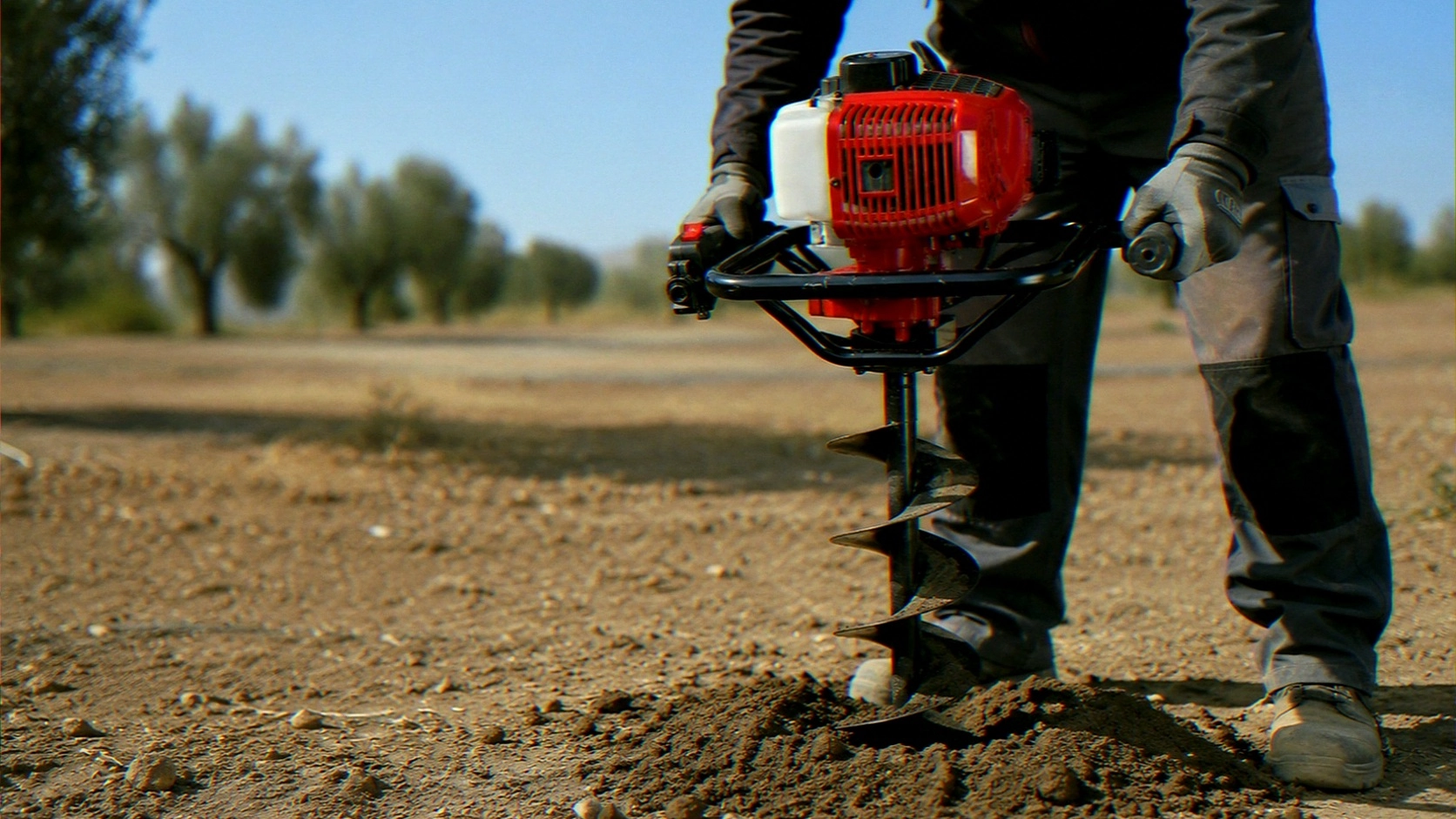
Earth Auger Engine Stalls During Drilling: What to Check Under Load
An earth auger engine may stop during drilling when cutting resistance rises suddenly, the operator applies too much downward pressure, the fuel or air supply cannot support the load, or the engine condition does not match the working demand. A brief drop in engine speed when the bit enters harder soil can be normal. Repeated stalling is not.
This article covers a gasoline earth auger that starts normally but stalls as the drilling load increases. It does not address a bit that spins without digging, a bit that stops because of a transmission fault, or a machine that jumps during drilling. Those symptoms require different checks.
Quick answer:
Reduce downward pressure before adjusting or replacing parts. Lift the bit slightly so packed soil can leave the flights, then test the auger in softer ground. If the engine still stalls, inspect fuel quality, fuel lines, the air filter, throttle travel, spark-plug condition, cooling passages, and muffler restriction. Check the cutting edges, bit diameter, shaft condition, and soil match before blaming the engine. Carburetor, compression, ignition, clutch, and gearbox inspection should come later.
1. Confirm Whether the Engine Is Overloaded
Compact soil, dry clay, buried roots, and packed layers can raise drilling resistance quickly. The engine must maintain enough speed to keep the bit cutting and carrying soil upward. A temporary reduction in rpm does not automatically mean the engine is faulty.
Observe the machine immediately before it stops. The way the engine loses speed gives useful evidence.
| Engine behaviour | Likely direction | First check |
| Slows gradually in harder soil | Load is increasing beyond the current working speed | Pressure, bit condition, soil discharge |
| Stops suddenly when throttle opens | Fuel, air, throttle, or carburetor response may be weak | Throttle travel and engine supply systems |
| Restarts immediately after stopping | Temporary overload remains possible | Retest with reduced pressure |
| Runs normally in softer ground | Application resistance is strongly involved | Soil and bit matching |
| Stalls in every hole | Persistent engine or drive fault is more likely | Fuel, air, ignition, clutch, gearbox |
When the engine slows progressively before stopping, the first correction is usually the drilling method. Avoid replacing parts until the machine has been tested with controlled pressure and a clear soil-discharge path.
2. Reduce Drilling Pressure and Clear Packed Soil
Many earth auger complaints begin with the relationship between the operator, bit, and ground. Pushing down aggressively does not always make the machine drill faster. It can prevent the engine from maintaining speed and reduce the bit’s ability to remove soil.
Try lifting the auger slightly while keeping the engine running so loose material can move up the flights. Continue with controlled pressure after the hole has cleared.
Correct operating approach
|
Conditions that increase load
|
3. Check Fuel Supply Before Carburetor Adjustment
An earth auger can idle normally while still having insufficient fuel flow for drilling. Once resistance increases, the engine requires a stable supply. A partial restriction may only become obvious under load.
| Fuel check | Possible problem | Dealer action |
| Tank level and fuel age | Insufficient, stale, or contaminated gasoline | Replace with correctly prepared fresh fuel |
| Fuel-line condition | Cracks, kinks, looseness, or restriction | Inspect routing and connections |
| Fuel filter, if equipped | Flow becomes insufficient under demand | Inspect and replace only with a matched part |
| Carburetor response | Fuel metering cannot support acceleration or load | Inspect after basic fuel checks |
Stop the engine and allow hot parts to cool before inspecting fuel components. Gasoline vapour and leakage create a fire risk near the muffler and cylinder.
Do not immediately turn carburetor screws. An incorrect adjustment may add cold-start, acceleration, temperature, or fuel-consumption problems without correcting the original restriction.
4. Inspect Airflow, Spark Plug and Cooling Areas
A restricted air filter may not prevent the engine from idling, but it can reduce available power once the bit enters the soil. Dirt around the intake or cooling passages can also increase operating temperature and worsen performance.
Engine-condition checks
- Air-filter cleanliness and condition
- Dirt buildup around the air intake
- Spark-plug deposits, fouling, and physical condition
- Blocked cylinder or cooling-air passages
- Signs of muffler or exhaust restriction
A spark plug can provide useful evidence, but its appearance should not be used to diagnose every fault by itself. Heavy deposits or repeated fouling may indicate that the engine is not operating correctly, while abnormal colour may need to be considered together with fuel, load, and temperature conditions.
Clean and inspect components according to the actual engine design. Do not operate the auger with blocked cooling areas because overheating can introduce additional power loss and component stress.
5. Confirm Throttle Travel and Working Speed
The engine should reach a stable operating speed before the bit is loaded. Applying heavy pressure too early can make the auger stall before it develops the output required for drilling.
A throttle cable or control fault may also prevent full engine response. Check that the trigger moves through its expected travel and returns correctly after release.
| Step 1 | Test throttle movement with the engine stopped. The trigger and cable should move smoothly without binding. |
| Step 2 | Run the engine without drilling load and confirm that it accelerates without severe hesitation. |
| Step 3 | Allow working speed to stabilize before the cutting edges enter the ground. |
| Step 4 | Apply controlled pressure and observe whether the engine slows gradually or loses power suddenly. |
If the engine does not respond properly before the bit enters the ground, inspect the throttle system and engine condition first. If it accelerates normally without load and fails only in demanding soil, the bit and application require closer attention.
6. Match the Bit to the Ground and Machine
A worn or unsuitable auger bit can make a normally operating engine appear weak. The bit determines how much soil must be cut, loosened, and lifted with each rotation.
| Bit condition | Effect on drilling load | Procurement concern |
| Worn cutting edges | More pressure is needed to enter the ground | Replacement cutting parts |
| Bent shaft or damaged flights | Rotation and soil discharge become inefficient | Correct bit specification |
| Large drilling diameter | More soil must be removed per revolution | Application and model matching |
| Packed clay around flights | Discharge resistance rises rapidly | Operating guidance for dealers |
Wet clay, rocky ground, compacted soil, and loose cultivated soil create very different working demands. A single bit-and-machine combination should not be presented as suitable for every application.
The selected bit diameter, cutting-edge type, accessories, and replacement parts should be confirmed according to the actual order requirements.
7. TM-EA520B Product and Application Check
The TM-EA520B should be evaluated as a complete drilling configuration. Its practical performance depends on the selected bit, soil condition, operator technique, and the confirmed accessories supplied with the order.
|
Application-Matched Recommendation TM-EA520B Earth AugerModel: TM-EA520B Relevant for distributors who need a gasoline earth auger that can be ordered with drilling accessories matched to the intended hole size and local ground conditions. Before quotation, confirm the soil application, required bit, replacement cutting parts, supplied tools, packaging details, and after-sales parts configuration. |
|
A model that works normally with one bit in loose soil may experience much greater load with a larger diameter in compact clay. Dealers should therefore avoid judging performance from one specification value or a no-load demonstration.
Final specifications, drilling accessories, and spare-parts compatibility should be confirmed in the quotation or proforma invoice. The supplied configuration should also be recorded for future repeat orders.
8. Importer and Dealer Audit Checklist
Pre-delivery inspection should confirm more than whether the engine starts. The machine, controls, bit, and accessories must work together as the selected order configuration.
| No. | Audit item | Acceptance requirement |
| 01 | Target soil type | Application is defined before model and bit selection |
| 02 | Required hole diameter | Bit size matches the customer’s actual drilling task |
| 03 | Throttle operation | Control reaches full travel and returns smoothly |
| 04 | Fuel-system assembly | Lines and connections are secure without leakage |
| 05 | Engine response | Engine accelerates through different speeds without severe hesitation |
| 06 | Assembly fasteners | Engine, handles, gearbox, and bit connections are secure |
| 07 | Noise and vibration | No abnormal mechanical noise or uncontrolled movement |
| 08 | Supplied accessories | Bit, tools, and ordered accessories match the PI |
| 09 | After-sales parts | Fuel, filter, plug, clutch, and drilling parts are model matched |
| 10 | Repeat-order record | The confirmed machine and bit configuration is documented |
When a stalling complaint is received, record the soil type, bit size, drilling depth, engine behaviour before stopping, restart condition, and whether the fault occurs on every hole. This information helps distinguish application overload from an engine or transmission problem.
9. Stop Operation When Stalling Becomes Repetitive
Do not continue forcing an earth auger into hard ground when the engine repeatedly stops. Continuous overload can increase stress on the engine, clutch, gearbox, shaft, and bearings.
Remove the auger from service if
- The engine stops in normal soil conditions.
- Power disappears suddenly instead of dropping gradually.
- Fuel leakage appears.
- The engine or clutch area becomes excessively hot.
- Unusual knocking, scraping, or transmission noise develops.
- The bit or shaft rotates abnormally.
- Increasing pressure is required to continue every hole.
If the engine still stalls in moderate soil after pressure, fuel, air, throttle, cooling, and bit checks, further inspection may include the carburetor, compression, ignition system, clutch engagement, gearbox, or transmission resistance. Internal parts should be inspected in that order rather than replaced at random.
Frequently Asked Questions
| Q1 |
Why does my earth auger run normally until it enters the soil?The engine may be unable to maintain enough speed, fuel flow, airflow, or torque when resistance rises. Drilling pressure, bit condition, soil discharge, and engine supply systems should be checked. |
| Q2 |
Can too much downward pressure stall the engine?Yes. Heavy pressure can overload the engine and clutch while preventing the bit from clearing soil efficiently. Controlled pressure is usually more effective. |
| Q3 |
Why does the auger stall more often in clay?Clay can create high cutting resistance and pack around the flights. Lift the bit periodically, reduce pressure, and check that the cutting edges and bit diameter suit the ground. |
| Q4 |
Should I adjust the carburetor first?No. Check fuel quality, fuel flow, air-filter condition, throttle movement, cooling areas, spark plug, drilling method, and bit load before adjusting the carburetor. |
| Q5 |
Can a larger auger bit cause repeated stalling?A larger diameter usually creates more load because more soil must be cut and lifted. The bit, soil, and selected machine configuration should be matched before ordering. |
| Q6 |
What should dealers record when a TM-EA520B stalls?Record the soil type, bit size, drilling depth, engine behaviour before stopping, restart condition, throttle response, and whether the fault occurs in every hole or only demanding ground. |
Confirm the Right Earth Auger and Bit CombinationRepeated stalling should be diagnosed through drilling load, soil discharge, fuel and airflow, throttle response, bit condition, and only then internal engine or drive resistance. Review the TM-EA520B configuration before quotation, shipment, or repeat ordering. |
|