
How to Avoid Tree Bark Damage With a Wheeled Brush Cutter
Prevent tree bark damage when using a wheeled brush cutter by controlling blade clearance, wheel position, approach angle, debris, and orchard operating speed.
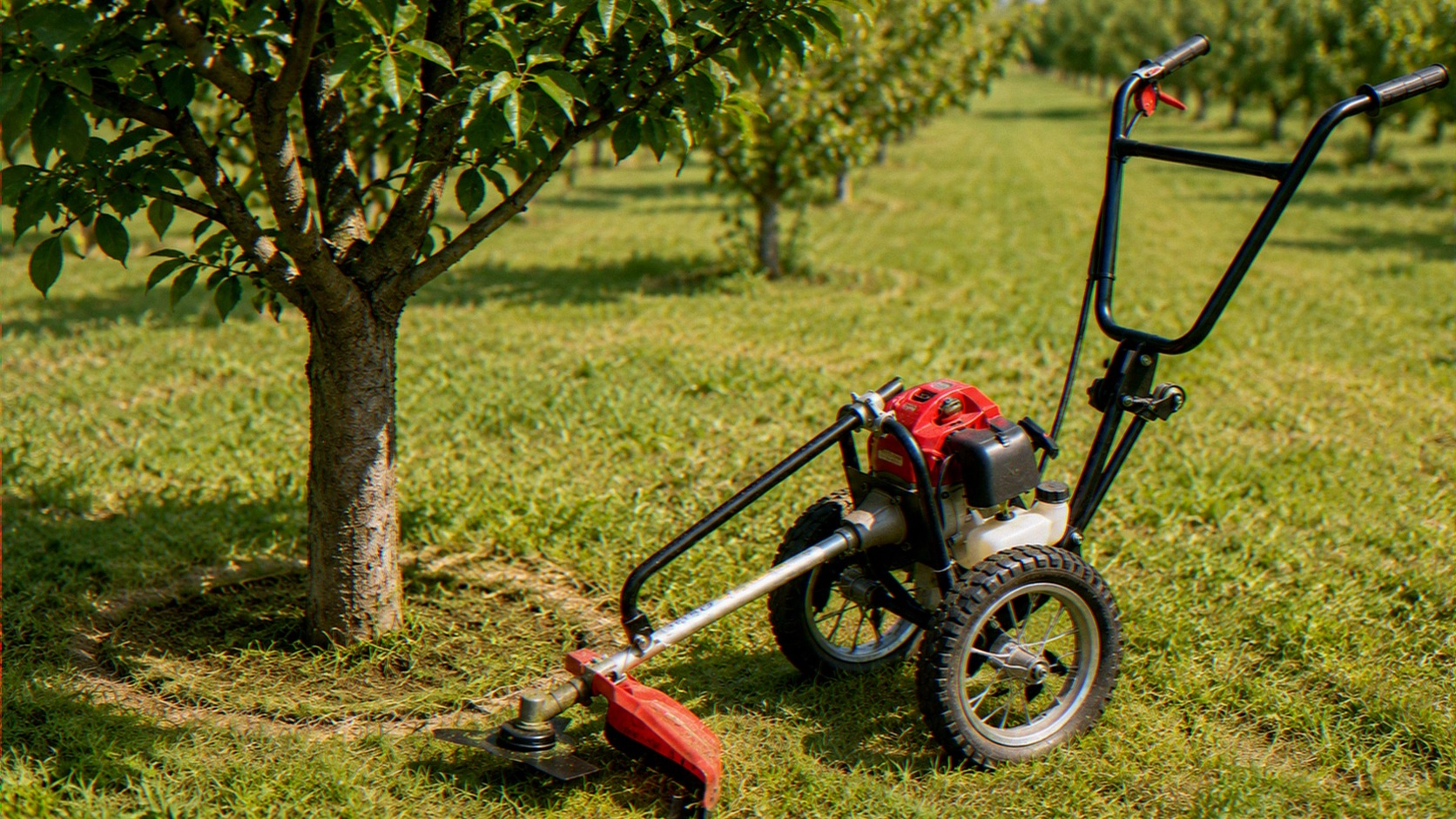
Wheeled Brush Cutter Tree Bark Damage: Orchard Safety Guide
Wheeled brush cutter tree bark damage usually happens when the blade enters the root flare, the cutting head swings inward during a turn, or uneven ground changes the angle of the machine. The wheels may still appear to be outside the trunk area even though the forward cutting zone has already crossed the safe boundary.
This guide focuses on preventing blade, guard and frame contact during orchard floor maintenance. It does not cover machines that clog in long grass, leave uncut strips or lose engine power. In this situation, the engine and blade may be working normally; the main risks are clearance, ground condition, attachment choice and operator movement near trees.
| Quick answer: Orchard operating priority | Tree bark is most likely to be damaged when an operator judges clearance from the wheels instead of the blade and guard. Mark a visible no-cut ring, approach its edge in a straight line, slow down before turning and leave a wider margin around raised roots, soft soil and irrigation channels. Importers and dealers should confirm the actual cutting width, blade-and-guard combination, wheel arrangement and replacement mounting parts before positioning a wheeled brush cutter for orchard use. |
1. Where Wheeled Brush Cutter Tree Bark Damage Begins
A hand-push brush cutter is easier to guide across an open orchard floor than a handheld machine, but its size and turning path make it less suitable for extremely close trimming around trunks. The cutting head commonly extends ahead of the wheel axle. This means the blade can reach the tree before either wheel touches the safety ring.
The risk is especially easy to miss when grass hides the lower trunk or root flare. An operator may see only the upright trunk and overlook the wider area where roots meet the soil. Damage can occur even when the blade does not touch the visible vertical section of the tree.
| Observed condition | Why clearance changes | Practical response |
| Tall grass around the trunk | The root flare, stakes and irrigation parts are hidden. | Inspect the base of each tree before starting the machine. |
| Tight turn beside a tree | The front cutting head swings inward as the frame pivots. | Reverse out and reposition instead of circling the trunk. |
| One wheel enters a rut | The blade tilts lower or toward the tree. | Reduce speed and increase the no-cut margin. |
| Downhill approach | Machine weight and momentum make stopping less precise. | Approach from a more controllable direction where possible. |
| Wide or aggressive blade | The active cutting zone extends farther than expected. | Confirm compatibility and measure the real cutting boundary. |
Young trees require a larger safety margin because their bark is thinner and their trunks can move when contacted. Even limited bark removal may expose tissue to moisture loss, insects or infection.
2. Establish a Safety Ring Before Cutting
The safest working pattern begins before the engine is started. Walk the row, inspect the base of each tree and create a visible no-cut ring around the trunk and root flare. The correct ring size depends on the blade diameter, guard position, wheel track, tree age, slope and surface condition. A fixed distance should not be applied without checking the actual machine configuration.
| 1 | Expose the lower trunk area.
Identify the full root flare rather than judging clearance from the narrowest visible part of the trunk. |
| 2 | Remove hidden obstacles.
Clear loose stones, wire, fallen branches and other objects that could deflect the blade or change the machine’s direction. |
| 3 | Mark the outer cutting limit.
Use a visible reference that operators can follow even when vegetation partially hides the ground. |
| 4 | Clear the open area first.
Use the wheeled brush cutter between rows and outside the marked ring, where its wider cutting path is useful. |
| 5 | Leave the final narrow ring for another method.
Use a more controllable tool or manual clearing method near bark, exposed roots, stakes and irrigation components. |
Leaving a small amount of grass is usually a lower-risk decision than forcing a wide machine into a space where the operator cannot maintain consistent blade clearance.
3. Approach in a Straight Line and Control the Turning Path
Do not make a tight curved pass around a trunk while the blade is close to the bark. On a two-wheel frame, sideways pressure on the handles can pivot the cutting head inward even when both wheels remain outside the marked safety ring.
A more controlled method is to approach the outside of the ring in a straight line, slow down before reaching it, stop forward movement, reverse along the same path and reposition for the next pass. This takes more time than circling each tree, but it makes the cutting-head movement easier to predict.
Suitable operating pattern
|
Not suitable near trunks
|
Operators should watch the outer blade edge, the forward edge of the guard and the point where the cutting head swings during a turn. Wheel position alone does not show the complete cutting path.
4. Uneven Ground Can Remove a Safe Clearance
A distance that appears safe on level ground may disappear when one wheel rises or drops. If the right wheel passes over an exposed root, the cutting head can tilt toward the opposite side. If a wheel enters soft soil, a rut or an irrigation channel, the blade may move lower and closer to the tree.
The movement may seem small at the handles but become more significant at the blade. Before orchard work, inspect for irrigation channels, rodent holes, soft ground after rain, raised roots, hidden stones and sloped planting rows.
When the frame cannot remain level, increase the uncut area. Trying to recover the original clearance by pushing harder on the handles can cause a sudden steering correction and move the blade toward the trunk.
Approach rough ground gradually and reduce forward pressure before a wheel reaches the obstacle. Do not rely on machine weight to carry the cutter through a rut or over an exposed root.
5. Check the Blade, Guard and Orchard Obstacles
Metal blades can clear woody weeds and dense vegetation between orchard rows, but they are less forgiving near bark, irrigation tubing and exposed roots. A wider or more aggressive attachment increases the area that must remain outside the safety ring.
The guard should never be pressed against a trunk as a spacing device. Guard contact can scrape bark, change the shaft angle or push the cutting head inward. A loose, bent or incorrectly installed guard may also fail to represent the blade’s actual boundary.
| Inspection point | Acceptable condition | Stop-use condition |
| Guard and fasteners | Secure, correctly positioned and free from visible deformation | Cracked, loose, bent or contacting the blade |
| Metal blade | Centered, compatible and rotating without guard contact | Bent, cracked, chipped or installed off-center |
| Gear head and shaft | Mounting points remain firm without visible movement | Looseness, movement or new vibration after impact |
| Blade hardware | Correct parts installed and securely tightened | Missing, damaged or repeatedly loosening hardware |
Stop the engine before inspecting the blade area. Disconnect the spark plug lead where appropriate, wear gloves when handling metal attachments and never remove wrapped vegetation while the blade is moving.
Young orchards also require checks for support stakes, tree ties, protective sleeves and drip irrigation lines. Plastic trunk sleeves are not blade-resistant barriers. Where vegetation grows tightly around irrigation tubing, leave the final close pass for a method that does not place a rotating metal blade beside the line.
6. TM-WBC520A Application Fit for Orchard Dealers
| MODEL REFERENCE TM-WBC520A
Hand-push wheeled brush cutter |
The listed TM-WBC520A reference configuration uses a 51.7 cc two-stroke engine, has a 700 mm cutting width and lists an 18 kg net weight. Its two-wheel hand-push layout is intended for gardens, farms, orchards and roadside vegetation work. For orchard markets, the model is most relevant for clearing open spaces between trees and along field edges. Its wide cutting path and machine momentum mean that a controlled safety ring should be maintained around trunks, root flares, stakes and irrigation equipment.
|
Final blade, accessories, branding and packing details should be confirmed according to the quotation or proforma invoice. Dealers should not position the machine for close trunk trimming without first verifying the supplied blade, guard and mounting combination.
For orchard-focused orders, replacement guards, blade mounting hardware and compatible cutting attachments are more relevant than unrelated accessories. Operator guidance should also explain the machine’s forward cutting boundary and turning behavior.
7. Importer and Dealer Orchard Checklist
A wholesale inspection should cover both the supplied configuration and the way the machine will be presented to orchard customers. The following checks help reduce unsuitable applications and avoidable after-sales complaints.
| No. | Configuration check | Why it matters for orchard use |
| 1 | Confirm the actual cutting width. | Operators need to know where the blade extends beyond the wheels. |
| 2 | Verify the supplied blade type and diameter. | A wider or more aggressive blade requires a larger safety area. |
| 3 | Check the guard shape, position and fasteners. | A loose or deformed guard cannot indicate a dependable boundary. |
| 4 | Confirm wheel dimensions and frame layout. | Wheel position affects stability, but does not define the full cutting path. |
| 5 | Inspect handle control and turning behavior. | Sharp handle movement can swing the cutting head toward a trunk. |
| 6 | List compatible blade mounting hardware. | Dealers need correct replacement parts after impact or normal wear. |
| 7 | Confirm replacement guard availability. | A damaged guard should be replaced rather than bent back and reused without assessment. |
| 8 | Define suitable and unsuitable applications. | Open orchard floors and field edges differ from close trunk trimming. |
| 9 | Include safety-ring and straight-pass guidance. | Clear operating instructions reduce contact caused by tight turning. |
| 10 | Record the confirmed configuration for repeat orders. | Changes in blade, guard or wheel arrangement can alter orchard suitability. |
8. Stop and Inspect After Any Contact
If the blade, guard or shaft contacts a trunk, exposed root, stone, support stake or irrigation fitting, release the throttle and stop the engine. Inspect the machine and the tree before continuing. The engine may still run normally even when the impact has affected blade balance or loosened mounting components.
| Check after impact | Action |
| Missing or torn bark | Stop work around the tree and follow appropriate tree-care practices for the species and local conditions. |
| Fresh cut in the root flare | Record the location and prevent another pass through the damaged area. |
| Bent or chipped blade | Do not continue operating with the damaged attachment. |
| Loose blade hardware | Inspect all mounting parts and replace damaged components with compatible parts. |
| Guard displacement | Confirm that the guard is correctly installed and does not contact the blade. |
| New vibration or shaft movement | Stop using the machine until the blade, gear head, shaft and mounting points have been checked. |
Avoid applying unverified coatings or chemicals directly to a bark wound. Tree treatment should be selected according to the species, wound condition and local orchard-management practice.
9. Frequently Asked Questions
Can a wheeled brush cutter be used around orchard trees?
Yes, but it is better suited to open spaces between trees than to extremely close trimming around trunks. Maintain a visible safety ring and use a more controllable finishing method beside bark, roots and irrigation lines.
Why can the blade reach a tree before the wheels?
The cutting head usually extends ahead of the wheel axle. During a turn, its outer edge can also swing inward, so wheel position does not show the full blade clearance.
Should the guard be used to maintain distance from the trunk?
No. The guard can scrape bark and may push the cutting head inward if it contacts the tree. It is intended to help control discharged material, not to act as a tree guide.
Does blade choice affect wheeled brush cutter tree bark damage?
Yes. A wider or more aggressive metal blade increases the active cutting zone and is less forgiving around bark, irrigation tubing and exposed roots. Compatibility with the guard, gear head and mounting hardware must also be confirmed.
What should a dealer supply for orchard after-sales support?
Useful parts include compatible guards, blade mounting hardware and confirmed cutting attachments. Dealers should also provide clear guidance about the cutting boundary, straight-pass method and unsuitable close-trimming applications.
When should the machine be stopped after hitting a root or trunk?
Stop immediately after any contact. Inspect the blade, mounting hardware, guard, gear head and shaft before restarting, and do not continue if there is bending, cracking, looseness, displacement or new vibration.
| Confirm the Right Orchard Configuration
For wholesale wheeled brush cutter orders, confirm the blade, guard, cutting width, mounting hardware and spare-parts arrangement before finalizing the quotation. |
|