
Why Is My Lawn Mower Blowing White Smoke?
A lawn mower blowing white smoke may have excess oil, oil in the air filter or oil moved during tipping. Check the cause safely before restarting it.
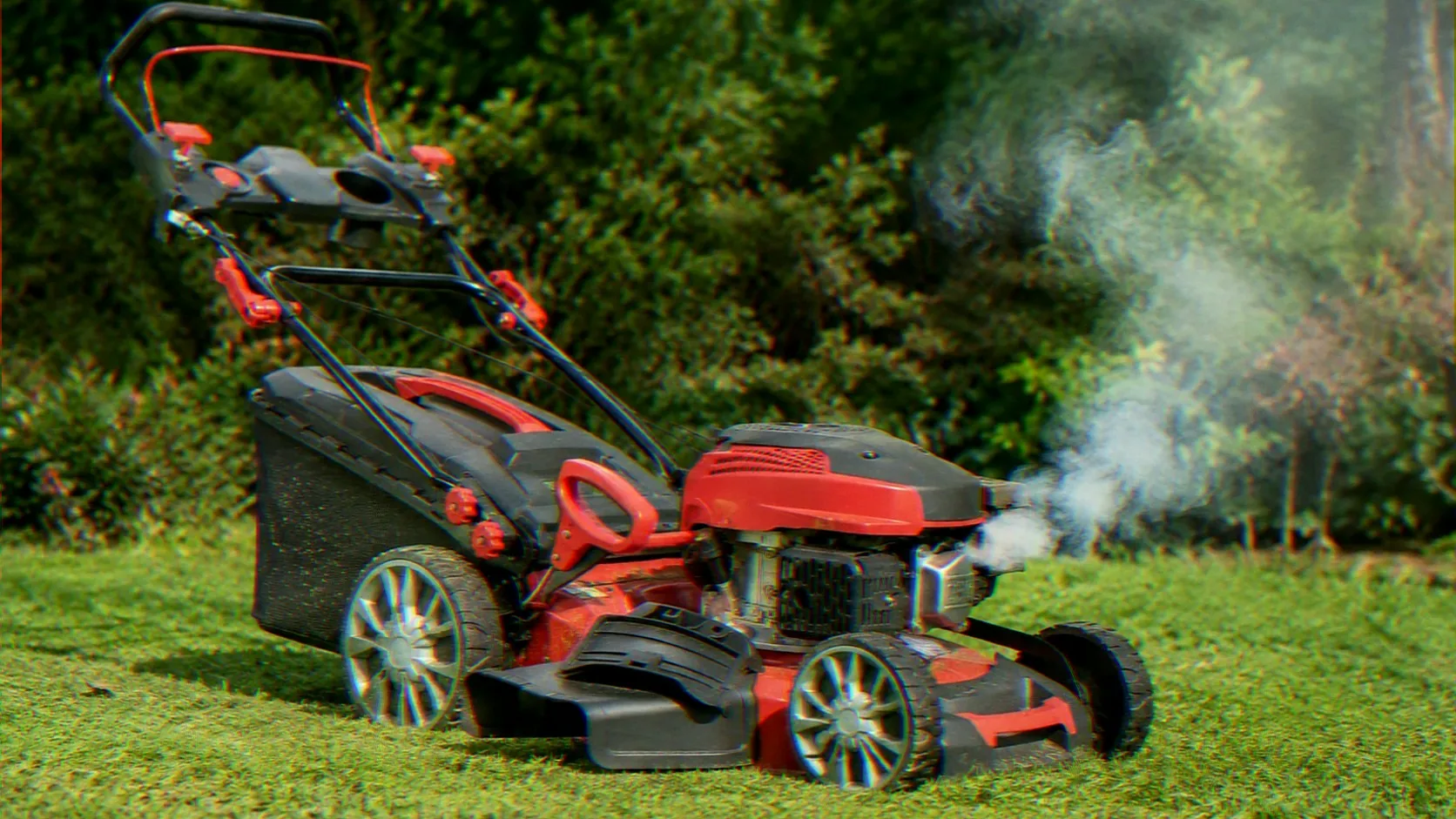
Four-Stroke Mower Service Guide
Lawn Mower Blowing White Smoke: Causes, Checks and Dealer Troubleshooting
A lawn mower blowing white smoke is usually burning engine oil that has entered the cylinder, air intake or muffler. The problem commonly appears after the mower has been tilted, overfilled with oil, operated on a steep slope or transported on its side.
This guide covers a four-stroke petrol mower that starts and runs but releases white or blue-white exhaust smoke. It does not cover black smoke, an engine that repeatedly starts and stops, poor grass collection, uncut strips or vibration after the blade strikes a hard object.
FIRST DIAGNOSTIC PRIORITY
Quick answer: First ask when the smoke began. If it appeared immediately after deck cleaning, blade service, transport or an oil change, check the oil level on flat ground and inspect the air-filter housing and muffler for oil. Correct excess oil instead of running the mower to consume it. Brief smoke caused by accidental tilting may clear after contaminated areas are serviced, but smoke that continues at operating temperature may indicate a crankcase breather, gasket, piston-ring, cylinder or valve-related problem.
1. Stop the Mower and Identify When the Smoke Started
Release the operator control, switch off the engine and wait until the blade stops completely. Move the mower away from dry grass or other combustible material because oil reaching a hot muffler can create smoke and a strong burning smell.
Allow the engine to cool before touching the air filter, dipstick, spark plug or exhaust area. Disconnect the spark-plug cap before inspecting underneath the metal deck.
The timing of the first smoke is one of the most useful diagnostic clues. Record whether it began:
| 1 | Immediately after the mower was tilted or the underside of the deck was cleaned. |
| 2 | After changing or adding engine oil. |
| 3 | During mowing on a steep bank, roadside slope or uneven lawn edge. |
| 4 | After transport or storage with the mower lying on its side. |
| 5 | Gradually after many operating hours or continuously at normal working temperature. |
White or blue-white smoke from a small four-stroke engine generally indicates that engine oil is being burned. The cause may be temporary oil movement after tilting, or a continuing oil-control problem that requires further inspection.
2. Check Whether Tilting Moved Oil Into the Engine
Tilting is one of the most common reasons a lawn mower suddenly begins smoking even though it worked normally before maintenance. When a four-stroke engine is placed on the wrong side, oil may move from the crankcase into the cylinder, carburetor, air-filter housing or muffler.
Common tipping situations
|
Why direction mattersThe correct tipping direction depends on the positions of the spark plug, carburetor, fuel tank and air filter. Do not choose the direction by habit. Follow the instructions for the actual mower and engine configuration. |
A small quantity of oil that has entered the cylinder or muffler may produce smoke briefly and then clear. If the mower continues smoking heavily, runs unevenly or develops an oil leak, stop it rather than waiting indefinitely for the oil to burn away.
Service boundary: Brief smoke after known tilting is different from persistent white smoke that begins without recent maintenance, transport or slope operation.
3. Check the Oil Level Correctly on Flat Ground
Too much engine oil can be pushed through the crankcase ventilation system and into the intake. It may then burn inside the cylinder and create white or blue-white smoke.
Place the mower on a firm, level surface and allow the oil to settle before reading the dipstick. Some dipsticks are checked after being screwed fully into the filler neck, while others are read without threading them in. Use the method specified for the actual engine.
| Oil observation | Possible meaning | Required action |
| Level above the upper mark | Crankcase overfilled | Remove excess oil using the correct drain procedure |
| Foamy or aerated oil | Oil disturbance, overfilling or contamination | Stop testing and inspect oil condition |
| Oil smells strongly of gasoline | Fuel may be diluting the crankcase oil | Investigate the fuel-entry cause before further operation |
| Level has risen since the previous check | Possible fuel contamination or incorrect filling | Do not continue running the engine |
| Oil spills from the filler opening | Severe overfill or incorrect inspection position | Correct the level before restarting |
Do not fill the engine simply by pouring in the full published capacity. Some oil may remain after draining, and the actual quantity required can vary with engine version and maintenance method.
If the oil level is above the permitted range, remove the excess. Do not operate the mower in an attempt to consume the extra oil.
4. Trace Oil Through the Air Filter, Intake and Muffler
Inspect the air-filter housing
Oil that moves into the air-filter housing can restrict airflow and then be drawn into the cylinder. This is particularly likely when the mower was tilted with the air-filter side facing downward.
- Check for liquid oil inside the filter housing.
- Inspect whether a paper element is soaked with oil.
- Check whether a foam element is dripping or excessively saturated.
- Look for oil around the carburetor inlet.
- Confirm that the filter is correctly seated and undamaged.
- Remove grass and dust from around the intake without pushing debris into the carburetor.
A disposable paper element saturated with oil normally requires replacement. Do not wash a paper filter unless its instructions specifically permit it. Some foam filters use a controlled amount of oil, but they should not be heavily saturated.
Check whether oil reached the muffler
When a tipped mower is restarted, oil inside or around the exhaust system can smoke as the muffler becomes hot. The engine may already be running normally while residue on the muffler continues to produce visible smoke.
Signs that oil reached the exhaust area:
- Smoke is concentrated around the muffler rather than only at the outlet.
- An oily film is visible on the muffler shield.
- A strong burning-oil smell appears after startup.
- Smoke steadily decreases as exterior residue burns away.
- Oil appears around an exhaust joint.
Allow the muffler to cool before inspection. Wipe accessible exterior residue with a suitable cloth, but do not dismantle a hot exhaust system or pour cleaning fluid into the muffler.
5. Rule Out Incorrect Fuel and Excessive Operating Angle
Make sure two-stroke oil was not added to the gasoline
A four-stroke lawn mower keeps gasoline and engine oil in separate systems. Adding two-stroke oil to the fuel tank can create exhaust smoke, spark-plug deposits and unstable combustion.
| 1 | Stop the engine and allow it to cool. |
| 2 | Drain the incorrect fuel into an approved container. |
| 3 | Refill with clean gasoline suitable for the four-stroke engine. |
| 4 | Check the engine-oil level separately before restarting. |
Do not continue using the mower until the incorrect fuel is consumed. Fuel and oil specifications should be confirmed according to the actual engine documentation and local fuel conditions.
Review slope and terrain conditions
Operating a four-stroke mower at a steep angle can move oil away from its normal position and allow it to reach the crankcase breather or cylinder.
This may occur during extended mowing on:
- Steep banks.
- Roadside slopes.
- Drainage channels.
- Raised lawn edges.
- Uneven areas that repeatedly tilt the mower sideways.
Keep a hand-push mower as level as practical during operation. If the site requires extended work on steep terrain, confirm whether the mower structure and engine lubrication system are suitable for that application.
6. Inspect the Spark Plug and Decide Whether Smoke May Clear
Oil entering the cylinder can foul the spark plug. The engine may continue to start but run unevenly, misfire or produce additional smoke.
After the engine has cooled and the spark-plug cap has been disconnected, inspect for:
- Wet oil on the electrode.
- Heavy black deposits.
- A damaged insulator.
- Incorrect electrode gap.
- Deposits that return shortly after cleaning.
A fouled plug may be cleaned or replaced according to its condition and the engine instructions. Replacing the plug will not correct an overfilled crankcase or an oil-contaminated air intake.
Smoke may clear during a controlled test when
|
Stop the test when
|
Run any controlled test only outdoors in a well-ventilated area, with people and loose objects kept clear of the cutting deck.
7. Persistent White Smoke Requires Deeper Engine Inspection
White or blue-white smoke that continues after checking the oil level, air filter, fuel and tipping history may require workshop diagnosis. Smoke color alone is not enough to confirm the failed component.
| Possible inspection area | Why it matters | Workshop evidence required |
| Crankcase breather | A damaged or restricted breather may affect crankcase pressure | Breather condition and crankcase-pressure checks |
| Head gasket or other gaskets | Leakage may allow oil movement, depending on engine design | Leak inspection and engine-specific testing |
| Piston rings or cylinder surfaces | Wear can allow oil to enter the combustion chamber | Compression, oil consumption and internal inspection |
| Valve guides or valve seals | Wear may permit oil entry around the valve area | Cylinder-head inspection |
| Fuel dilution of engine oil | Thinned oil and rising oil level can create further engine problems | Oil smell, level change and fuel-system diagnosis |
Stop using the mower if it continually loses oil, produces thick smoke at operating temperature, cannot maintain stable power or repeatedly fouls the spark plug with oil.
8. TM510P Configuration and Dealer Preparation
|
HAND-PUSH MOWER REFERENCE TM510P Lawn MowerThe TM510P uses a TM175V 175cc four-stroke OHV engine. Its product information lists a 0.5 L reference oil capacity, a 1.0 L fuel tank and a 510 mm, or 20-inch, cutting width. The metal deck and broader cutting width are intended for ordinary lawn and yard maintenance. They do not remove the need to control the mower angle during cleaning, transport, storage or work on uneven ground. |
Dealer preparation focus:
|
The published oil capacity is a reference value. Final filling should still be confirmed using the dipstick and the instructions for the supplied engine because residual oil and maintenance method can affect the required amount.
Final engine, blade, filter, accessories, branding and packing details should be confirmed in the quotation or proforma invoice.
Importer and Dealer Pre-Delivery Checklist
| 01 | Confirm whether oil is already present. Do not add more oil before checking the dipstick. |
| 02 | Fill by oil level rather than capacity alone. Residual oil may remain after draining. |
| 03 | Explain the correct tipping direction. Match the instruction to the actual engine and mower layout. |
| 04 | Keep the mower upright during transport. Avoid storing or shipping it on its side. |
| 05 | Inspect the air filter before delivery. Confirm that it is clean, dry where appropriate and correctly seated. |
| 06 | Run a short outdoor startup test. Watch for smoke, oil leakage and unstable operation. |
| 07 | Record the correct oil specification. Avoid applying two-stroke fuel instructions to a four-stroke mower. |
| 08 | Record the spark-plug specification. Use the engine documentation for the correct type and gap. |
| 09 | Match replacement filters to the engine. Do not select filters only by mower cutting width. |
| 10 | Confirm repeat-order consistency. Check the final engine, filter, blade, accessories and packing configuration before shipment. |
Frequently Asked Questions
Why is my lawn mower blowing white smoke?
A four-stroke mower commonly produces white or blue-white smoke when engine oil enters the cylinder, intake or muffler. Recent tilting, oil overfilling, side transport and steep-angle operation are the first conditions to check.
Will white smoke clear after the mower was tilted?
A small amount of oil that entered the intake, cylinder or muffler may burn off during a controlled test. The oil level and air-filter housing should be checked first, and the test should stop if smoke becomes heavier or the engine runs poorly.
Can too much engine oil make a lawn mower smoke?
Yes. Excess oil can move through the crankcase ventilation system into the intake and cylinder. Remove the excess using the correct procedure instead of running the mower to consume it.
Why is there oil in the lawn mower air filter?
Oil often reaches the filter housing when the mower is tilted with the air-filter side facing downward. It may also enter through the crankcase ventilation path when the engine is overfilled.
Should a four-stroke lawn mower use mixed gasoline and oil?
No. A typical four-stroke mower uses clean gasoline in the fuel tank and engine oil in a separate crankcase. Follow the actual engine instructions before filling either system.
When does persistent white smoke indicate engine damage?
Workshop inspection is appropriate when smoke continues at operating temperature after correcting the oil level and servicing the intake, especially if the mower loses oil, loses power, develops mechanical noise or repeatedly fouls the spark plug.
How much engine oil does the TM510P use?
The TM510P product information lists a 0.5 L reference oil capacity. The final level should still be confirmed on flat ground using the dipstick and the instructions supplied with the actual TM175V engine.
Confirm the Oil Path Before Assuming Internal Engine WearWhen a lawn mower blows white smoke, begin with tipping history, oil level, air-filter contamination and muffler residue. For TM510P wholesale orders, clear oil-filling, transport and deck-cleaning instructions can reduce avoidable dealer complaints. |
|